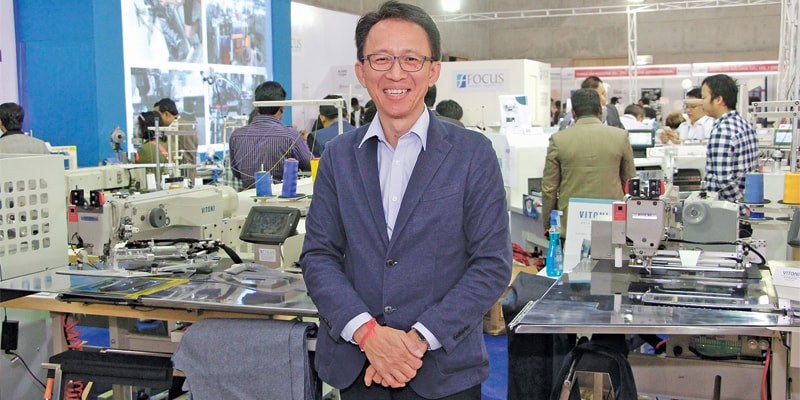
Bangladesh has some key factors which augur well for the steady growth of the RMG sector and this sector continues to show robust performance. “Knitting, dyeing, sewing, finishing, packing and logistics are all done in-house in Bangladesh factories. Seeing this, even Chinese factories are shifting to the country to tackle surging cost issues in their homeland. I believe Bangladesh, in 4 to 5 years’ time, will be the world’s best garment exporter because factory owners here have a global view and they are way smarter compared to 10 years ago,” claims Foo Toon Pow, Managing Director of Focus Garment Tech Pte. Ltd.
The role of RMG sector in Bangladesh’ economy is remarkable. Future prospects in the sector are bright and big global brands of sewing and automation technologies are keeping an eye on the country’s vibrant market. Focus Garment Tech Pte. Ltd., a subsidiary company of Chu Cheong Co Pte. Ltd. of Singapore foresees great business potential in Bangladesh. The company is a one-stop solution for all kinds of industrial sewing machines and garment equipments from cutting, sewing to finishing section and has a business network that spans from Singapore to Asia, Middle East and Africa.
Foo Toon Pow believes that lingerie, winter jackets, denims, pants and shirts are going to play a key role in Bangladesh’s growth, as close competitors like China are moving up the value chain, leaving value for money in apparel manufacturing to more cost-effective players. “In 2016, Bangladesh exports of garments increased more than 20 per cent and this year also, it might increase by another 20 per cent. Though China is a big player in the same sector, it has been suffering from cost-related problems for some time. The salary of a Chinese garment worker is around RMB 4000 to 5000, equivalent to almost US $ 650 to US $ 700. This salary can cover 4 to 5 workers here in Bangladesh,” reasons Foo Toon Pow at the 16th edition of GARMENTECH 2017 held in Dhaka recently.
Vitoni, Nissin, Keki and Juita Nisho are four of the company’s latest brand offerings for the country. “Some European brands are selling high-speed automation sewing machines here in European price, whereas, we are selling our Vitoni machines at almost half the price with almost similar performance. Our company is supplying good quality machines for past 50 years keeping price suitable for the Asian market as we see lots of opportunities here,” says Foo Toon Pow. While Nissin offers specialized shirt making machines, fusing, pressing, pattern sewer and conveyor belt systems, Keki manufactures ladies lingerie equipment, computer placket sewing machines for ladies and men’s underwear, auto elastic robot which offers increased production and stable quality. Juita is a multifunctional auto template fully robotic machine equipped with powerful NC auto sewing converter software. These machines can handle the work of four workers, thus increasing production while reducing cost.
Focus Garment has a clear understanding on how the company can deepen its roots in Bangladesh through in-depth study and targeted strategies. “The biggest strength of the country is its hard working people. But they need to change their system of working by bringing in more automation and ERP technologies in order to streamline efficiency and improve the quality of work, because even if you are equipped with 10,000 manpower, it is of no use if it’s not making less money for you,” argues Foo Toon Pow.
With a target to increase its grip on the lingerie and denim segment, Focus Garment has started supplying machines that are exclusive to the segments. “Sri Lanka is the world’s leading manufacturer of lingerie products and all big lingerie brands. Autonomy are procuring machines from us. Now that we see the lingerie sector moving towards Bangladesh, we have already put in place plans to supply our machines here,” says Foo Toon Pow.
One of the biggest reasons for Bangladesh’s rising popularity in RMG exports is its reliability as a source for denim products, mostly because China, the world’s largest denim supplier, has become dearer for its higher costs of production, making Bangladesh a favourite supplier of denim. “Denim’s market is huge. There are billions of people in the world who use denim products. And as Bangladesh is developing capabilities to give world class products in the segment, we are also focusing on this product category,” concludes Foo Toon Pow on an optimistic note.