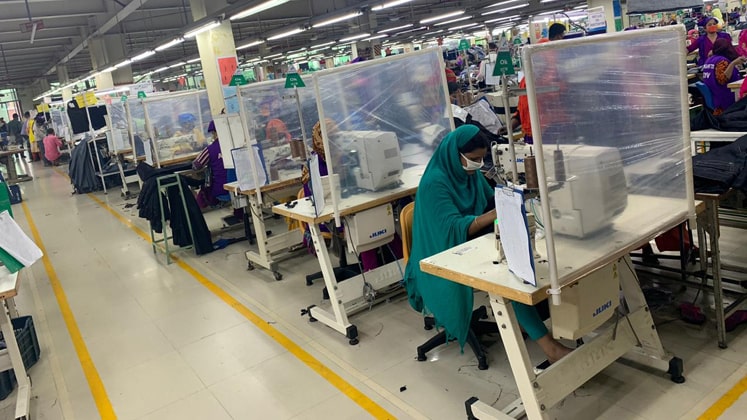
Garment manufacturing and export today is not what it was perhaps a decade or so back. Over the years, as the number of players (manufacturing hubs) have increased,so has the competition between them.
Nevertheless, irrespective of the competition, Bangladesh has managed to hold its sway as far as its lure as a sourcing centre is concerned. And this is as per the survey conducted by none other than one of the leading global management consulting firms, McKinsey & Company, the trusted advisor and counsellor to many of the world’s most influential businesses and institutions.
As per McKinsey & Company (McKinsey & Company is an American worldwide management consulting firm, founded in 1926 by University of Chicago professor James O. McKinsey, that advises on strategic management to corporations, Governments, and other organisations), Bangladesh’s attractiveness as an apparel-sourcing destination has remained potent despite increased competition in recent years even as the 2019 Chief Procurement Officers (CPO) survey of the consulting firm pointed to Bangladesh as the top global sourcing hotspot while Vietnam was close behind it, and was the preferred sourcing country among the US executives.
McKinsey & Company came up with the survey on Bangladesh after 10 years — it first published such a report in 2011, which had painted a rosy picture and, in fact, all the predictions made by the entity then had come true over the last 10 years — even as McKinsey & Company, conducted its flagship CPO survey titled What’s Next for Bangladesh’s Garment Industry, After a Decade of Growth? among the top 10 global apparel sourcing companies, reportedly over a period of two months.
“We appreciate the report. It indeed portrays a picture of the progress that Bangladesh’s RMG industry has made over the past decade,” stated the President of the Bangladesh Garment Manufacturers and Exporters Association (BGMEA), Dr. Rubana Huq, interacting with the media, adding, “It’s greatly appreciated that McKinsey has acknowledged the recent progress of the industry and our new initiatives regarding climate change and circularity and that we have advanced the sustainability agenda.”
The McKinsey survey also touched upon diverse facets that are considered significant in today’s context (for example, sustainability) and has a lot to do in terms of contributing towards the reputation, acceptance and popularity of any sourcing destination.
Sustainability, in particular, is becoming ever more important, with increasing consumer demand for environment-friendly products, and concerns about climate change and social justice even as the report went on to highlight the garment sector’s transformation after the massive reforms in inspection and remediation by the Accord and Alliance, the two foreign platforms for inspection of the garment factories.
Today, Bangladesh’s RMG sector is a frontrunner in transparency regarding factory safety and value-chain responsibility, thanks to initiatives launched in the aftermath of disasters, which include the Accord on Fire and Building Safety in Bangladesh, the Alliance for Bangladesh Worker Safety and the RMG Sustainability Council (RSC). These measures led to the closure of hundreds of unsafe, bottom-tier factories and the scaling-up of remediation activities.
More than 1,500 Bangladeshi companies are certified by the Global Organic Textile Standard (GOTS), which is the second-highest in a single country, maintained the BGMEA President while going on to add the fact that the report also makes reference to the RMG Sustainability Council (RSC) and says that this has added to Bangladesh RMG sector’s credibility and ‘is reassuring, and we remain grateful for the acknowledgement’.
Over the last decade, the garment industry in Bangladesh has experienced unprecedented blooming, maintained the survey report adding that recently, however, pandemic pressure and shifts in global markets have brought stiff challenges and, in order to meet the challenges, the sector will need to innovate, upgrade and diversify, investing especially in flexibility, sustainability, worker welfare and infrastructure.
McKinsey & Company also pointed out that comparable data for global exports in 2020 has not yet been published by the World Trade Organisation (WTO); however, data from European and US imports indicate that Vietnam likely overtook Bangladesh in 2020—pushing Bangladesh’s ready made garment industry out of its position as the second-largest garment-exporting country in the world after China, it said but not before adding that Bangladesh’s RMG sector remains a strong exporter to Europe’s fashion industry and has grown its market share significantly over the past decade.However, this trend may not continue because a new preferential trade agreement between the European Union and Vietnam, launched in August 2020, could lead to apparel exports from Vietnam outperforming Bangladesh’s even as among the US apparel importers, Vietnam has outpaced Bangladesh’s RMG industry for some time.
As buyers from the USA move sourcing out of China, Vietnam is reportedly proving to be the biggest winner even if in 2020, Vietnamese apparel imports into the US reportedly was worth 2.5 times those from Bangladesh.
Nevertheless, Bangladesh’s garment sector has every prospect of remaining one of the world’s largest RMG manufacturers and is continuing its impressive story of growth and improvement, but for managing the growth, Bangladesh will reportedly need to rise to the challenges to compete without preferential trade access, meeting decreased demand from traditional customer markets and making a fundamental shift towards a demand-driven and more sustainable sourcing model.
The concern is, some of the global buyers the McKinsey spoke to, believe the industry is not moving fast enough in this direction. However, others are more positive, and they feel that given the resilience and adaptability the manufacturers in Bangladesh have shown in the past, the apparel industry will be able to navigate the necessary transformation even if the structural changes would be inevitable.
Another area of worry seems to be Bangladesh’s moving out of the grouping of the least developed countries to join the big league of developing nations, which means the preferential access to European and other markets is up for negotiation and additional tariffs would be seriously disruptive for the RMG sector, but levelling the playing field with competing markets could also trigger the much-needed focus on productivity, as well as investment in digitalisation, automation and sustainability.
It may be mentioned here that graduating out of the LDC status is a matter of pride for Bangladesh and its RMG sector, which contributes more than 83 per cent to the country’s total export earnings, besides contributing significantly towards the overall socioeconomic development. However, it is also to be noted that the growth of the industry has been accelerated by the fact that Bangladesh as an LDC enjoys duty-free market access to the European Union (EU) — which accounts for more than 60 percent of total apparel exports—under the EU’s Generalised Scheme of Preferences (GSP), and after graduating to a developing country status, Bangladesh will no longer be eligible for the GSP facilities even if Bangladesh will have the opportunity to continue to enjoy duty-free access to EU countries if it can attain the GSP Plus.
Meanwhile, as per the survey, some global executives are reportedly reducing sourcing from Bangladesh, as their sourcing volume reaches a tipping point in their dependency and supply-chain risk on the country (which is further heightened by the pandemic), and owing to loss of competitiveness in some product categories even as it maintained all these positive steps (as has been undertaken by the industry) helped restore Bangladesh’s attractiveness in the global apparel-sourcing market, leading to a decade of rapid growth.
A decade ago, McKinsey forecast a growth of 7-9 per cent and indeed, RMG exports from Bangladesh more than doubled, from US$14.6 billion in 2011 to US$33.1 billion in 2019 (a compound annual growth rate of 7 per cent) even as several sourcing executives McKinsey spoke to for the report highlighted the progress that Bangladesh’s RMG sector was making in diversifying and upgrading its product offerings.
For instance, there is now greater capacity to produce garments made from synthetic fibres, manufacture more complex products such as outerwear, tailored items and lingerie, and provide new washes, prints and laser finishing while entry into these new segments has been supported by the changing rules of origin for preferential trade with the EU, allowing for the use of imported fabrics even as there also has been some increase in vertical integration of the supply chain, as a result of which, more suppliers are now able to offer lead times below the standard 90 days.
McKinsey further said it is worth noting that this growth was within the forecast range of the 2011 report, a collaboration with the Bangladesh German Chamber of Commerce and Industry (BGCCI) even if over this period, Bangladesh’s RMG industry increased its share of global garment exports from 4.7 per cent to 6.7 per cent, which is within the range forecast in the report.
However, it also shows that the country has not captured the full potential foreseen 10 years ago while the value of Bangladesh’s RMG exports fell by 17 per cent in the first year of the pandemic, representing revenue losses of up to US$5.6 billion.
Meanwhile, commenting on the survey findings, the BGMEA President put forth a few clarifications even as the report analysed the trade data of Bangladesh vis-à-vis competitor countries, particularly with that of Vietnam.
“The pace Vietnam has maintained in terms of export growth in the past 10 years is phenomenal, and we have so much to learn from their success stories…Yet, probably this is not the right time to assess country performances since trade, retail and manufacturing are unprecedentedly disrupted,” reportedly underlined Rubana, while adding, “At this moment, our focus is to deal with the COVID-19-induced crisis while keeping our progress in the area of sustainability continued, and push the agenda of innovation and upgradation forward.”
Going by the various findings of the survey, it goes without saying that even if competition has been increasing significantly over the last few years, Bangladesh has not only been able to maintain its attractiveness as a sourcing destination but also managed to make all round growth and development as a manufacturing hub, which adds to its reputation and standing in the global arena.