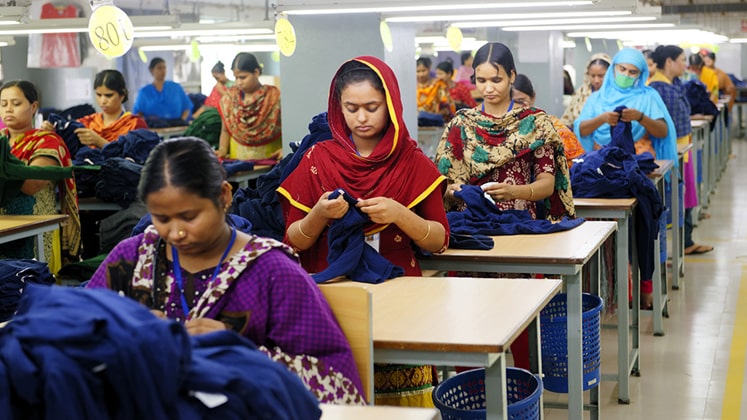
In a public brief published recently, witness signatories to the Accord, expressed their concern about the ability of this vital programme to monitor and improve the safety of Bangladeshi garment factories. Rights groups questioned Accord’s heir’s fitness to ensure factory safety even as Clean Clothes Campaign (CCC) reportedly underlined that BGMEA has made false claims and unsubstantiated commitments to Building Safety in Bangladesh.
BGMEA, though, strongly refuted all the allegations.
“As an association, the BGMEA cannot issue ‘false statement’ or can afford to have ‘unsubstantiated commitments’ to building safety in Bangladesh, especially when the industry belongs to us and the safety of the industry is key to our survival,” said BGMEA President Dr. Rubana Huq, adding, “Hence, there is no scope for any of us from within the industry to be passive about the level and standard of safety.”
So, even as the war of words continue, questions are being asked if the garment industry’s most important safety programme would stay on course?
Remediation exercises in the Bangladesh readymade garment industry, notwithstanding their successes, have never been free of controversies, which refuses to die even till date. If Accord and Alliance had been the much talked about topics in the industry once, these days it is the RMG Sustainability Council or RSC, which is in news.
The Bangladesh Accord on Fire and Building Safety, established in 2013, was established in direct response to the Rana Plaza disaster, which worked towards making factories safer for the garment workers. However, in 2019, a protracted legal conflict ended with an agreement to replace the Accord with a national RMG Sustainability Council (RSC).
Subsequently, the RSC started its journey on 1 June, 2020 as Bangladesh created a history after the newly formed home-grown entity took over responsibilities from the Accord, thereby writing a new chapter in factory remediation and workplace safety in the country’s apparel manufacturing sector.
The RSC, which comprises 18 Directors (six each from trade unions, industry and brands), issued a press communique informing that the national platform which plans to cover all garment manufacturing units would initially start with more than 1,600 garment factories by conducting programmes on workplace safety.
Dr. Rubana Huq (representative on the RSC board of Directors), the President of Bangladesh Garment Manufacturers and Exporters Association (BGMEA); General Secretary of IndustriALL Bangladesh Council, China Rahman and H&M’s representative on the board Roger Hubert amongst others are part of the RSC.
Roger Hubert maintained that brands would continue to honour supply chain responsibilities committed to through Accord while IndustriALL Bangladesh Council (IBC) Secretary General underlined that IBC with its affiliate entities and unions would work towards ensuring safe workplace while also making sure access to remedy to address safety concerns, then.
“Today the operations of the Bangladesh offices of the Accord on Fire and Building Safety in Bangladesh have transitioned to the RMG Sustainability Council (RSC), a permanent national organisation with equal representation from RMG manufacturers, global apparel companies, and trade unions representing garment workers,” stated a press release even as Barrister Omar H Khan, an advocate of Bangladesh Supreme Court, through advertisements in different newspapers, on behalf of his client Accord maintained, “My client Stitching Bangladesh Accord Foundation is going to close all its activities in the country from 31 May,” adding, all Government and non-government organisations as well as individuals are requested to close formalities with the Accord.
It may be mentioned here that following the Rana Plaza building collapse on 23 April, 2013 that killed more than 1,100 people most of whom were garment workers, the EU buyers and brands formed Accord to improve workplace safety over a period of five years that ended in May, 2018.
The platform wanted an extension for another three years but the Government allowed it a transition period of only six months. Later in February, 2019, the platform submitted a time-bound transition plan to the High Court seeking an extension period of 281 days. The court allowed the platform to continue operations up to May.
A lot of water has flowed under the bridge since.
But even as things were seemingly settling down slowly and steadily, the issue made a comeback recently, and rather strongly, after witness signatories to the Accord on Fire and Building Safety in Bangladesh publicly raised concerns as to its successor’s ability to meet the responsibilities.
Four witness signatories to the Accord – the Clean Clothes Campaign (CCC), International Labour Rights Forum/Global Labour Justice, Maquila Solidarity Network, and Worker Rights Consortium – fear that progress toward factory safety in Bangladesh was at risk.
The issue witnessed group of international non-governmental organisations (NGOs) and the BGMEA run into a war of words after the Clean Clothes Campaign reportedly levelled charges that BGMEA made false claims and unsubstantiated commitments to Building Safety in Bangladesh.
On 22 December 2020, Clean Clothes Campaign, Maquila Solidarity Network, Worker Rights Consortium, Global Labour Justice and International Labour Rights Forum expressed their concern in a statement which reportedly stated that the BGMEA, a member of the RSC’s governing board, on 26 November had issued a response that contains false claims and unsubstantiated commitments about the RSC.
The BGMEA, however, termed the statement as false.
The BGMEA “falsely claims that the RSC is founded on the core principle that its governance structure brings together all critical stakeholders in one single platform with equal voice and authority”, the NGOs said, and went on to object that the representatives of workers (global and local unions) make up only a third of the RSC board members.
Furthermore, the RSC’s board has refused to include a key group of critical stakeholders, labour rights NGOs, who have worked extensively to ensure the obligations of the Accord are being fully executed and who have participated directly in the governance of the Accord in their capacity as non-voting witness signatories, they said.
“The RSC board has formed a committee for including the critical stakeholders in the advisory council already. This was adopted as a resolution during the last board meeting. Therefore, the claim that the board has refused to include any key group of critical stakeholders, labour rights NGOs is false,” the BGMEA clarified.
Meanwhile, the rights group said that the RSC lacks transparency as it did not display information about factory-specific remediation data, aggregate reports, nor minutes of its board meetings on the website even after six months of inception, in reply to which the BGMEA said that the RSC website was almost ready and it will mirror all the data and there will be no exception to that rule.
Sharing the minutes of board meetings was an issue that was agreed during an executive board meeting of the RSC only two weeks back. “Thus, this claim is also dated,” it added.
The RSC has committed to a boiler safety inspection programme that was first initiated as a pilot in 2018. But even after six months since the RSC began its operations, there is no indication that a boiler safety inspection programme has started, the NGOs said.
“This exposed the imminent risk of a boiler explosion,” they underlined.
The pilot programme for boiler safety has not been stopped, while the Government has inspection standards and engineers who are ready to engage with RSC on boiler inspections, underlined the BGMEA in response.
“Thus, that claim too is incorrect,” the BGMEA maintained.
Further, as per the NGOs, one of the most important commitments made in that Transition Agreement, which was the recruitment of an independent Chief Safety Officer (CSO), remained unfulfilled. “A CSO with the same independence, autonomy, authority, and reporting requirements as elaborated and practised by the Accord, is essential for the quality and credibility of the inspection programme,” the statement said.
The RSC has received a number of CSO applications that are being reviewed. A CSO for RSC should be in place by April 2021, according to the BGMEA.
In the meantime, the MD is acting as the interim CSO.
The NGOs are also alarmed by the BGMEA’s reference to carry out a so-called ‘deep dive’ pilot programme to improve the progress rates of factories. “While the witness signatories encourage the continued progress of remediation across all factories, it is critical that these efforts be carried out and approved in accordance with the Accord’s rigorous standards. Failing to do so or rushing the process of remediation places the safety of millions of workers at risk,” the NGOs observed even as the BGMEA President on her part reportedly said that programme was necessary to help the factories reach 100 per cent remediation level.
If a factory is offering inspection and is failing during final inspection, then the only way to help them is to look at their individual issues and offer specific remediation instead of general reference to National Fire Protection Association (NFPA) or the Bangladesh National Building Code (BNBC).
The job of RSC is to ensure remediation and as an industry, the BGMEA remains committed to supporting RSC to the best of its ability, underlined the BGMEA chief while adding, “It is perhaps easy to point fingers and come up with random accusations, but it takes a lot to build, sustain an industry and provide employment to millions.”
So even as the war of words continue to rage, one can only hope things do not take a turn for the worse, which undoubtedly would not be in the interest of anyone.