Bangladesh is bustling with untapped creative energy that has remained under the wraps for quite some time now, waiting to erupt – and luckily enough, the past few years have seen young blood mix their passion with a determination to stand out and be noticed.
One such story about giving flight to one’s dream and passion is of Rumana Chowdhury, Founder and Chief Designer of Warah, who aspired to make her mark in the world of fashion at the young age of 25.
A Fashion Design graduate from BGMEA University of Fashion and Technology (BUFT), Rumana noticed multiple fashion brands blooming in Dhaka at the time and got a sudden extreme motivation to open a design store and create her own brand.
“When you’re that young, you don’t have a detailed plan or thought process when you are attempting to achieve something,” Rumana told Apparel Resources (AR) in an exclusive interview adding, “However, I did not want to learn about entrepreneurship or other business technicalities, and so, I decided to immerse myself in the process and see how it goes, simply because my heart said so.”
In 2008, Rumana began her journey on a very small scale from the comfort of her home. Soon after, she did her first photoshoot and posted on it social media, post which there was no looking back!
“When my shoot hit Facebook, my phone was flooded with calls and text messages enquiring as to when and where will I be selling the clothes featured in my shoot. I was overwhelmed with the positive response, and individuals began calling me for appointments.” Rumana said, adding, “Yet, I could not give sufficient time as I was occupied with my child. At that particular point, I chose to open an outlet in Banani and call it Warah, named after my son, Saad Omar Warah.”
PRODUCT ASSORTMENT AND PRICING
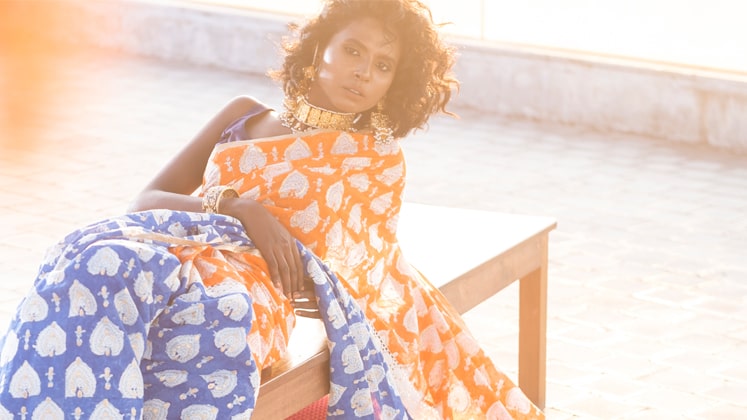
Warah offers a range of designer Angarkhas, sarees, long dresses and men’s kurtas priced between BDT 3500 to BDT 75000. Local fabrics such as khadi bring out the essence of modern designs with techniques like block printing, embroidery, crochet work, etc.
“We always keep in mind the buying capacity of our esteemed clients, and hence, the price proposition of Warah is very reasonable,” Rumana explained. She further stated, “Being reasonable in price is another reason why Warah has been so popular among the local fashion industry for more than a decade.”
The USP of the label lies in the fact that Warah is an ethnic Bangladeshi designer wear brand, with a niche market that caters to consumers within the age group of 20-55 years. The brand offers sizes for women from 36-44 and for men from S to XXL.
The target clientele comprises fashion enthusiasts who appreciate local materials, premium quality, and classic designs.
“Today’s customers are very appreciative of locally produced Bangladeshi clothes and Warah has been a front runner in popularising local materials and craftsmanship to the local and global arena,” Rumana said adding, “Warah works with local fabrics and aims to improve the livelihood of local artisans.”
TECHNIQUES AND DETAILS
For over a decade, Warah has created a fantastic blend of high street fashion and trendy outfits that promote Bangladesh’s rich heritage and culture. The designs are modern and yet reflective of Bangladeshi traditions in every thread.
Using different patterns, cuts and techniques has allowed Warah to bring heritage and modernism within the same realm.
Commenting on the same, Rumana said, “Customer’s taste and preference have been one of our major priorities. Innovation of design according to evolving seasons and festivals and most importantly ensuring quality of locally made fabric are the reasons behind Warah’s popularity among its customer base and within the industry.”
Warah’s products are simple but classy. The brand uses golden colour blocks (Khari), crochet lace and hand embroidery to differentiate its products from others.
“My personal favourite colour is white and different shades and variations of white (ivory, pearl white, etc.), because I believe white is a blank canvas that allows me to be extremely creative. Also, it can be seen that white serves as a base colour and is predominant in most of Warah’s collections,” Rumana cited.
MANUFACTURING AND SOURCING
Founded in 2008, Warah started out with just 6 employees and today, has grown into a team of 32 extremely talented and committed individuals.
The manufacturing unit is located in Baridhara Extension, Dhaka, where all the brand’s products are manufactured in-house.
Warah majorly works with khadi and muslin materials that are all sourced locally.
The brand mainly works on five collections, namely Fall/Winter, Spring/Summer, Boishakh and two Eids. Few of the collections are season-based; while one collection focuses on the Bengali New Year, two other collections focus on the biggest religious festivals in Bangladesh that are the two Eids.
“We replenish our store every day and online, once a month,” Rumana explained.
BESTSELLERS
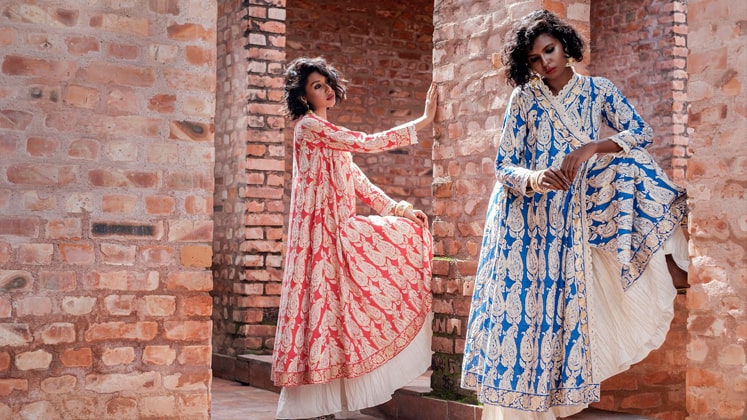
The bestselling and signature style of Warah is the Angarkha.
Highlighting the same, Rumana said, “This Angarkha is a unique and classy design that the Bangladeshi market has observed for years. The inspiration of the design has been taken from the Mughal Era when the elite class of the society used to represent the posh and classy fashion wears. From this inspiration, Warah has made a blend of heritage wear and modern trendy outfit by incorporating local fabrics.”
This clutter breaking design of the Angarkha has been widely accepted and appreciated among the niche yet influential target base of Warah and mostly by fashion celebrities, models and the posh customers.
“A mix of seasonal colours, comfort and classy look of the outfit made the design distinct from others and gradually became the bestselling style of Warah.”
THE IMPACT OF COVID-19
During the lockdown period like every other local and global brand, Warah also observed a drastic shift in its business pattern and initiated digital platforms for its functioning.
“Since customers were unable to come to the stores, Warah reached its customers through digital avenues such as Facebook, Instagram, etc.,” Rumana explained, “When customers come to physical stores, they get the option to choose from different designs and purchase a few products which is a positive side of the retail store. On the digital platform, on the other hand, this mindset of choosing multiple products becomes less and this impacts the final sale.”
The pandemic has given Warah a new and a very interesting perspective about the purchasing patterns of consumers, which has helped the brand devise certain strategies for further development of its e-commerce side.
Ruamana expounded, “This shift from physical buying to online purchasing has helped Warah grow digitally, on a global scale. Warah has been able to grow a healthy consumer base across the globe and ship products to the USA, UK, UAE, Canada and Australia.”
It can be said that Warah has been able to overcome the few hurdles caused by the pandemic.
THE FUTURE OF FASHION
The debate over online shopping and bricks-and-mortar shopping is a never-ending debate to loom over. Physical stores and online stores both hold their own versions of limitations and uniqueness, and the COVID-19 pandemic has certainly negatively impacted both the fashion and textile world globally.
That being said, one of the major trends in fashion will be an amalgamation of partywear (eveningwear) and regularwear.
“Because of our very busy schedule, customers would want something, where some minimum additions can turn an officewear into an eveningwear. Secondly, easy, breathable fabrics will become a big trend in the eveningwear space. Because of the climatic changes, I believe that there will be a big shift in the choice of materials for eveningwear. People will shift from velvet, heavy banarasi to cotton and linens with greater emphasis given on patterns and cuts to turn these simple fabrics into gorgeous eveningwear,” Rumana stated.
ATTENTION TO DETAIL
Warah ensures after purchase service with a commitment towards addressing concerns such as resizing and alteration as per client’s requirement; redoing colours up until 6 months of purchase; welcoming feedback on their digital platform and assigning qualified call centre agents to help resolve any issues that a client may face.
Instead of relying on the existing delivery companies, Warah has its own delivery system in place that ensures timely and proper delivery of the products.
Packaging is the carrier of impression for a brand. Keeping the same in mind, Warah pays as much attention to its packaging as it does to its brand value. It represents the brand in a classy manner, which helps to uphold the quality and class for the brand.
To achieve the same, Warah uses environmental-friendly and perishable materials for its packaging such as handmade paper, which ensures that the brand’s packaging remains sustainable over a period of time.
All these services play a crucial role in retaining clients and adding new clients to Warah’s loyal client base.
The brand stocks its products in Bangladesh because of the close proximity to its warehouse in Dhaka.
Currently, Warah sells its products through its Facebook page and official website.
In addition to the local clientele, Warah also has a very strong international client base.
Commenting on the same, Rumana said, “My future plan for Warah is to expand it globally by having physical stores outside Bangladesh to ensure that my clients outside Bangladesh can feel, touch and see the uniqueness of Warah’s creations rather than just ordering via online channels.”