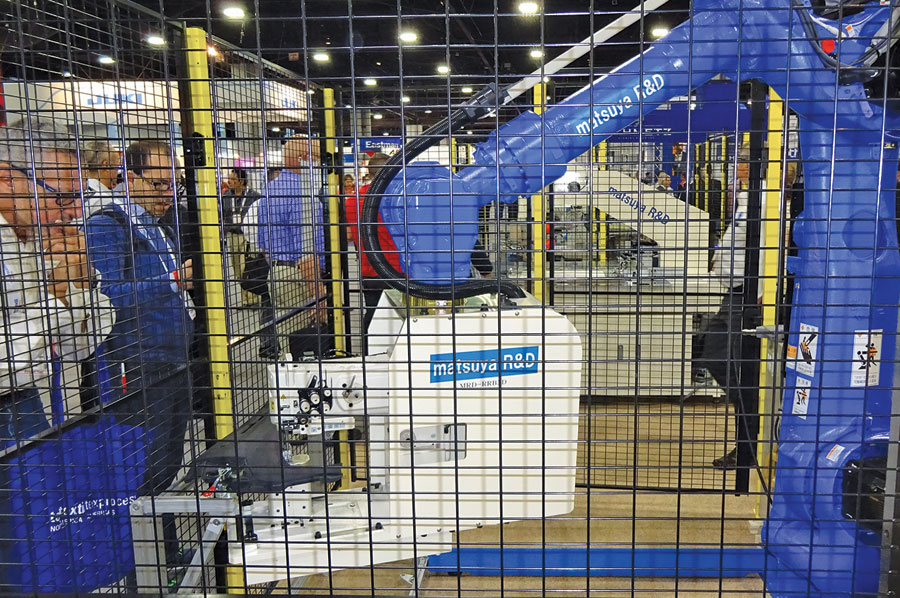
IoT (Internet of Things) and Robotics are being advocated as the next big thing in personal lives and professional environments as well. IoT will enable machines to be run, managed and maintained remotely in real time Definitive industrial-scale solutions along these lines are already available. However, robotics is an intriguing possibility due to the speculated limitations of a robotic interface when it comes to understanding the sensation of touch and counter flexible material.
At the previous edition of Texprocess Americas, the primary theme was ‘Made in US’. Understandably, the secondary theme was ‘Automation and Robotics’ to enable the purported revolution of manufacturing in the US. Since the last edition, while the automation has matured visibly, robotics continues to remain limited in its scope when it comes to material handling as it is just capable of picking and sewing.
Texprocess Americas’ 3rd edition took place from May 3-5, 2016 at the Georgia World Congress Center in Atlanta, Georgia. Held concurrently with Techtextil North America and JEC Americas, the show was spread across an area of 166,000 square feet and hosted 9,357 visitors. Country pavilions included Italy, Belgium, China, Germany, China, Taiwan, Business France and SEAMS Made in USA.
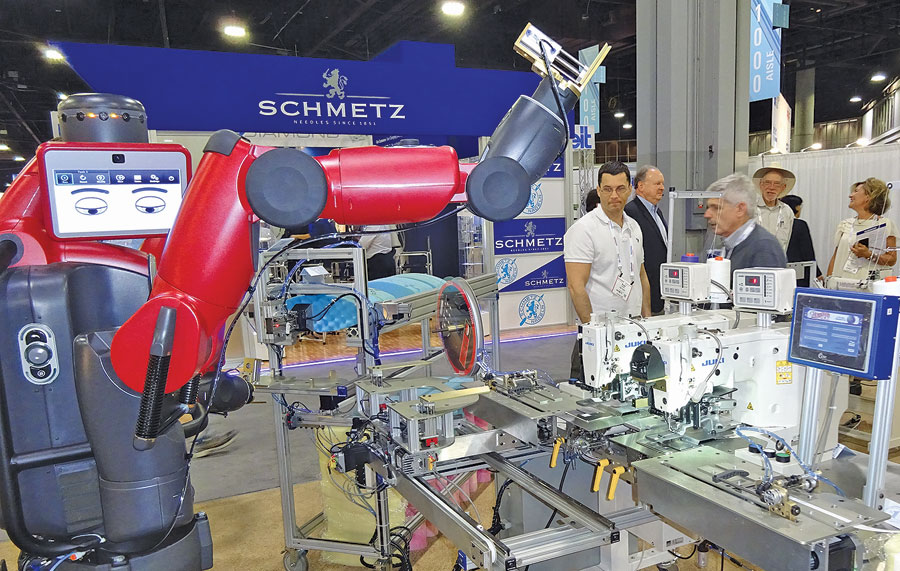
Currently, the robotic arm picks only the hard material or the made-up collars or cuffs. The pick is facilitated through suction or electrostatic current or sensory fingers, which can sense what has to be picked and where should it be placed. Another definitive direction comes from developments which offer robotic arms for as low as US $ 1000. The most pertinent exhibits in question was the robotic arm ‘CUFF 2015’ for cuff assembly by Duerkopp Adler, PFAFF and KSL. Also on display were the arm from Mitsuya and Baxter. Another interesting technology on display was for moving material, from Grabit Inc. Grabit’s solution uses electro adhesion to pick up fabric, move it, and then release it flat. The technology can be used to stack and un-stack pieces or pick up pieces from a cutting table without the distortion or wrinkling – a level at par with what one would get from picking up fabric manually or a hand-like robotic end effector.
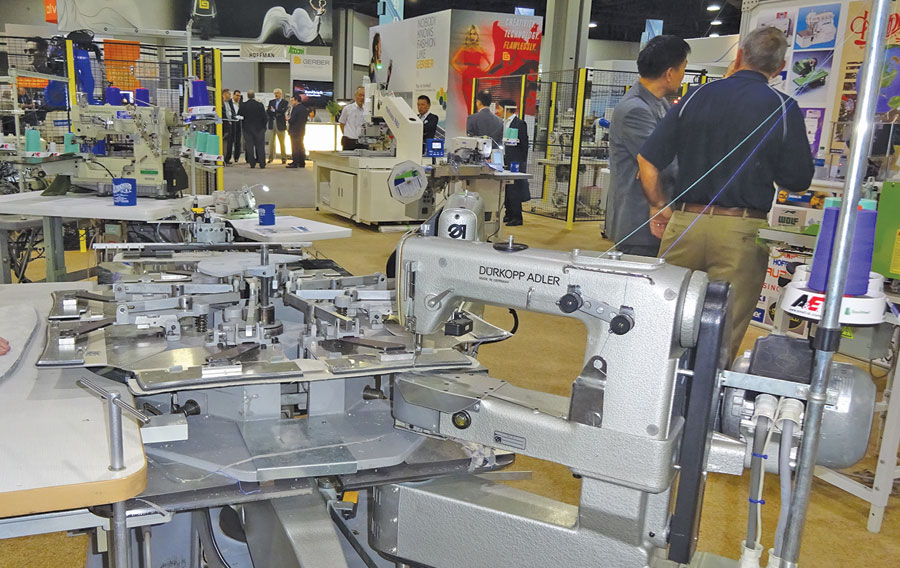
While there weren’t any tangible developments on display, a certain sense of direction has been paved and in the next few years many new innovations and changes can be anticipated. CUFF’s upgrade is expected to be equipped with a camera system to check the alignment between two to three fabric layers and another arm to pick and sew or just pick and place. It was also hinted by KSL that the company will present an interesting arm to pick fine fabric at the upcoming edition of Texprocess, Germany. Some technology providers are also looking at developing arms that can align three plies. Stimulated by a recent visit to facilities of Kuka (a German manufacturer of industrial robots and solutions for factory automation), Gerber Technology, the US-based cutting room automation specialist, is working towards integrating the pattern data with the robotic arm.