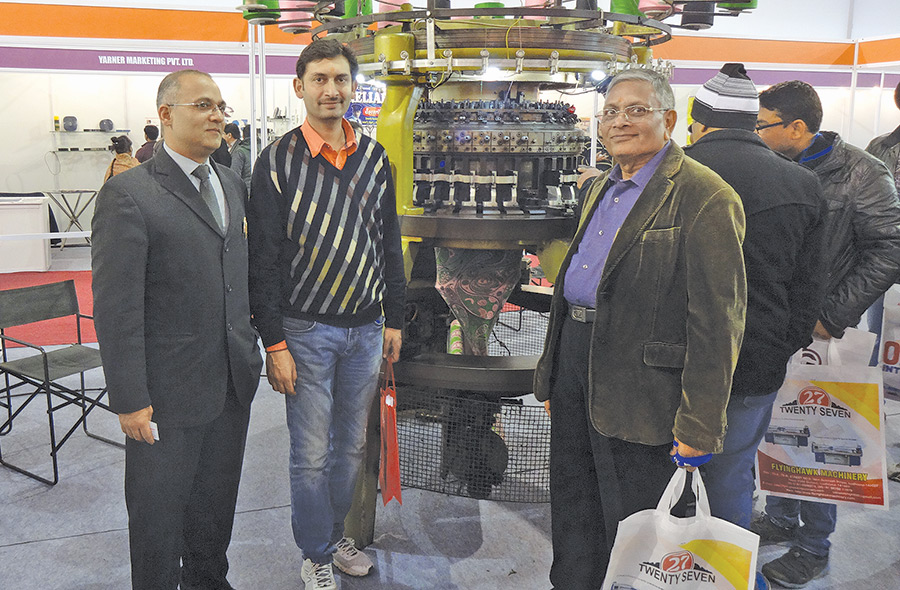
The textile industry of Ludhiana, a hub known for flat knitting, observed a slowdown in sales this winter due to several reasons, prime of which are late oncoming of the cold season and increasing rate of dollar, which in turn affected sales of knitting machines as well. Other segments like circular knitting and sportswear were also affected, but not as much. The dull mood of the industry was clearly reflected in the low participation and reduced footfall at the recently concluded 22nd edition of Knit World. The visitation was mostly from the domestic manufacturers and the export industry was conspicuous by its almost total absence. While many blamed the increased number of technology fairs being held almost back-to-back in the city for the debacle, some participants felt that the type of visitors suited the technology exhibited at the fair, which was mostly Chinese machines or second-hand European machines with very few showing any real innovation worth seeking exporters’ attention.
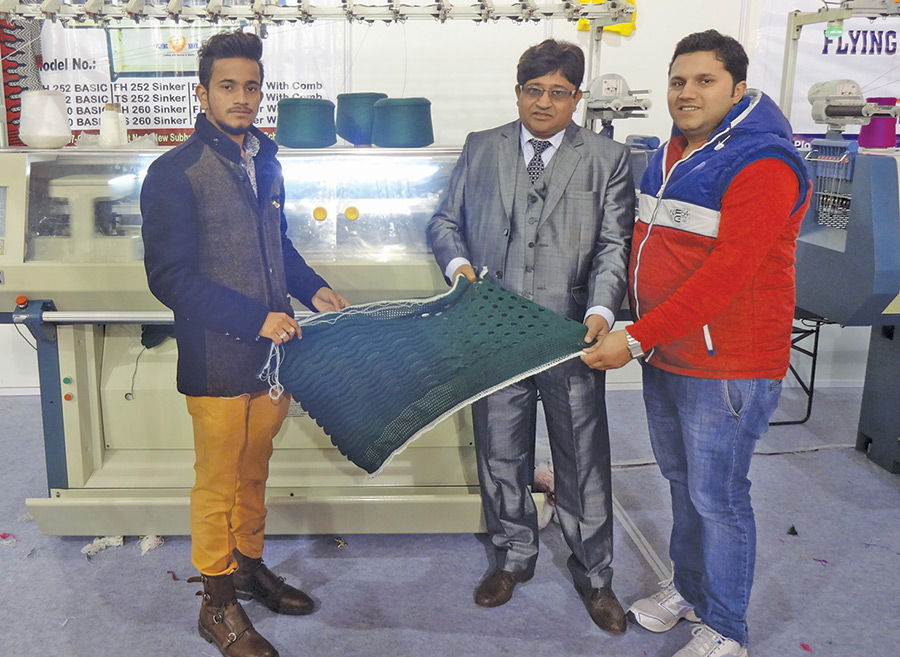
Despite low visitor-turnout, many of the participants at the Knit World claimed that they got enquiries for their machines. Inder Arora of Arora International, dealer for Chinese flat knitting machines-Guosheng Machines, was happy to receive good queries after a lull in sales for almost eight months. “The delay in the setting in of winter season in all major markets has certainly affected sales of knitwear manufacturers, but now machine sales are picking up as most of the manufacturers are looking at this period to improve their facilities and plan for the next season. So accordingly they have begun buying machines,” informed Arora. The highlight at Arora International’s booth was GSJX-1-1-80 – a double carriage 1+1 flat knitting machine with a knitting amplitude of 80”. Capable of knitting at a speed of 1.2 metre per second, the machine comes with an eight-section needle selector made of electromagnetic needles arranged with a narrow needle space which is extremely useful for high speed knitting of jacquard designs. The machine generates an automatic alarm in case of yarn or needle breakdown, floating yarn, completion of piece counting, incorrect cradle movement, needle foot firing, or program failure.
Another person that seemed optimistic about sales in 2016, was Harvinder Chauhan of Harvinder Knitting Solutions, trader of China-based Flying Hawk knitting machines. The latest upgrade in the Flying Hawk machines was the flat knitting machines with comb, which replaced the roller. The comb, now available in all Flying Hawk machines, helps in automatically bringing down a ‘palla’ as soon as it gets completed. The company was also excited to get many enquiries for a ‘made in China’ flat knitting machine for shoe uppers, which Harvinder claimed was a growth segment in the region.
Although the old European circular knitting machines are 36 feet wide, which are no longer being used in European countries, but they are easily adopted by domestic manufacturers in India.
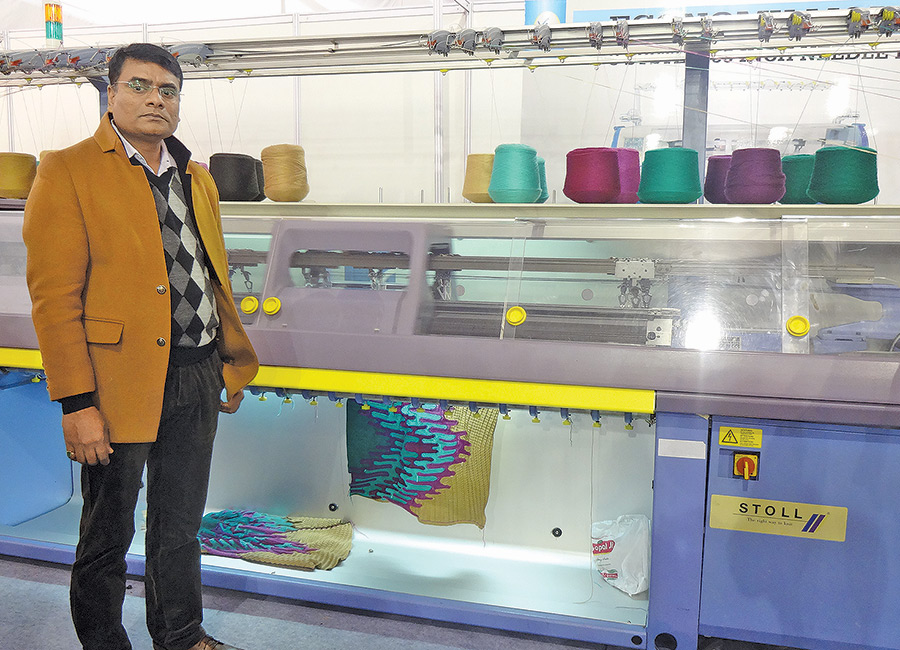
Apart from the traders of Chinese knitting machines, Ludhiana-based manufacturer of knitting machines, Omex Mechanical Works also presented their flat knitting machine with jack system, which, according to the manufacturer, is not present in other Indian machines. “Conventional domestic machines have single needles throughout the bed, but our machines have a jack below every needle that enables the working of even the low butt needle, which in conventional machines is non-functional,” informed Harish Daffu, Omex Mechanical Works. This system enables the machine to produce fabrics with ‘text-based’ design knitted into them unlike the conventional machines that can produce only plain solid fabrics. The gauge of Omex flat knitting machines varies from 3G to 14G and the company can design machines with higher gauges also in the knitting width from 45” to 52”. The options available in terms of carriers and systems are – single carriage with single systems, and double carriage with four systems. With 2×8 yarn carriers on each side of 4 guiderails, special intarsia carriers also can be put in place. Omex registered a downtrend in sale of machines in 2015, which it blamed on the global slowdown.
Ajay Kukreja, Proprietor of Shubham International, traders of Chinese knitting machines dealing in second-hand European flat knitting machines from STOLL, was also present at the fair. The company has seen good sales of these machines as the industry in Ludhiana feels that even reconditioned European technology is more reliable than the Chinese machines, hence the industry easily invests more freely in second-hand machines. The company has kept two technicians for the servicing of STOLL machines, and has four technicians for Chinese machines, which they claim face more breakdown problems. The company did not introduce any new technology at the fair, as according to Ajay there wasn’t any new technology even at ITMA 2015, Milan, in this segment. Ajay further expressed that the industry has been adopting computerized knitting machines for a long time now, which hasn’t had any new technological development apart from software updates.
Shubham International has seen good sales of European machines as the industry in Ludhiana feels that even reconditioned European technology is more reliable than the Chinese machines, hence the industry invests more freely in second-hand machines.

Taking the trend of second-hand machines forward, GS Patyal, Proprietor, Soham Enterprises, a first-timer at the fair, retrofits Chinese systems into second-hand European circular knitting machines to convert them into modern computerized knitting machines. Although the machines are 36 feet wide, which are no longer being used in European countries and are easily adapted by domestic manufacturers in India. This kind of machine costs around Rs. 12 lakh, due to the cheap Chinese systems, whereas a new machine of similar capabilities would cost around Rs. 1 crore. This huge difference in costs has made it pretty easy for the company to sell its machines to the Indian knitwear manufacturers working for the domestic market. Yet, Patyal was sceptical of the market conditions. “The situation of the industry will not improve till the time the Government liquidates the market by pumping in money,” said Patyal.

Companies like Peayush Enterprises were also seen focusing on specialized machines, other than the flat knitting machines, presenting the automatic multi-needle sewing machine/quilting machine by Dayu, which can be used in sewing of 3D-quilted car seat covers, quilted jackets, backpacks, shoe insoles, and other similar products with thick materials. Equipped with an extra-large hook, it is suitable for thicker thread sewing with less frequent bobbin changes and hence improved productivity. Other than that, it also presented its computerized jacquard cap knitting machine, which can make a jacquard cap in just four minutes. It is a fully automatic 10-gauge machine, and six such machines can be handled by a single operator at a time. “We have tried to present some new product ideas to the industry,” asserts Prateek of Peayush Enterprises.
RR Enterprises, represented by Tarun and Rajeev Kalra, claimed to have seen decent sales in 2015 and credited the same to its established links in the industry and service quality. The company was among the few at the fair that had some high-end technology applications to showcase and introduced IRO in its range of high-end flat knitting machines. IRO is a self-cleaning, vibrating yarn tensioner, which reduces thread wastage by 50 to 60 per cent and machine down time, as it rewinds only the required amount of thread. Many visitors looking for solutions to improve productivity and reduce wastages, were interested in the intervention.
Texcellence Corporation feels that adoption of digital textile printing technology has increased, as it enables easy handling of variety of styles, along with the ability to print any amount of cloth at the same cost per metre, which is not possible with traditional printing.
Corroborating the interest of the industry in upgrading its machines, Munish Kumar, Sr. Sales Manager at Mehala, shared that the focus of the company was in promoting ‘servo motors’, which could be attached to any sewing machine as most of the companies were looking at saving running cost and energy. “Though we have showcased most of our sewing machines, the industry is currently not interested in buying new machines, they want to upgrade and use small investments for value results,” said Munish.
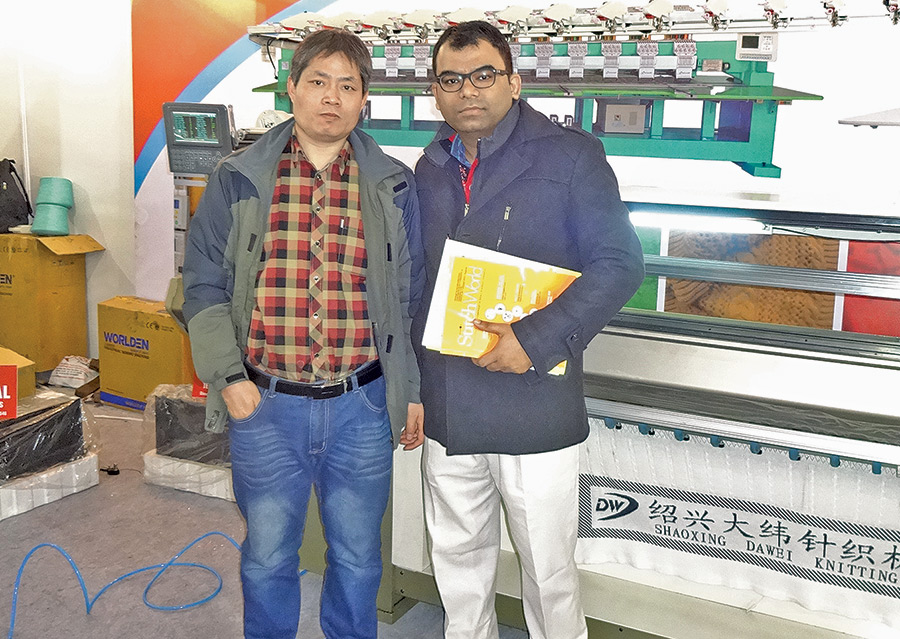
Focus on value-addition…
The slowdown observed in the knitwear market also translated into increased focus on value-addition in textiles for the manufacturers. Abhishek Aggarwal, Managing Director (Print Production), Texcellence Corporation India presented digital textile printers from Shanghai with wider guides of 25 mm width, which used to be 10 mm earlier. The wider guide is said to provide better stability to the print head, leading to better quality print. The printer was a sublimation printer, which could be used for printing on polyester fabric, whereas for cotton fabrics, the company showcased its direct-to-fabric printer at the fair as well. Texcellence has sold more than 100 printers in Ludhiana, and around 50 in Surat. Aggarwal informed that adoption of digital textile printing technology has increased, as it enables easy handling of variety in styles, along with the ability to print any amount of cloth at the same cost per metre, which is not possible with traditional printing. Also, digital printing is environment-friendly as it does not ‘pollute’ the environment on account of practically zero-discharge, unlike the traditional printing techniques, which require lots of water.
A major attraction at the fair was the DNA Expert Services booth that displayed Air Splicers, which instead of tying a knot on thread breakage, splices the thread, unwinds it, and then winds it back again, resulting in formation of a knotless yarn with its original strength.
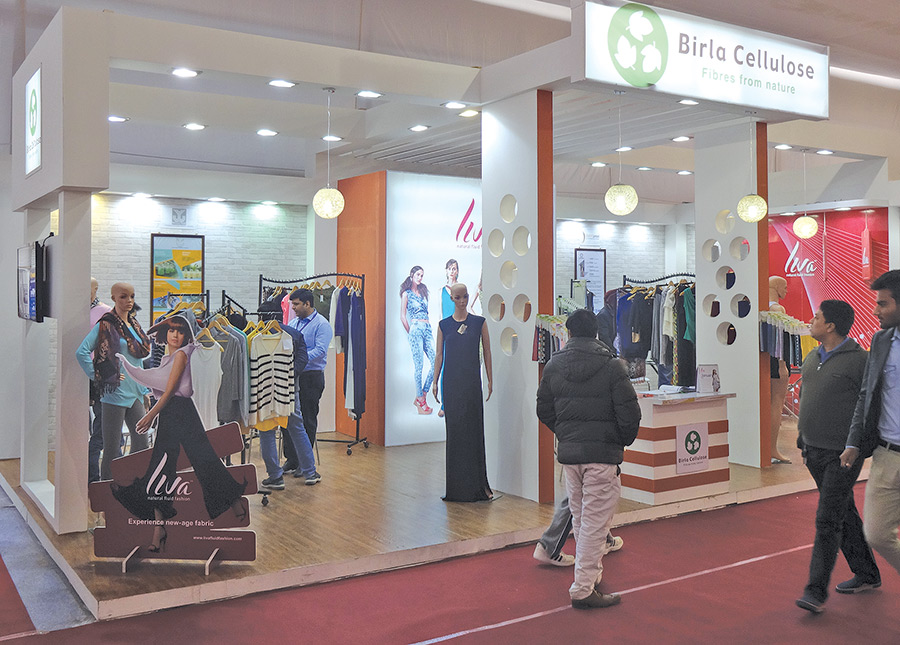
Besides digital printing, multi-head embroidery machines are also picking up pace. Ankur and Varun Malik of Star Traders, apart from their usual range of flat knitting, sewing, glove making, and embroidery machines, presented a new series, of machines for Rhinestone/hot fix, which outlines the embroidery with coloured sequins or rhinestones along with embroidering. This eliminates the time-taking process of applying sequins or rhinestones manually.
A major attraction at the fair was the DNA Expert Services booth that displayed Air Splicers, which instead of tying a knot on thread breakage, splices the thread, unwinds it, and then winds it back again, resulting in formation of a knotless yarn with its original strength. Two models were available at the fair – first for cotton, with a water tank, and the second one for other yarns like polyester. Rajesh Khanna, Managing Partner of DNA informed that the company has sold almost 2,500 machines in Ludhiana itself, and has served all major textile mills in the country like Nahar, Vardhman, and Salujas.
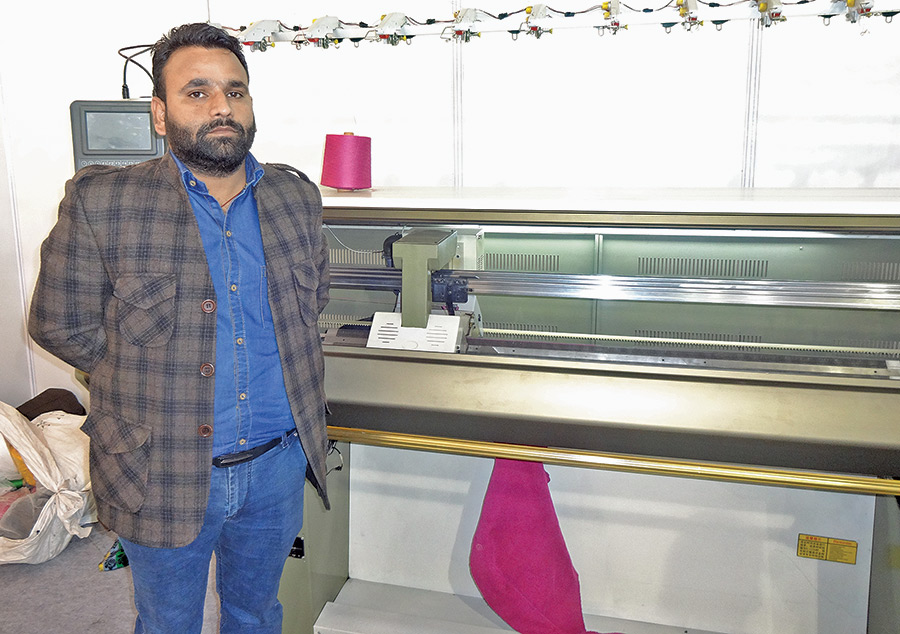
Visitor observations…
The enthusiasm to see what new products could be sourced from the region saw some sourcing professionals from domestic brands visit the fair. “We have overstocked in sweaters from the region and the inventories are high. For the next season it is important to understand what different we can get and coming here gives us an idea of the opportunities that may develop in a few years,” said Som Raj, Sourcing representative of Westend, Ludhiana. Another domestic player, Syed Tahir Abbas Kazmi from Uniform Kampus, who had come down from Kashmir to explore manufacturing options in his home town, averred, “We supply school uniforms and are looking to invest in technology that can give us a value proposition, so we can set-up our own unit in Kashmir.”

The fact that Ludhiana was too dependent on sweaters for business was a subject of concern for many of the visitors. “Working only on sweaters is no longer feasible, so exploring new options to remain in the market is very important. Knitted shoe uppers, the technology of which we saw at one of the stalls, could be an interesting investment at this point of time, as it will help us to get the first entry advantage of the new product,” reasoned Jitender Thappar of Coral Clothing, a visitor at the fair.
Namit Jain of Raj Nirmal Knitwear, who was exploring value-addition technologies at the event, summed up the overall sentiments, saying, “Basic products are too competitive in the market and we are looking at options to add value to the garment for better price and such new ideas are always interesting.”





 Bharat Tex Special Report 2026