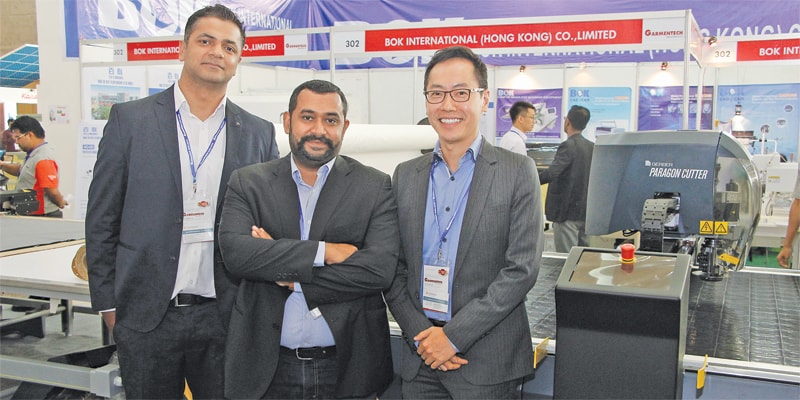
Meeting export target of US $ 50 billion requires not only the willingness of garment manufacturers but also equal support of technology providers with highly flexible and automated solutions. Gerber Technology is one of these leading companies and for nearly half a century, it has been dedicated to offering the most advanced solutions in the cutting industry. Reaching its 25 years of partnership with India Industrial Garment Machines (IIGM), the company is a perfect example of those companies which are devoted to provide support and serve Bangladesh markets, helping customers to reach their optimum.
Since the beginning, Gerber has been continuously innovating intelligent technologies and leading solutions to maximize productivity, efficiency and to decrease costs. Facing such a dynamic and globalized market, exporters based in this country are wishing to grow and expand faster, thus increasing the number of enquiries for Gerber Technology in last few years. “To achieve growth in a short time is a huge task. The only way to reach the mark is to hold hands with technology. Sticking to manual cutting comes with hard work, low efficiency and human errors. Gerber integrated cutting solution is the answer. By integrating cutting rooms with software systems, chances of error and cost per human input can be minimized,” says Louis Hoi, Sales Director, Gerber Technology.
Termed as the most advanced cutting system in the world, the company exhibited Gerber Paragon Cutting System HX series at the recently closed GARMENTECH ’17. Paragon can cut up to 7.2 cm of compressed material and its quick, accurate setup and self-adjusted cutting intelligence allows for faster cutting and with greater efficiency. Integrated with Gerber AccuMark® CAD and automated spreading systems, Accumark generates cut orders automatically, and cut ticket for a specific workflow. The process of spreading is also simplified by scanning the barcode to generate the number of plies as required and then material plies could be spread automatically. After the spreading process is accomplished, cutting system generates another code for this specific material. “Minimize human error, and maximize automation. That’s how we do it,” Hoi says.
However, the situations of solution providers in this industry are very uneven – from technologies to products and from service to maintenance. Many manufacturers still undertake manual cutting with the wish to double productivity in a short time and just don’t know how. “It’s not practical for them to retrain or double their workforce for now, and many are moving to automation slowly,” says Hoi. To change their idea towards automation is a big challenge. Customers care for price, the most. “Price should not be the core issue. Suppose you bought some sets of equipment turning out not to be reliable and no support or spare parts are provided, it is just loss in the end,” adds Hoi.
Many of Gerber users in apparel manufacturing taste the benefits of automation cutting room while those who stick to manual cutting hesitate to give a try. “Perfection is what we insist. We get to know user’s current production process and then present our cutting plan based on their status quo, helping with cutting room integration or setting up a new factory,” says Hoi. Technical experts from Gerber Australia and US will consult with them closely in the first and ROI of Gerber solutions always surprises them.
There are about 120 apparel manufacturing groups in Bangladesh comprising of 8-10 companies each. It is safe to be put out that 70 per cent of the business comes from these groups. Providing support to these groups requires both experience and efforts, and of course strong service teams. “Gerber Service is around the world. Global network of highly-skilled technical support professionals and field service engineers are committed to help customers maximize their profitability always,” Hoi says in the end.
IIGM is thrilled to be a partner of Gerber in Bangladesh and supports apparel manufacturing industry. Endorsing the opinions of Hoi, Sajith Kumar, Vice President, IIGM, emphasized on the importance of customer service. “We have a CRM system connecting the machines and it helps us analyse all breakdowns, logging timing from breakdown to recovery; better monitoring less downtime. It is dedicated to support the industry when adopting and adapting to new technologies,” concludes Sajith.