The protracted Covid glut ultimately seems to be making way for good days as Bangladesh’s export earnings made a strong rebound in the just-concluded fiscal year, fetching US $ 38.75 billion, thanks to revival of apparel shipments.
According to the latest Export Promotion Bureau (EPB) data released recently, compared to export earnings of US $ 33.67 billion in FY ’20, export earnings in FY ’21 has been US $ 38.76 billion, growing by 15.10 per cent.
As per the figures, in FY ’21, apparel export grew by 12.55 per cent to US $ 31.45 billion from what was US $ 27.95 billion in FY ’20 with export earnings from woven garments increasing by 3.24 per cent to US $ 14.49 billion from US $ 14.04 billion in FY ’20 while earnings from knitwear export in FY ’21 grew by 21.94 per cent to US $ 16.96 billion from US $ 13.90 billion in FY ’20.
So, at a time, when apparel export is on the rebound, shipping crisis has come back to haunt the garment makers again and, this perhaps could not have come at a worse time!
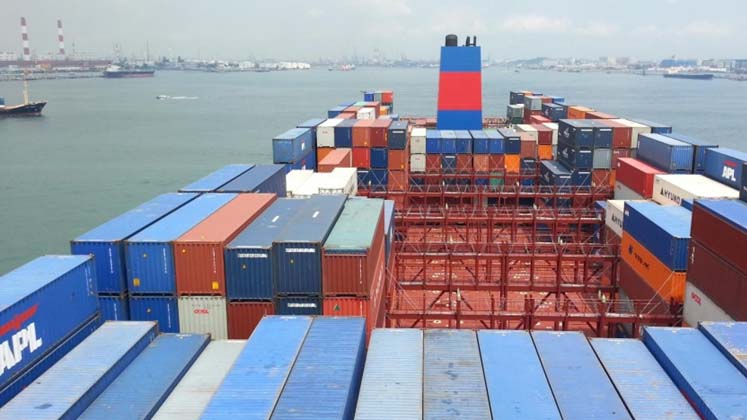
According to reports, the number of Bangladeshi goods carrying containers, which have now remained stuck in three transhipment ports (Port Klang in Malaysia, and the ports in Singapore and Colombo, Sri Lanka), is over 30,000 TEUs (twenty-foot equivalent units) even as experts have attributed the ongoing crisis to a surge in demand after months of blank sailings following the rebooting of businesses globally, slow delivery of goods from transhipment ports, and port workers getting infected with Coronavirus and falling ill.
It may be mentioned here that as there is no deep seaport in Bangladesh, mother vessels cannot come to the Chittagong Port directly and as such Bangladesh’s export and import consignments have to change vessels at the transhipment ports.
Meanwhile, Hapag-Lloyd, the German container shipping company, has reportedly decided to suspend its booking of import containers bound for Bangladesh via Singapore for a month.
The container transportation company announced on June 24 that bookings for cargo moving into Bangladesh via Singapore would not be possible for the next four weeks due to an increased backlog of containers destined for Chittagong at the transhipment port even as reports suggest the waiting time in Colombo port remains above 14 days while more than 3,500 Bangladesh-bound import containers being carried by the company are now sitting idle in Singapore.
This situation was caused by the increased number of import containers heading for Chittagong and reduced transport capacity among feeder operators and, due to its failure to clear the import shipments in a timely manner, the company is having to bear tremendous storage costs at Singapore port, which charges store rent from the date of arrival if a container remains for longer than the 7-day free storage period.
Also Read: FTA with China: Bangladesh’s chance to take trade ties to next level and reduce trade imbalance!
“We foresee a change in this situation by the last week of July and will ensure that we keep you updated on the developments,” said Hapag-Llyod in its announcement, even as Khairul Alam Sujan, Director of the Bangladesh Freight Forwarders Association, said backlogs at the transhipment ports such as Singapore, Colombo and Port Klang have prevailed for months due to prolonged delays in shipment caused by a recent blockage at the Suez Canal.
These ports are yet to get rid of that backlog, he added.
The delays, apart from jeopardising exports, have also hit the importers hard as raw materials meant for industrial production are getting stuck at the ports, causing losses.
Speaking to the media, Managing Director of Rahim Textile Mills Ltd., A Matin Chowdhury, said, “A consignment of raw cotton for my factory had been stuck at the Colombo port for an additional 30 days. Those containers, which were supposed to reach the Chittagong Port towards the end of April, are now waiting at the outer anchorage.”
Shipping companies said Bangladesh-bound containers see a delay of around 45 days because of a massive gridlock at the Colombo port, while shipments get delayed by two-three weeks at Singapore port and Malaysia’s Port Klang.
“Production is being hampered as many consignments of imported raw materials have been stuck at transhipment ports,” underlined the Managing Director Pacific Jeans Ltd., Syed Mohammed Tanvir, adding, “The shipment delay increases lead time. That is why the RMG sector has to face big losses as buyers demand air freight for quick delivery… As mother vessels do not come directly to our port, we have to depend on transhipment ports. The present crisis is taking a heavy toll on Bangladesh export-import business.”
To add to the situation, freight charges have increased significantly of late. According to reports,
freight charges have almost tripled on the two most regular routes – Europe and the USA – from Bangladesh when compared to the pre-pandemic time even as around 80 per cent of Bangladesh’s export goods are transported through these two routes while people in know of things maintained that the freight charge for a 40 sq. ft container on the route to Europe was US $ 300-US $ 3,500 before the pandemic, which is now US $ 10,000-US $ 12,000. During this time, the freight charge of a USA-bound 40 sq. ft container has increased from less than US $ 5,000 to over US $ 9,000.
“We are also concerned over the hike in freight charges, as buyers reduce our cutting and manufacturing prices due to high freight charges. This will cause us to lose competitiveness in the market,” stated BGMEA First Vice-President Syed Nazrul Islam, expressing apprehensions.
Meanwhile, speaking to the media, Chairman of Envoy Group Kutub Uddin Ahmed underlined that shipment of raw materials are being delayed owing to a shortage of containers, leading to an increase in freight costs.
According to reports, which cited sources, earlier in November last year, workers at the Colombo port abstained from work because of the pandemic, resulting in container congestion, while adding that the crisis has intensified with many port workers getting infected while Port Klang GM Captain K Subramaniam reportedly said 500 workers have tested positive for the dreaded virus.
So, even as the shipping crisis continues to deepen further, the apparel exporters and freight forwarders have demanded that the Ministry of Shipping take up an initiative to launch direct vessel operations from Chittagong Port to Europe and the USA to resolve the crisis due to shortage of vessels and congestion at transhipment ports.
At a meeting held recently, leaders of the Bangladesh Garment Manufacturers and Exporters Association (BGMEA) and the Bangladesh Freight Forwarders Association (BFFA) also decided to work jointly to resolve the export snag even as the meeting reportedly specified a set of recommendations to resolve the crisis.
Now if and when the crisis is resolved is yet to be seen but till then apparel exporters are in for some hard time, at least so it seems.