The world is facing a shake-up like never before, and as manufacturing countries find their footing in a new world order, governments across the world are fighting their own war with major policy changes or new initiatives either already in place or on the way. Many of these have the potential to impact the textile value chain in the months to come.
China is, of course, at the receiving end of a lot of criticism, tariff restrictions and business pull-outs. The US, in particular, has come down hard on China in continuation of the ongoing trade war that was a matter of dispute even prior to the pandemic.
India could benefit from cotton sanctions on China
More recently, the US withheld release orders on cotton and apparel imports from specific producers in China’s Xinjiang Uygur Autonomous Region (XUAR), which experts believe might escalate global trade tensions.
In coming months, there is a strong expectation of more sanctions by the US government to curb imports of products originating from or having linkages with XUAR. The textile industry is watching the developments closely and India Ratings & Research (Ind-Ra) has predicted that China could resort to retaliatory measures. The most obvious being delays in cotton procurement from the US by Chinese mills, which in turn could lead to favourable supplies from Brazil and India – both of which are likely to have high inventories.
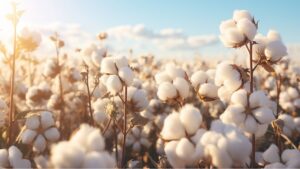
While yarn manufactures could benefit from the US-China stand-off, it cannot be overlooked that garments manufactured from cotton will also see increased demand. Since the US will prefer to source its cotton-based products from countries other than China, India with its traditional stronghold in the segment stands to benefit. Recent efforts to put a spotlight on cotton will be an additional booster to the potential business in months and years to come.
It cannot be ignored that India, the world’s largest cotton producing country, has thrived on the category along the textile supply chain. Recently, the government launched its cotton brand ‘Kasturi’. This branding initiative will fetch better value for the Indian cotton growers. The Kasturi Cotton brand will represent whiteness, brightness, softness, purity, lustre, uniqueness and Indianness. To add more value to the entire supply chain, the Ministry of Textiles and the Ministry of Commerce and Industry are working for a certification system for organic cotton to be introduced in phases in the entire value chain.
Also Read: This is where leading textile and apparel states can improve
Bangladesh extension of duty-free benefits to the EU
While India is set to benefit from developments in the global cotton industry, Bangladesh could very well continue to enjoy the duty-free trade benefits in the European Union (EU) for a few more years even after its graduation from the group of least developed countries (LDC).
This coming November, the EU is lined-up to review the duty-free facility to Bangladesh under the EBA scheme. If the duty- and quota-free facility is withdrawn, Bangladesh’s export will decline 5.7 per cent annually as local exporters will then have to face an 8.7 per cent duty on exports to the EU.
Bangladesh has called upon the World Trade Organisation (WTO) to extend the trade benefits that Bangladesh currently enjoys as a least developed country to 10 more years (from 2024 to 2034) post LDC graduation even, as Bangladesh is expected to graduate from the LDC category by 2024. As a least developed country, Bangladesh currently enjoys 12 per cent preferential margin and relaxed rules of origin on its export to the European countries – the EU is a major export destination for ‘Made in Bangladesh’ apparel items – as per the WTO wing officials.
India ready for Preferential Trade Agreement as stepping stone to FTA with EU
After trying for a long time to come to a consensus with the EU to formulate an FTA, Piyush Goyal, Minister of Commerce & Industry, has hinted at the possibility of starting with a preferential trade agreement (PTA) for an early harvest to get faster outcomes. It is for long established that a duty-free access to the EU will make Indian exporters in the textile sector highly competitive there. For instance, Indian yarn, fabrics and garments attract export duties of 4 per cent, 5 per cent and 9.6 per cent, respectively, in the EU, while competitors like Bangladesh and Pakistan export there at zero duty.
The suggestion of initiating talks for a PTA, to start with, is a good move accepting the fact that instead of waiting for the resolution of all the contentious issues to ink a full-fledged FTA, it’s better to clinch a limited deal on the points of convergence and then move on to a more ambitious one.
Movement for regional collaborations pick up momentum
Regional alliances are also a major thrust to enhance business opportunities in apparel exports. Governments, associations and even individual manufacturers are rooting for greater collaborations. Smriti Irani, Minister of Textiles, has said on record that there are many avenues of cooperation and coordination between India and Bangladesh textile and apparel industry. At a recent meeting, the minister said that measures are underway to address the logistics challenges in order to reduce the turnaround time for movement of cargo between the two countries, and inland waterways will also be leveraged for the same.
Other areas stressed for collaborations are imposition of zero duty on exports of ethnic apparel from India to Bangladesh, increasing yarn and fabric exports to Bangladesh and partnership to capture a share in global value chain of silk and jute as well. The criticality of grabbing the opportunity thrown by the current pandemic to restructure global value chains in the sector in favour of India and Bangladesh has become a major subject of discussion.
Vietnam facing challenges in navigating trade policies
Vietnam’s textile and garment exports to the Eurasian Economic Union (EAEU) may face safeguard duties this year as volumes to the bloc (Armenia, Belarus, Kazakhstan, Kyrgyzstan and Russia) are close to exceeding the limit set under the Vietnam-EAEU free trade agreement. Product of exports that will be most impacted are ladies’ garments, which have already reached over 79.4 per cent of limit value in the period January – July 2020.
Even as Vietnam seeks a way to overcome the issue, Vietnam’s apparel products may be subject to the most favoured nation (MFN) tariffs for 6-9 months, depending on the exceeding value, which may negatively impact exports.
Also Read: Indian textile firms must add value to their offerings to get business from Vietnam
On the other hand, the Trump administration has ordered probe into Vietnam’s currency practices, which many fear could just be the beginning of another trade war – this time, with Vietnam. If there is no successful resolution on the aforementioned issue, it could result in tariffs, quotas and other restrictions on imports from Vietnam. And that’s not good for Vietnam, especially for its apparel industry, which has a major share in the US apparel imports.
Canada withdraws from trade negotiation with China
The magnitude of the change is reflected in the fact that Canada is abandoning free trade negotiations with China amid a host of disagreements on a range of topics. The official statement clearly says, “I do not see the conditions being present now for these discussions to continue at this time. The China of 2020 is not the China of 2016 – a reflection of what a majority of countries feel!”
Quad meet to focus on improved bilateral ties
The recent quadrilateral meeting between Japan, US, Australia and India, held physically even in the time of pandemic, highlights the growing anger against China. The group called Quad a “fabric” that can “counter the challenge that the Chinese Communist Party presents to the world.” As an expert pointed out, China was the godfather of the Quad at the time of its inception and it remains the motivating factor for the Quad even today, since it has been going everywhere picking a fight. The group urged other countries that share these values to join in.
The recent meeting focused on economic cooperation and collaboration on issues such as critical materials to reduce over-dependence on one source, and all of this is good for India. In apparel trade, India is the country which is most likely to be benefited from the Quad. It cannot be overlooked that the US, Australia and Japan are all important markets for India in apparel exports.
Among the latest developments that could have long-term implication for the garment industry is a notification by the US Customs and Border Protection (CBP) requiring that goods produced in Hong Kong and exported to the US to be mandatorily marked as coming from “China” after 25 September 2020. Goods that fail to comply with this rule will face a punitive duty of 10 per cent ad valorem at the US ports.
The notice for all tariff purpose indicates that Hong Kong exports to the US may soon face the additional tariffs that the US has imposed on Chinese products amid the trade war between the two superpowers. This could mean that many products currently being sources from Hong Kong could attract an additional tariff of 7.5 to 25 per cent, making them uncompetitive. An opportunity for other apparel manufacturing countries to watch out for in the coming months!
Also Read: MMF – It’s now or never for India