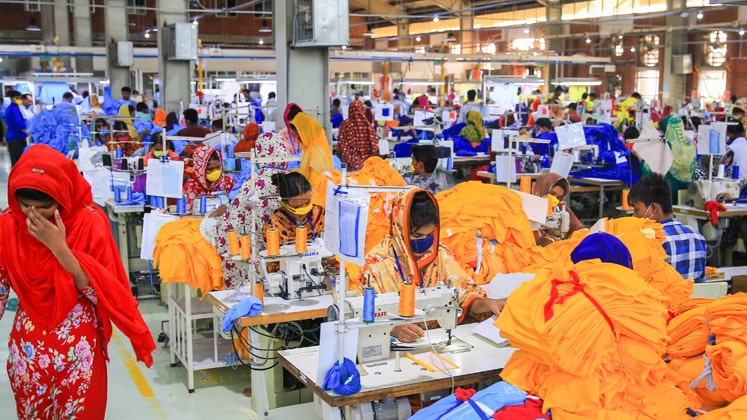
If one would remember, Bangladesh Government reimposed strict Covid lockdown from 6.00am of 23rd July to midnight of 5th August this year, after a brief relaxation of restrictions from 14th July midnight to 6.00am on 23 July as Coronavirus pandemic wreaked havoc in the country, and this time around there was no exception for any sector or industries including the readymade garment sector, considered the lifeline of the country’s economy.
Initially two trade bodies associated with the apparel industry of Bangladesh- the Bangladesh Knitwear Manufacturers and Exporters Association (BKMEA) and the Bangladesh Textile Mills Association (BTMA) advised their respective members to keep their factories closed until 5th August, in compliance with the Government’s strict lockdown.
“If massive losses are incurred, they would seek incentive support from the Government after the lockdown period came to an end,” reportedly added BKMEA President AKM Salim Osman while the BTMA also requested its members to keep their factories units closed in a separate notice.
It was the apex garment makers’ body of BGMEA, which did not issue any announcement or guidelines in this regard even as BGMEA Vice-President Shahidullah Azim, said they have urged the Government to allow opening of apparel factories from 1st August, before the lockdown period ended four days later.
However, it was but just a matter of time before the clamour for allowing garment units to resume production grew stronger and understandably so as of the total apparel items shipped from Bangladesh, 40 per cent are shipped in July and August and garment shipment would have suffered a serious setback if production remained suspended in July and August as it is the prime season for apparel manufacturers since sales rise in the Western market on account of ensuing winter and Christmas.
“It is a peak time for us to book new work orders and ship the goods for the next winter and Christmas. So, it is not logical to suspend the production of garment factories during this period,” explained Managing Director of the Narayanganj-based Plummy Fashions Ltd., Fazlul Hoque, adding, “We are expecting a boom in work orders for the next year as many buyers are shifting orders to Bangladesh from other countries. If we go for a long holiday and shutdown, we will not be able to attract those orders, which will be very painful for us,” even as Shahidullah Azim, on his part added the sector would face a massive loss if the garment factories are kept shut for a long time while Mohammad Hatem, the First Vice-President of the BKMEA, stated: “We have supplied products at prices that are lower than the production cost with a hope to make a profit in the future. Now is the time to make the profit as many of our suppliers are overbooked with fresh orders. We will lose our business aimed at the sales during next winter and Christmas. We will also lose plenty of orders for the next summer if a long lockdown is imposed.”
Considering the importance of the sector as well as the persistent demand of the garment makers, the Government, after prolonged uncertainty, allowed all export-oriented industries to resume operation ultimately on the 10th day of the stringent lockdown, amid warnings against Covid surge as workers started returning to their workplaces to resume work.
Even though the factories resumed operations, public health experts warned the mass movement of garment workers, as they reported back to work, and the congested living condition of most of them and working in close proximity within the factory premises, could increase the risk of these workers getting infected with the dreaded virus.
Speaking to the media then, Chairman of Mithela Textile Industries Limited, Azhar Khan stated although exports were slightly lower, they are optimistic that shipment volume will increase soon even as Faruque Hassan maintained, “It is our earnest request that the brands you represent do not penalise their suppliers for any reasonable delays caused by this lockdown,” while Shahidullah Azim quipped, “…we are expecting good days ahead.”
Even though the factories had implemented all required health guidelines, there was but a lingering question, if reopening the factories was a wise move?
Now, months down the line, it was time to take stock and if apparel export statistics are something to go by, the move to resume operations seems to have paid off as large number of work orders have come in and continue to do so still following the reboot of global economies even as industry insiders underlined now is the time for apparel entrepreneurs to get their businesses back to pre-pandemic levels by overcoming pandemic-induced losses.
It may be mentioned here that Bangladesh registered the highest-ever single-month export growth of 60.37 per cent, year on year, in October with overall US $ 4.72-billion income as apparel shipments rebounded from pandemic recession even as people in business circles credited the readymade garment (RMG) industry for the same as it kept its wheels rollingeven amid the Coronavirus onslaught.
In October ’21, out of the US $4.72 billion, the country fetched US $3.56 billion from RMG exports.
If one would remember, the export sector of Bangladesh suffered heavily during the April-June period of the last year as countries in the EU, Canada, Australia went under lockdown and the current export performance — of the total US$ 15.74 billion worth of export income during the July-October period, the RMG sector fetched US $ 12.62 billion, recording a 20.78-per cent growth compared to the corresponding period of last fiscal even as Bangladesh earned US $10.45 billion from apparel exports in the corresponding period of FY’21 —is evidence enough that allowing the garment factories to resume operations did pay off.
There’s also no report of any significant increase of COVID-19 cases amongst the garment workers as the country continues its massive vaccination drive to prevent further spread of the virus!
“Notwithstanding many challenges during pandemic-led restrictions, we kept on factory operations even at losses. Now, we are receiving a lot of work orders from international buyers and brands because of our compliance with everything necessary for the health safety of workers,” stated BGMEA President and Managing Director of Giant Group Faruque Hassan, adding, “All the challenges we faced in the pandemic time have now turned into opportunities for us…”
However, the garment makers have now requested the Government to enhance port’s capacity and ensure uninterrupted supplies of gas and power to help them capitalise on the opportunities that are on offer.
“The country has witnessed a significant rise in work orders since last July, which continues to date and will continue in the coming months,” said another garment maker and the BKMEA Executive President Mohammad Hatem pointing towards the fact that allowing factories to resume operations is now paying dividends.
“During COVID-19, we could keep buyers with us even counting losses and kept our factories operational. Despite difficulties, we didn’t leave our workers. That’s why buyers are recognising us and we’re getting orders,” claimed the BGMEA Chair even as industry insiders have called upon the international buyers to give fair prices of the products while seeking greater support from the buyers to survive in these difficult times.
“International supply chain will remain uninterrupted if the suppliers can sustain and survive,” underlined a garment maker, expressing hope better days while maintain the decision to allow the garment factories resume production was definitely not a wrong move even if the garment makers are now getting concerned about the fast-evolving Covid scenario in many of the export bastions as a new variant of the dreaded virus has reportedly been detected amidst rising public health and safety concerns.
However, that is an altogether different issue, which ultimately may not have much of an impact on apparel exports after all as countries, is all one would expect.