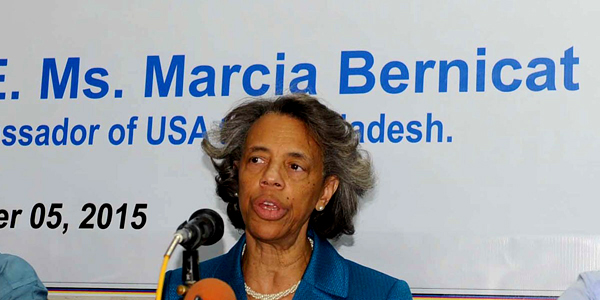
At a time when Bangladesh is keenly awaiting restoration of the Generalised System of Preferences (GSP) from the US, US ambassador in Dhaka Marcia Bernicat reportedly maintained that GSP does not give any extra benefit to the Readymade Garments (RMG) sector of any country.
Also Read – Improve RMG sector’s working conditions to regain GSP: Bernicat to Bangladesh
“All GSP countries pay the same duties,” Bernicat reportedly said in a Facebook chat on Sunday, marking the completion of her one-year term in Bangladesh, which had primarily focused on the apparel sector in the wake of the recent review of the Sustainable Compact.
It may be mentioned here that the US Ambassador in Dhaka had recently called upon the garment sector of Bangladesh to improve the working conditions of those employed in the in the apparel manufacturing sector, in order to regain the Generalised System of Preference (GSP) as well as to boost garment exports. “Importers will not like to buy garments from Bangladesh unless the country improved its working environment in the sector,” Bernicat had recently said at an event.
Also Read – Bangladesh Commerce Minister sees ‘politics behind GSP non-restoration’
The Generalized System of Preferences is a preferential tariff system that provides for a formal system of exemption from the more general rules of the World Trade Organization (WTO). Specifically, it is a system of exemption from the most-favoured nation principle (MFN) that obliges WTO member countries to treat the imports of all other WTO member countries no worse than they treat the imports of their ‘most favoured’ trading partner. In essence, the MFN requires WTO member countries to treat imports coming from all other WTO member countries equally, that is, by imposing equal tariffs on them, etc.
However, USA suspended the trade privilege enjoyed by Bangladesh under the GSP in 2013, following the fire at Tazreen Fashions and collapse of the Rana Plaza building. Further, it also set a total of 18 conditions, including improvement in the working condition and safety of workers later on, for Bangladesh to get back the privilege.





 Bharat Tex Special Report 2026