Today, businesses are being built on 3Ps – People, Planet and Profit – and sustainability is being used for driving productivity, resource efficiency and closed loop systems in making organizations more sustainable. Apparel manufacturers, including SMEs should start thinking and investing in sustainable initiatives from the business perspective. Reimaging sustainability in designing enterprises of the future and many such thought-provoking discussions took place at the Sustainable Business Leadership Forum, instituted by Sustainability Outlook (a division of cKinetics), in Delhi. With active participation from top management of leading apparel and home furnishing exporters to chief sustainability officers of corporate houses that are at the forefront of sustainable initiatives, and presence of representatives from top apparel houses, international brands and many other industries, the day-long event was an interesting platform to exchange ideas on sustainability.
Discussing on designing smart and resilient manufacturing – management strategies and tools, the experts (both top and senior management) shared their experiences related to different pillars of smart manufacturing that is operational efficiency; resource efficiency; KPI (Key Performance Indicator) tracking; Capacity Building and Automation. Experts also shared, what has worked for them.
Biswajit Nanda, VP (Operation), Shahi Exports shared his experience of how product prices have come down in the past despite inflation in material and resource prices. It couldn’t have been possible without overall sustainable initiatives and continuous improvement. He also insisted on making the entire system ‘predictable’. “There may be extensive trials, but it is necessary to have correlation between your lab and bulk production (fabric wet processing operations),” he added.
Sharing his success story on operational excellence, TN Thirukumar, MD, Jansons Industries Ltd. highlighted how implementation of various lean tools helped them to excel in quality, produce at a highly competitive price and become the biggest supplier of cushion covers for a well-known buyer in home segment. “Before adopting 5S, our output from one machine was 130 pieces of cushion covers, but now on same machine, our operators can make 180 pieces of the same style in the same time. This is how we became sustainable through productivity enhancement and due to this not only our buyers, but even our workers are happy.”

Any effort is incomplete without developing the system capability to implement and absorb the change management. Vineet Lall, MD, Modelama Skills outlined that SMEs which are 80 per cent of our country’s entrepreneurs, are still struggling to figure out how to make their manufacturing capabilities smarter, realizing that unless we intervene with skill development, one can’t use the machine/technology effectively. He insisted that along with lean tools, industry also needs to focus on improving technical skills of workers to effectively drive ‘right first time’ culture. “It is a must to analyse root cause of the defects, as in some cases we find that few of the workers keep repeating the same defects in spite of being told… Obviously, they simply don’t understand the instructions,” reasoned Vineet.
Anshul Chawla, Engagement Manager, cKinetics shared a case study that how cKinetics helped a leading denim dyeing plant to enable additional Rs. 200 crore revenue potential with same water and thermal energy resources. Tools like value-added water and integrated energy management were used for this. There was reduction of demand by 10 per cent of fresh water and 4 per cent of thermal energy. The direct business impact was on capital investment reduction of Rs. 5 crore towards ZLD implementation, and Rs. 50 lakh towards boiler expansion.
Manoj Menon, ED & CEO, Mahindra Gears and Transmission pointed out that customers are demanding quality products and are less willing to accept variations in quality parameters of products. There are learnings from traditional way of doing business which when married to technology advancements enables the management to track the operational and resource consumption closely. Mahindra is effectively dealing with these challenges through “Breaking barriers among different departments as everyone was working in silos. We got everyone to work on same floor,” shared Manoj.
Shrinivas Naik, Head – Business Sustainability, Arvind Lifestyle highlighted the need for measurement and monitoring systems, “In order to promote smart and resilient manufacturing, measuring resource use is very important. Companies must put a target for achieving reduction in resource consumption.” Shrinivas also shared that design and product development could be the key to create higher value add products, further adding that Arvind’s innovation centre works on bringing newer technologies, automations, innovations to reduce all kind of cost, specially process cost. “De-skilling, resources measure and target, documentation are also needed to put focus on continuous improvement.”
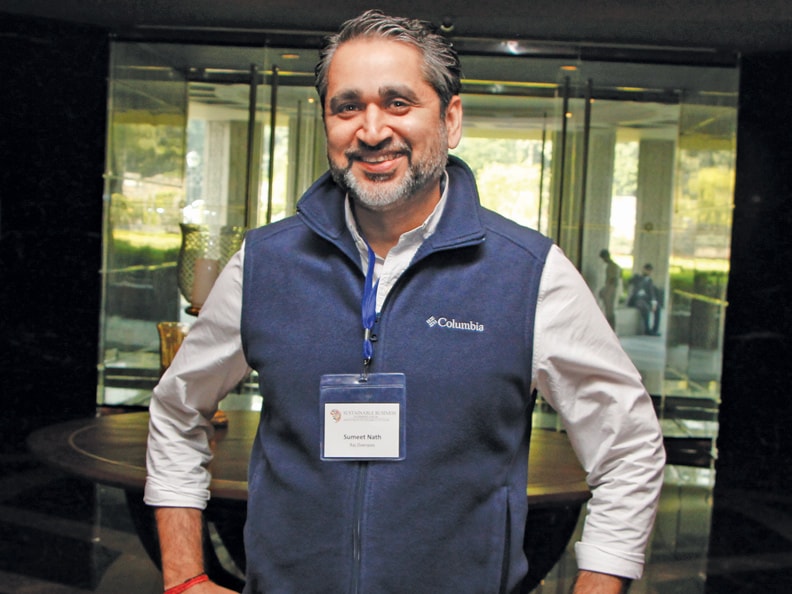
Another parallel track was focused on the implementation of Zero Liquid Discharge (ZLD) in textile industry. The track was focused on the risks, opportunities, challenges and the way forward for driving towards a sustainable textile industry through ZLD. The panel comprising of Reena Satavan (CPCB), Sumeet Nath (Raj Overseas), Abhishek Bansal (Arvind Limited), Harsh Sheth (SIWI) and Aparna Khandelwal (Sustainability Outlook) reflected on the outlook for ZLD implementation in the textile sector in India in light of the updated ZLD guidelines issued by Central Pollution Control Board (CPCB) in Oct 2016. While Reena provided a detailed overview of the thought-process of the regulator behind the new ZLD guidelines, Abhishek shared their experience of setting up one of the largest ZLD facilities in India. The panellists discussed the key implementation challenges for ZLD as also the experience of wet processing units in Tirupur who have implemented ZLD more than 7 years ago. The key focus of discussion was the way forward which can be adopted by the textile sector in order to move towards a more water sustainable manufacturing.
“Companies have to adapt ZLD as it is the ‘law of the land’ but it should be done in a phased manner where cost implication is given back to consumers, but should not hit them once and for all. We have to see how much implication it has on our product as far as cost is concerned, and how much implication it has on company per se as far as investment is concerned. How much technology do we have to really go in for ZLD so that we can make the required changes in our industry.” – Sumeet Nath, Partner, Raj Overseas, Panipat
One of the key highlights of the event was ‘Sustainability Innovation Circle’, a platform where companies from Indian industry presented their disruptive innovations under various categories, like resource efficient systems, water and waste water, creating newer market segments and materials. One of the presenters, Zenatix, aims to reduce power wastages for commercial electricity consumers by 10-20 per cent without requiring any upfront and equipment retrofits. WattMan, an automated energy control and monitoring product, leverages IoT (Internet of Things) stack and cloud to deliver operational energy efficiency to retail/BFSI (Banking, Financial Services and Insurance) through automated and intelligent controls triggered by rules, sensors and analytics. In addition, WattMan also provides real time monitoring of energy and temperature.





 Bharat Tex Special Report 2026