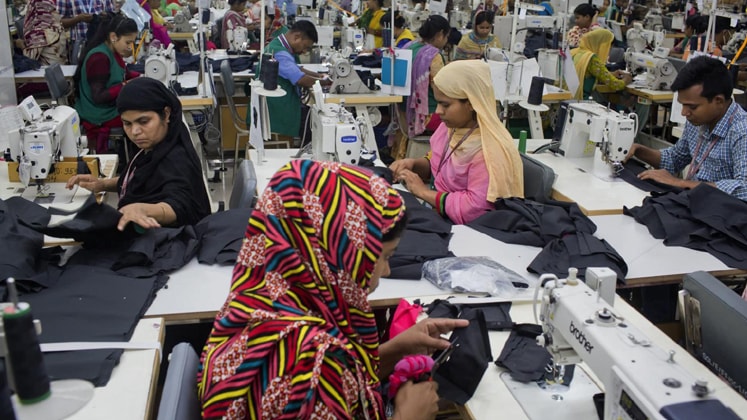
Bangladesh’s track record in terms of labour rights has not been very impressive when looked at from the global perspective. Even its biggest apparel export destination and close trading partner, the European Union, has in the last few years raised several questions on the status of labour rights issue in the country, especially in the garment manufacturing sector, which employs a strong 4 million workforce, predominantly women, to churn out apparel items for the global buyers.
The EU – which has been sending its teams to the country to assess the situation at the grassroots level – has also harped on improving the labour rights scenario with relation to the continuance of trade benefit that Bangladesh currently enjoys in the EU nations. In one such visit earlier last year, the EU pressed the Government for a time-bound action plan to address their concerns related to labour rights situation in the country to retain the trade benefits under its EBA (Everything but Arms) initiative.
The delegation members, during their 3-day visit, held meetings with leaders of different rights groups and RMG sector trade-bodies, discussing the latest labour law reforms in Bangladesh and collecting necessary information to report on development and progress made in the remaining issues for the biennial Generalised Scheme of Preferences (GSP) report for the European Parliament and the EU member states. The delegation urged the Government to allow trade unions instead of workers welfare associations as well as assessment by labour inspectors without prior approval from the Bangladesh Export Processing Zones Authority (BEPZA) in the factories in its eight EPZs. The visiting delegation also wanted further amendments to the labour law and labour rules in line with the International Labour Organisation (ILO) Convention 87 concerning freedom of association and protection of the right to organise along with Convention 98 regarding the right to organise and to bargain collectively.
The EU team also asked for reduction of minimum membership threshold for trade union registration to 10 per cent.
In the meeting, then Labour Secretary KM Ali Azam informed the mission about the progress related to amending labour law, the move to revising labour rules, and updates on Bangladesh EPZ Labour Act, trade union registration, anti-union discrimination and measures to eliminate forced labour and child labour. Regarding ILO Convention 138, the Labour Secretary said except it, Bangladesh ratified seven out of eight ILO core conventions, and his ministry has been engaged with the ILO and other partners regarding this issue.
So one year down the line, have things improved much? The answer to this may not be a big ‘YES’, more so if one is to take into account the latest report of the International Trade Union Confederation (ITUC), which has ranked Bangladesh among the 10 worst countries for workers’ rights in 2020, four years in a row.
The ITUC in its ‘Global Rights Index 2020’ launched recently listed Bangladesh among the 10 worst countries in terms of labour rights due to violence, mass dismissal and regressive laws. The other nine countries in the list are Brazil, Colombia, Egypt, Honduras, India, Kazakhstan, Philippines, Turkey and Zimbabwe.
Egypt, Honduras and India are new entries in the list in 2020.
Honduras has joined this group for the first time, while India’s repressive labour legislation has seen it re-enter since it first appeared in 2016, and Egypt was one of the ten worst countries in 2015, 2017, 2018 and makes a return in 2020, the report showed.
The 2020 ITUC Global Rights Index showed the world’s worst countries for workers by rating 144 countries on a scale from 1 to 5+ based on the degree of respect for workers’ rights with 1 being the best rating and 5+ the worst.
Workers had no or restricted access to justice in 72 per cent of countries with severe cases reported in Bangladesh, where labour courts have accumulated a 3-year backlog, while a staggering 18,000 cases filed by workers were still pending, the ITUC report underlined, adding workers in Bangladesh could not exercise their basic rights at work without fear of retaliation and brutal repression.
However, Labour Secretary KM Abdus maintained that the observation of ITUC was not correct, as the labour situation has improved a lot in the last few years. He said that the Government amended labour act in line with the conventions of International Labour Organisation and many more activities have been going on for the wellbeing of workers.
KM Abdus said that the Government was working to protect the interest of workers in the ongoing COVID-19 situation, and the Prime Minister announced an incentive for ensuring payment of workers’ wages.
In the garment sector, which represents an overwhelming share of the country’s export economy, over 5,00,000 workers employed in the EPZs were not allowed to form or join unions, which left them without real power to bargain for better working conditions, the ITUC observed. According to the report, a total of 1,104 union registration applications were examined between 2010 and 2019, and 46 per cent were rejected by the Department of Labour. Further, of the 575 unions which were registered, 62 have been busted or are inactive due to anti-union retaliation, and 81 unionised factories have closed down, it said.
Members reported to ITUC that information about their participation in trade union activities was sent to their home villages to verify their data and create pressure.
The 2020 ITUC Global Rights Index found that violations of workers’ rights are at a 7-year high, with mounting evidence that some Governments are using the coronavirus situation to increase attacks on the rights of working people. “As if the findings of the Rights Index are not shocking enough, we are already seeing some countries take things further, and under the cover of measures to tackle the coronavirus pandemic, they are advancing their anti-workers’ rights agenda. This has got to stop, and be reversed,” maintained ITUC General Secretary Sharan Burrow.
It goes without saying that the COVID-19 pandemic has posed a new question mark on the livelihoods of the garment workers with more and more garment manufacturing units shutting down due to financial stress. And many of those, which are still in the business, are forced to deal with order cancellations, discount demands and payment being deferred by the buyers for extended periods. And the results are already here to see!
As per the latest available reports, a massive number of 21,331 workers, most of whom were employed in the readymade garment sector of the country, have lost their jobs since Eid. Of these, 11,000 have allegedly been retrenched in just a couple of weeks.
As per the reports, which cited data collated by the country’s Industrial Police, of the 21,331 workers who were employed with around 129 factories spread across six industrial zones that are under the jurisdiction of the Industrial Police, 19,409 were said to be employed with garment and textile units. Further, of these 19,409 workers, 2,298 are from 16 factories that are under the Bangladesh Knitwear Manufacturers and Exporters Association (BKMEA) while 16,853 were reportedly employed with around 86 factories that are members of the Bangladesh Garment Manufacturers and Exporters Association (BGMEA). The remaining 258 retrenched workers were reportedly working in four mills that are under the Bangladesh Textile Mills Association (BTMA).
Meanwhile, labour leaders in Bangladesh have claimed that the total number of retrenched workers would be much higher, as factories were allegedly sacking workers randomly without any notice.
It may be mentioned here that the figures collated by the Industrial Police are from the six industrial zones, whereas a large number of factories are also located outside the industrial zones.
In view of these developments, labour leaders have demanded more budgetary allocation for garment workers. A platform of 11 national labour organisations of the country, under the aegis of the Garment Sramik Adhikar Andolan, called for more budgetary allocation in the proposed budget for the residence, ration and health facilities of the garment workers.
Leaders of the labour organisations including Mahbubur Rahman Ismail, President of the Bangladesh Textile Garments Sramik Federation and Coordinator of the platform; Taslima Akhter, President of Garments Sramik Sanghati; Shamim Imam, Executive Adviser of Bangladesh Garments Sramik Mukti Andolan; other labour leaders like Shahiduyl Islam Sabuj, AAM Foyez Hosen and many others also formed a human chain in front of the National Press Club in capital Dhaka rejecting the proposed budget while demanding more budgetary allocation for the workers. They also called upon the Government to ensure the garment workers’ job security amidst reports of large-scale termination of workers in the backdrop of COVID-19 outbreak in the country and its economic fallout.
Given the scenario in hand, labour unrest has become a recurring phenomenon in the garment manufacturing hubs in and around Dhaka. But despite this, many factories are trying to productively engage the garment workers and taking all possible steps to ensure workers are not abandoned in such trying times.
“We have undertaken multiple measurers to create less information gaps between workers and management, which is imperative at this time. We have been arranging multiple awareness campaigns to minimise the intensity of crisis, our management at very early stage focused upon COVID-19 and its impact on business-based awareness drive. Retraining workers to adapt to this ‘new normal’ and keeping them updated regarding facts is the only way to avoid any unrest or uncertainty that is present right now from the baseless rumours and gossips in circulation,” Rafi Mahmud of Mahmud Denims told Apparel Resources, adding, “We are also using the lost times from less confirmed orders to train the workers to improve their skills, so that we can be more competitive. Every person has been updated on all the steps we are taking to improve safety and provide a more hygienic environment. We have taken precautions to disinfect all our premises and have applied social distancing norms and have planned to minimise human contact to decrease the likelihood of infection.”
Mahmud Denims is also regularly meetings with the WPC leaders, and together, they have formed a COVID-19 action team to maintain safety measures.
“Furthermore, we have explained to them their rights regarding their wages to reduce confusions on their due payments,” claimed Rafi.
Another entity that is working relentlessly towards ensuring workers’ welfare at this critical juncture is Energypac Fashions Limited.
“We have established a dedicated team who keeps workers aware of this recent crisis. We are also continuously communicating with the workers to instil faith that all steps are being taken to ensure their financial stability,” Humayun Rashid of Energypac Fashions told Apparel Resources, adding, “I am being personally connected with workers through Zoom and trying to make them understand that we are a family at Energypac.”
Considering the steps taken by these garment makers, which we are sure are also being done by many others, it is just a matter of time before the condition of labour rights makes a marked improvement in Bangladesh.





 Bharat Tex Special Report 2026