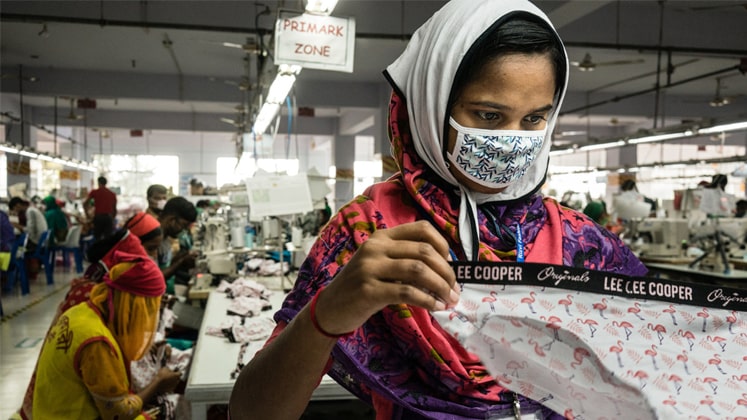
The year 2020 has been one that is better forgotten from the Bangladesh garment makers’ perspective. One country after another across the globe became victim of the devastating COVID-19 pandemic before it reached Bangladesh’s shores to bring everything to a grinding halt.
The Bangladesh Government had to declare a general holiday from 26 March 2020 to prevent the spread of the novel Coronavirus before it allowed factories to reopen with a limited number of workers from 24 April.
However, by then the damage had already been done. According to media reports, around 1931 brands either delayed, put on hold, or straight up cancelled their orders since the onset of the pandemic even as the total value of these orders was estimated at around US$ 3.7 billion, much of which though was reinstated later on. But as was expected, it dealt a crippling blow to the industry by then as significant number of smaller players had shut shop for good, unable to cope with the losses suffered, even as medium and bigger players struggled too to keep afloat.
The result, closure of many factories and mass retrenchment of garment workers, which as per some accounts, crossed several lakhs. This is when the Government had to intervene and instruct factory owners to pay 65 per cent salary to the rest of the workers who were on leave even as the factory owners were under tremendous pressure consequent to foreign buyers continuously cancelling, suspending orders and stopping the payment.
Seeing no way out, the Government set up a Taka 5,000 crore stimulus fund to pay loans at 2 per cent service charge to garment factory owners for paying the workers’ salaries of April, May and June in the first phase. Later, the size of the stimulus package was increased by another Taka 2,500 crore as not everyone could be paid with this money even as after that, Bangladesh Government increased the fund by another Taka 3,000 crore, even though in the last phase, the interest rate was increased to 4.5 per cent.
So, when on one hand, many factories were shedding workers in big numbers in face of work order cancellations, liquidity crisis and an uncertain future going forward, there were several garment manufacturers, who stood by their employees steadfastly even as many even paid full salary to the workers while there have also been factories, which provided fresh employment opportunities for the workers.
Bangladesh’s renowned Envoy Textiles Limited, the world’s first platinum LEED-certified factory, is one such name which did not lay off any worker and also tried to retain all facilities for them amidst the pandemic even if the company’s business took a sharp nosedive on account of the pandemic.
It also paid the workers full salary and once the factories were allowed to resume work on a limited scale by the Government, it resumed partial production by opening the factory in compliance with the health rules while also continuing to provide free accommodation, subsidised lunch and free snacks and bearing all medical expenses of the workers.
“The workers and officials working at this factory are a part of my family and one cannot abandon their family in any catastrophic situation. Instead, you need to take better care of your family during trying times. And, I did the same and the Government’s incentive package helped me in this regard,” maintained Chairman of Envoy Textile Kutubuddin Ahmed while speaking to the media, adding, “The business is going through a tough time due to the pandemic but this will not last forever. My workers are the driving force of my company,” even as an assistant operator at Envoy Textiles Limited said that during the crisis brought upon by the pandemic, they were calm as they knew the company will stand by the workers.
During the first few months of the pandemic, 100 per cent salary was paid on time and after the opening of the factory, other facilities were also continued, reportedly maintained the said assistant operator.
Founded in 2005, the company is situated on a 50-acre site at Bhaluka in Mymensingh and is considered one of the most environmental-friendly denim mills in the world. It also has modern accommodation for workers where out of the company’s 2650 employees, 1,200 live there rent-free.
Another name which needs to be spoken about in this direction is Interstoff Apparels. Around 40 per cent of workers got full payments after re-joining work after last year’s general holiday while the remaining 60 per cent received 65 per cent.
Divisional Assistant General Manager (Compliance) of the company Pradip Kumar Nath shared this with the media, while adding the factory could pay all the workers, including those who were absent, as it had received money from the Government’s stimulus fund.
Located in Gazipur’s Kaliakoir, the factory employs about 5,000 workers, none of whom lost jobs during the pandemic. They all reportedly received wages and allowances on time during the general holiday even as the company was already paying its workers through bank accounts before the pandemic broke out.
The knitting factory also employs over 100 disabled people recruited through the Centre for the Rehabilitation of the Paralysed (CRP), who are working as full-time workers after receiving training from the CRP.
The Divisional Assistant General Manager (Compliance) further added that many workers had made delays in joining work even after the factory had been fully reopened, adding, “But we did not fire any of them. Many returned from their hometowns after a month and they were paid even for that period. We wanted to stand by our workers during the crisis because their labour and sweat had helped our organisation grow.”
It may be mentioned here that even if Bangladesh Government provided loans for paying only 65 per cent workers’ salaries, most of these factories, which included names such as in Gazipur-based AMC Knit Composite, Narayanganj-based Fatullah Apparels, port city Chittagong-based Denim Expert Limited, apart from names such as Envoy, paid full salaries to their workers.
“I have been by the side of the workers for the last 30 years and there was no question of not being by their side during the pandemic. Even though the factory was closed till June, I paid the workers 100 per cent salaries. We have gradually returned to full production…,” maintained the Managing Director of AMC Knit Composite Limited, Shubol Chandra Shaha even as Chief Executive Officer (CEO) of Fatullah Apparels, Fazlee Shamim Ehsan, on his part maintained: “Despite the Government’s directive to pay 65 per cent, I thought we need to be by the side of the workers in these difficult times. So, I paid cent per cent salaries.”
On one hand, when these factories have been paying workers’ salaries in full while also providing them other facilities despite the fallouts of the pandemic, thanks to the Government’s stimulus package and orders from some global buyers, many factories have come up with fresh employment opportunity in midst of the economic downturn and general loss of employment in many sectors with names such as Youth Group, Envoy Group, AMC Knit Composite Ltd., DBL Group and Urmi Group, reportedly employing more than 10,000 workers despite the pandemic shock.
“We have recruited new family members as per our expansion plans thanks to some of our buying partners’ commitment for placing new orders… If the situation does not get worse, we will execute our plan as we already secured some orders,” reportedly maintained the Managing Director of Snowtex Group, SM Khaled speaking to the media while Chairman of Gazipur-based Hannan Group, ABM Shamsuddin, on his part added after the factories reopened on 26 April last year, the company employed new workers as 90 per cent of its suspended orders have been reinstated with a tight delivery deadline and new orders are coming too.
“When we observed some workers being infected with Coronavirus that time; we rented some houses to quarantine and treat them even as we hired new workers to meet the deadline,” reportedly said the Chairman of Hannan Group, which employed around 1,600 workers aiming to continue production in its five garment factories as it had sent as many as 1,357 workers into isolation then even as Snowtex Group, which has worker strength of around 13,000 now after reportedly recruiting around 3,000 people during the pandemic.
Such examples of humanitarian approach clubbed with unmatched entrepreneurial spirit of the Bangladesh garment makers is what sets them apart, reports of which, most of the times though fail to hit the global headlines.