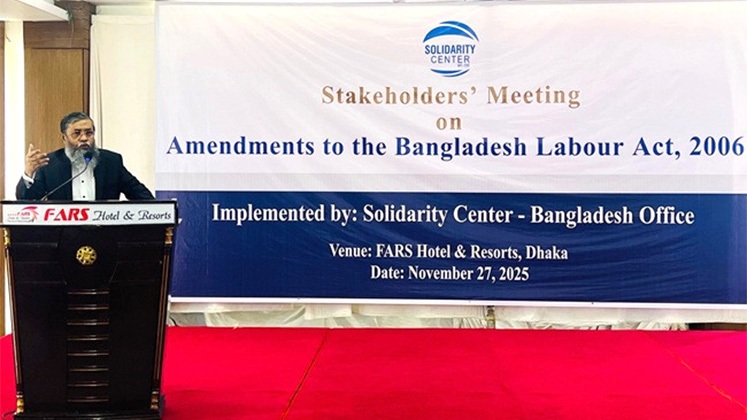
A high-level stakeholder consultation in Dhaka brought renewed scrutiny to the recently passed draft amendments to the Bangladesh Labour Act 2006, as industry leaders, worker representatives, rights groups and legislators convened to assess their implications for the country’s export-driven manufacturing sector. The dialogue, organised by the Solidarity Center, centred on how Bangladesh can strengthen worker protections without undermining the competitiveness of its readymade garment (RMG) industry amid rising global compliance demands.
BKMEA President Muhammad Hatem said Bangladesh must “strike a careful balance between worker welfare and industrial sustainability,” acknowledging government efforts to reinforce labour rights while warning that long-term sector resilience must not be compromised.
He stressed that clearer definitions of ‘worker’, updated trade union regulations and a more practical provident fund framework remain critical for ensuring a fair and efficient labour governance system. These areas, he noted, must be aligned with the operational realities of Bangladesh’s manufacturing environment as international buyers impose stricter conditions on transparency and supply chain due diligence.
On wage policy, Hatem cautioned that abrupt cost increases could overwhelm factories already grappling with high energy prices, inflation and shrinking global orders. He reiterated that most small and medium-sized units cannot absorb an 80% wage hike, advocating instead for an annual, inflation-linked salary adjustment mechanism to maintain stability for both employers and workers.
Experts, rights advocates, Labour Reform Commission members, employer bodies and government officials offered diverse perspectives during the consultation. Participants underscored the need for clearer implementation guidelines, stronger oversight capacity and improved dispute-resolution processes to ensure the amended law can be effectively enforced.
Stakeholders agreed that constructive cooperation among workers, employers and regulators will be crucial as Bangladesh prepares to meet emerging international due diligence standards. The consultation concluded with consensus that a balanced, transparent and forward-looking labour law is essential for safeguarding worker rights while sustaining industrial growth.





 Bharat Tex Special Report 2026