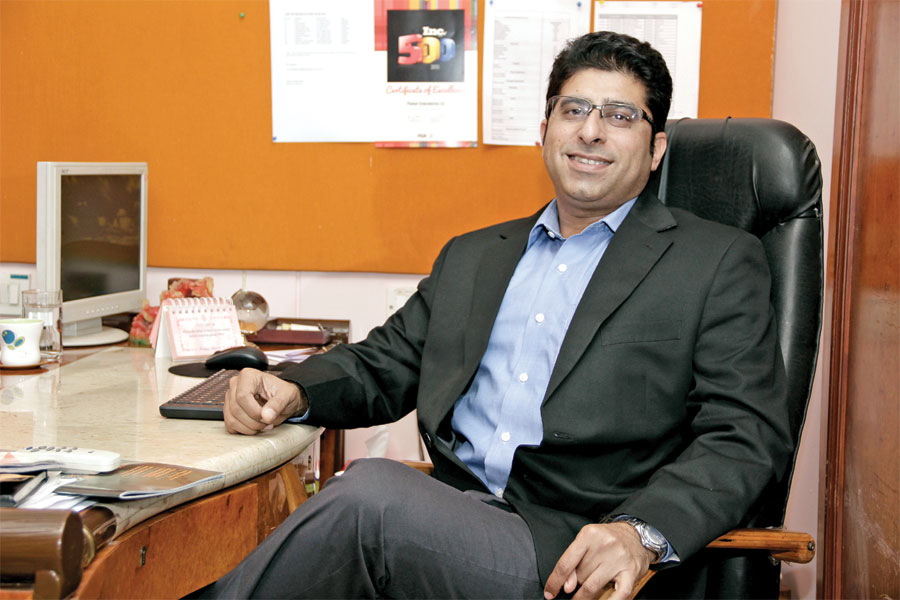
Mumbai-based embroidered fabrics, lace manufacturer and yarn major Pioneer Embroideries has established an impeccable reputation and carved its niche in the market for over a decade now. Also, the owners of a retail brand ‘Hakoba’, the company focuses on quality, creativity and innovation through a highly motivated team which drives the company’s success. Speaking exclusively to AO, Harsh Bassi, MD, Pioneer Group, shares strategies for both domestic and international markets and what sets the company apart from its competition.
Though the company’s share of domestic and exports business is 60:40, but the company focuses on the importance of service for both these markets. With clients in North America, Latin America, Europe, Middle East and Africa, an exceptional service gives further boost to the company’s reputation and success. “We speak the customer’s language. We are into wholesale, retail, jobwork and direct exports. So we have been working with people in New York as also in the by-lanes of Sadar Bazaar, Chandni Chowk, Kalbadevi, Anna Nagar and other similar pockets across the country. Market scenarios change, but as long as you’re giving the customer a good service, they always come back to you for more,” claims Harsh. The company believes in quick reaction time to inquiries and is open to criticism and accepting mistakes. “One part of our business is embroideries where mistakes can happen; after all it is not mechanical. One of the important things that we have taught our team is to be open to accepting faults,” adds Harsh. Besides goodwill from responsive service, the company is also gaining from the China market, which is moving to high-value goods and lowering its business in the textile segment.
Being one of India’s largest manufacturers and exporters of embroidered fabrics and laces, and Torchon/Bobbin laces, the company ventured into the polyester yarn business in 2007-2008, which now has grown to become two-third of the company’s business. The company manufactures 10,500 tonnes of dope dyed polyester yarn at its factory in Himachal Pradesh. Initially, the company started with basic yarns but realized that a differentiator was necessary to compete in the market, which is when the company started offering options of 500 colours. Additionally, the company does speciality yarns such as flame retardants, antimicrobial, air textured yarns for carpet manufacturing, upholstery, tapestry, etc. The company’s brand Silkolite is a replacement yarn for silk and is a 100 per cent polyester yarn with a look, feel and lustre of silk. “The demand for polyester yarn has been increasing in the last few years, especially for companies like us who supply to niche segments like carpet manufacturers, home furnishings, fabric manufacturing and even small weavers,” asserts Harsh.
The company’s design-driven business is given a boost through an in-house highly-inspired product development team, who are continuously working towards new designs to match the latest trend across the globe as also specifications of existing and new customers. In its quest for innovative concepts, the company today has 3,00,000 designs in its library to select from. “Though we are already spending a lot of time and investment in R&D, but we would like to do much more. We have the capability of nurturing a design house within ourselves, but we need to put in more efforts. We haven’t explored it to the optimal level, which I would love to do and is a target for this year,” shares Harsh. Though the export market is buyer-driven and there is less scope for innovation, but for the domestic market, the company offers its own designs.
“Every factory or organization has few unsung heroes who play a very important role, but their names might not come up, though we know them internally! A fitting example is of a machine, which is only productive when it’s oiled well… that brings our oil man into focus, who is incidentally the junior-most staff of the company. Let him not be around for 4 days and then we can see what happens to the state-of-the-art machines. One needs to recognize these efforts.” – Harsh Bassi, MD, Pioneer Embroideries Limited
Over the years, the company has faced challenges of pricing, when compared to players in the unorganized sector and new entrants, but still the company has successfully maintained its strong hold over the market. “After so many years, we are still going strong so we must be doing something right to maintain it,” reasons Harsh. Though the company has been outsourcing some of its requirements for a long time but they maintain their quality standards by choosing right vendor partners. Also, with a balanced business including wholesale, retail and domestic, the company manages to ride profits. “For instance, if one market does not run then the other market will balance it out. When Indian local market was down we discovered Bangladesh,” adds Harsh. With a turnover of Rs. 274 crore (US $ 44 million) last year and the international business making 15-20 per cent of this turnover, Pioneer is well-placed for future growth. State-of-the-art facilities with modern machines in numerous locations – Mumbai, Sarigam, Naroli and Coimbatore further aids the company in promptly fulfilling orders for both domestic and export markets. The company also runs a specialized embroidery, design and development centre in Gurgaon, which also houses a showroom.
Giving the business, the much needed support is a strong team, who are self-motivated and passionate about the business. Though as a business, embroidery is generally owner-driven, but we have a wonderful team and supported by defined systems they work with full freedom and decision-making authority, making every factory a profit centre. The company also conducts reviews every month, where one can raise issues and teams’ prioritize tasks on hand. “Most of our senior staff members have been with us for a very long time. The main thing is that we do not differentiate between people working in the organization; this is what sets us apart from others. There is a huge amount of respect. We operate in a very homely environment and the team is our biggest asset,” reveals Harsh.
Going forward the company is looking to expand its yarn business, increase capacities and enter new markets. As for embroideries, the company is going to focus on innovation aimed at both the domestic and export markets and is also looking at more outsourcing to cater to the growing demand. “We need to further strengthen all our existent systems – the processes, innovation, all needs to be jacked-up. We also have to focus on how to increase our offerings to the market. The strategy going forward will be to strengthen our operations and explore ways to increase market share,” concludes Harsh.