Going back, Tahsin recalls his journey that started with N.G. Apparels (a local buying house) and then to Jebsen & Jessen as an Assistant Merchandiser in 1997, which culminated with the opening of his own buying house Centro Tex Ltd. in 2006 with just 13 people including the partners. Today, the buying office has grown to the strength of 110 people. “I was the first Bangladeshi to have reached the DGM’s position in 2004 with a profit sharing option in the company Jebsen & Jessen (Triton Textile), but my inner self always prodded me to think what next,” recollects Tahsin who attributes his professional success to Jebsen & Jessen. Initially, the thought to float his own sourcing company never occurred to Tahsin, rather it was a vision shared with one of his business friends Mohsin Faisal who was working with an export house that opened the door to new opportunities. “I asked him (Mohsin Faisal) to invest money in my business and be the silent partner; surprisingly he agreed and another childhood friend (Syed Ahsan Ghani Shimul) also invested money and organized all necessary documentation, that is how we started this company,” Tahsin continued.
Since its commencement, Centro Tex has had no problems in getting orders as they had focused on the Danish market through customers like Signal and H2O. Later, buyers such as Bilka, Foetex, (AP Moller Group), Kik and New Yorker along with Australian buyers like Kmart Australia and Target Australia, came on board. Besides these buyers, Centro Tex is also making its sourcing services available to Peek & Cloppenburg (Germany), BHS (UK) and a few other leading UK retailers. Currently, the company has five partners – Tahsin Khan, Mohsin Faisal, Syed Ahsan Ghani Shimul, Amir Hossain and Masiur Rahman Khan, all of whom have well demarcated responsibilities resulting in high quality customer service and increasing number of clients.

With the help of a strong management system, the company has also shown steady growth and many leading buyers, even some who already have a liaison office in Bangladesh are working or looking to work with Centro Tex. “We are sourcing for Lidl through an importing company called Multiline, a German company which has huge operations in Bangladesh with 50 plus workforce but still they have appointed us as an agent,” informs Tahsin. Two other companies regardless of having their own office in Bangladesh are in process of signing a contract with Centro Tex as its sourcing agency.
It comes as a surprise that a liaison office is obtaining services of a sourcing agency despite having its presence in the country, but Tahsin asserts, “A liaison office with US $ 50 million turnover is a decent size company but how many QCs can they hire… five, six, seven or eight? How many factories can they source from and manage? Is it humanly possible for a liaison office to follow up production at every stage and make sure the unit is not using any sub-contracting facilities and at the same time performing quality check of its production?” Therefore, working on 3 to 5 per cent commission, the sourcing agencies are actually cost-effective for the retailers despite having their own liaison office in the respective countries. “These direct offices give us the target price; if a T-shirt costs US $ 2, and if we procure it for the same price or less, it’s not their problem as they will buy it at their target price only,” points out Tahsin who believes in providing the best quality products on time.
Meanwhile, the company has also put additional focus on the issues of compliance which has always been a concern in Bangladesh through its own compliance team that comprises of six people including a Compliance Manager, who is also an SA 8000 certified auditor. “Besides social audits we have also signed agreements with two civil engineering companies who inspect the buildings and check for any structural damages and if found OK then only certify them,” Tahsin elaborates.
Additionally, the company is also equipped with its own testing lab, which helps them provide solutions and services to its buyers on turnkey basis. Irrespective of the fact that buyers go for third party quality audits Centro Tex checks samples at its lab at pre-cutting stage to avoid rejection by the buyers at the later stages. “In a usual scenario Pre-Production (PP) samples are approved by the buyer and the garment manufacturer is allowed to start the production. We have introduced one more sample check in-between, which we call the Pre Cutting Approval Sample and it has to adhere to all the changes indicated by the buyers. It not only ensures that all the changes have been done but also helps us to check various tricky things which usually the buyers miss out at times,” explains Tahsin. Giving an example of a white T-shirt which has a patch, tape or embroidery in red with a high possibility of the red colour to bleed, spoiling the T-shirt. “It is better to check the possibility at the preproduction stage because once the shipment has gone, the buyers may reject the entire order, and at that time neither we can do anything nor can the manufacturer,” argues Tahsin.

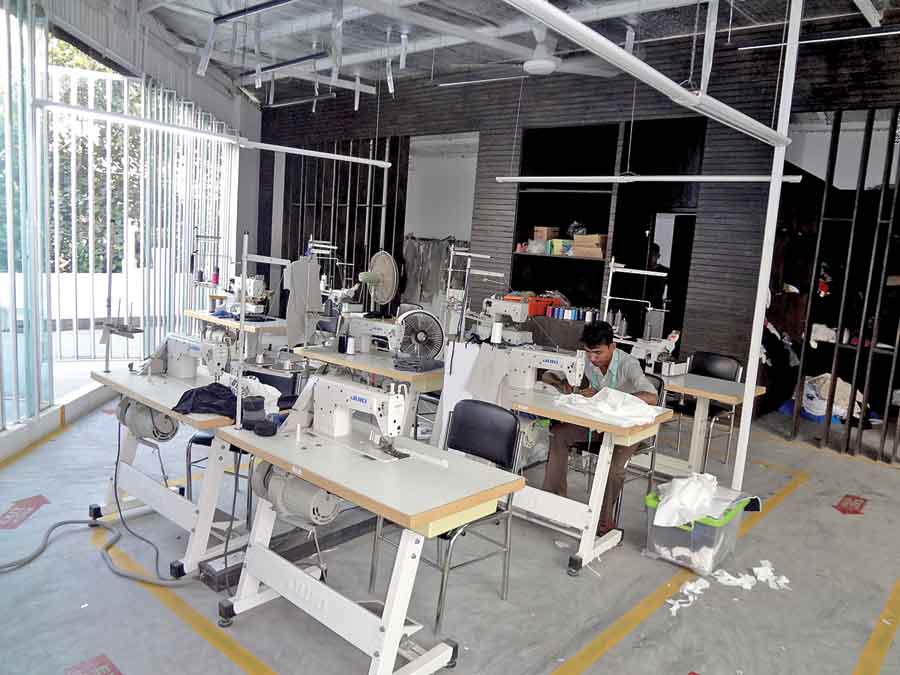
Today the company not only provides value additions but also has a comprehensive studio which keeps innovating new sample designs for its buyers and the company is also on a constant lookout for new markets and is currently looking at Brazil. With the reputation of high quality, reliability and unparalleled customer service Tahsin concludes, “At the end of the day, the buyers want the right quality products, produced from a safe place and at a given target price, and we help them achieve it with all our sincerity.”