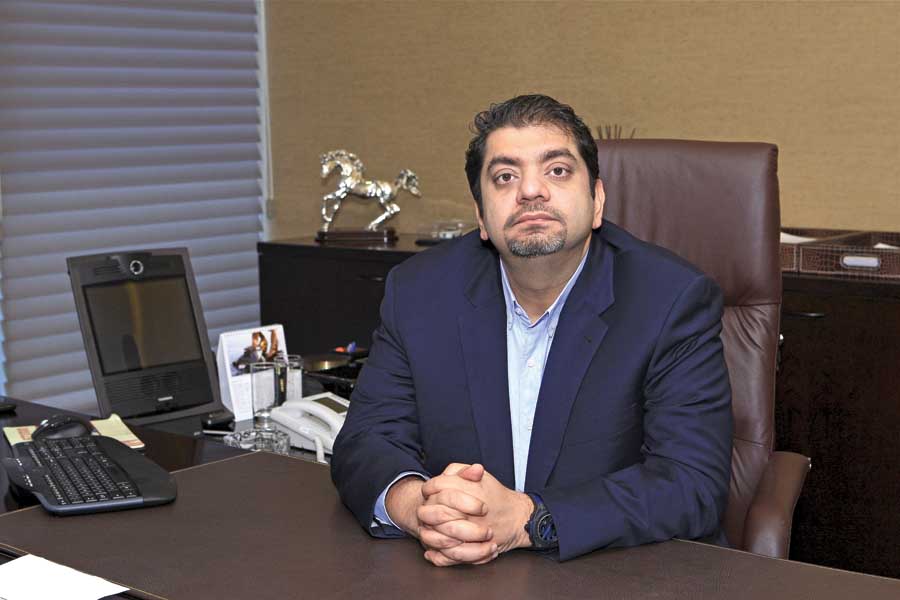
With a major presence in Bangladesh, the Epic Group has 6 units under 3 names, employing over 15,000 people. While the buying business of the Group is worth US $ 100 million, the manufacturing is worth US $ 250-300 million. Led by the dynamic vision of its Chairman Ranjan Mahtani, who is stationed in Hong Kong, going Green for the company was not a marketing gimmick to attract buyers but a self-motivated initiative to reduce waste, save energy and bring down cost of production.
The project to convert an existing 5 years old factory into a Green one was taken up as a challenge and has been treated like a group of initiatives with the ROI being calculated accordingly. “We don’t look at Green in a macro ROI situation, we have always engaged on ‘Green’ as individual projects within the larger goal of Green and we have an ROI individually based for each initiative. At the end of the day, the initial investments are not going to gain anything because you are trying to repay that investment, but after 3 years it should show a minimum 50% saving that is the aim,” he adds.
[bleft]“A lot of people go for Green so that they can put that in their portfolio to show to their customers, but we wanted to do it in a more practical way so that we can reduce waste, recycle waste and moreover if we can save energy it’s our saving and more importantly it is creating a clean environment which is very important for an industry like ours. Green for us is not a special requirement it’s an integral part of running an industry successfully.” – Ranjan Mahtani[/bleft]
As expected, buyers have appreciated the initiatives, but not only from the standpoint of cost saving which helps them, but more importantly for their concern for environment. However, Mahtani denies that this appreciation translates into better FOBs. “It’s like saying if my quality is good I am going to be paid extra… some things are taken as given, like on-time delivery and quality, and Green is fast becoming another thing which is ‘given’,” he says. Today Green for the Epic Group is a way of life, and how to setup tools for a sustainable environment is the mission.
The Group is now looking forward to its new unit coming up on one million sq. feet of land on the outskirts of Dhaka, next to their joint venture denim mill. “The idea is to go vertical in denim and doing really up-market jeans, offering our customer 45-60 days turnaround time on better jeans,” informs Mahtani. The manufacturing plant being built with a total investment of US $ 50 million will be broken into phases of US $ 5-10 million each. “The foundation is already done, and we expect the first unit to be active by third quarter of the next year. We are also in the reorganization and consolidation stage now so we have one unit coming up every 9-10 months,” he adds.
[bleft]Using a heat recovery boiler, which cost US $ 87,000 saves up to US $ 99,000 annually, as channelizing exhaust let out from gensets to run the boiler saves on diesel cost, while also reducing heat/fumes released in the environment.
A company can save up to US $ 10,000 and three tonnes of water annually, if it is saving one ‘blow down’ in every two days in the management of its boilers.
Wastages can be reduced by using cartons made from recycled paper or reusing the cartons wherever possible. [/bleft]
Mahtani believes that as the setup grows it becomes easier to run them. “Everything is an evolution and today we handle over 4 million garments per month, much easier than what we did 5 years ago, though we are handling 2 million pieces more. We have SOPs which have been documented for every department in our company, so every time we put up a new factory, the managers just use the already identified SOPs and implements the same in the new factory making the process easier. Creating the process for the first time is difficult and we feel that it’s only going to be easier to do lot more in the next 2-3 years to come, as we now have the systems in place” he reasons.
With a clear vision to continue growing, taking along its workers, associates and buyers, the Epic Group is very bullish on Bangladesh. “If the country can sort out their infrastructure issues and with the right impetus for labour, this is the ultimate manufacturing hub in Asia because there is no other country which is only ‘garment’ with such a huge labour force,” reasons Mahtani. He adds that in the coming years Bangladesh will double their product portfolios, adding on specializations like lingerie and suits which will encourage a lot of foreign investment. “The biggest fear that Bangladesh has is Bangladesh itself. The local textiles is just 3% of total garment consumption in the country, so investments in textiles has to come in so as to become more price-competitive in garment manufacturing and are able to offer better lead times.





 Bharat Tex Special Report 2026