Collective negligence, collective responsibility, collective efforts and responsible society are the root causes and best possible solutions for the increasing violence and worker unrest in Gurgaon-based garment export houses. It is an established fact that buyers are under price pressure due to market forces and are passing this pressure on to vendors; factory management tries to pass this pressure on to the workers and asks for more productivity and less holidays. Migratory workers, away from their families and living in deplorable conditions, too have pressures and are not having a proper platform to raise their issues and concerns; rumours spread by outsiders/ unsocial elements act as a trigger for worker’s pent-up frustration, resulting in violent incidents. Labour department, trade unions, NGOs as usual ask for more rights, salaries, social security for workers, without even attempting to get to the root of the problem. The only satisfying fact as of now is that despite continuous incidents, there is no impact on business and order flow, yet!
In the last half a decade or so, 7 major labour-ignited incidences of violence have erupted at Gurgaon-based garment export houses. Out of these, 3 happened in the last one year, and the most ironic fact of these incidences is that they happened at the bigger factories which are fully compliant, even more organized than the hundreds of smaller units in the vicinity. Also worth noting is the fact that the modus operandi in all the cases is similar, which result in heavy losses, not only for the factories but also for other staff members whose vehicles are damaged or burnt. It is also difficult to apprehend why these incidences are happening in Gurgaon when the migratory nature of workers, overall working conditions and systems are same in the entire Delhi-NCR belt. In fact, Gurgaon has a much higher wage rate compared to Noida, being officially under the administration of the Haryana Government.
Though, there are many voices that clamour to be heard, Virender Uppal, Chairman, AEPC, whose own factory Richa Exports was a victim of labour violence recently, had an interesting perspective to share. “In Gurgaon, things got spoiled after the Maruti incident and extensive unrest in the automobile sector, setting a bad example to the workers on how to vent their anger. Involvement of outsiders and socially undesirable elements is also one of the big reasons for such incidences in the past few years,” says Uppal. He further shared that the AEPC will soon be organizing a meeting of exporters to find the best possible solution and also try to identify and stop unsocial elements.
Anoop Thatai, Joint MD, Orient Craft, whose Sector 37-based factory is the latest victim of vandalism when workers set about a dozen cars and motorbikes on fire and smashed window panes of four units, is a disappointed man. “We are always sensitive to our workers and take utmost care of their safety, but even a small incident triggered off because the worker did not follow prescribed safety rules. Later this snowballed into a major issue, because the workers were fed with wrong information and provoked to get disruptive. If this continues, it will be difficult to operate in Gurgaon,” said Thatai sadly. He shared that Orient Craft was aggressively scouting for new manufacturing locations, and after Rajasthan, where they already have a factory complex; Bihar and Madhya Pradesh are the probable destinations.
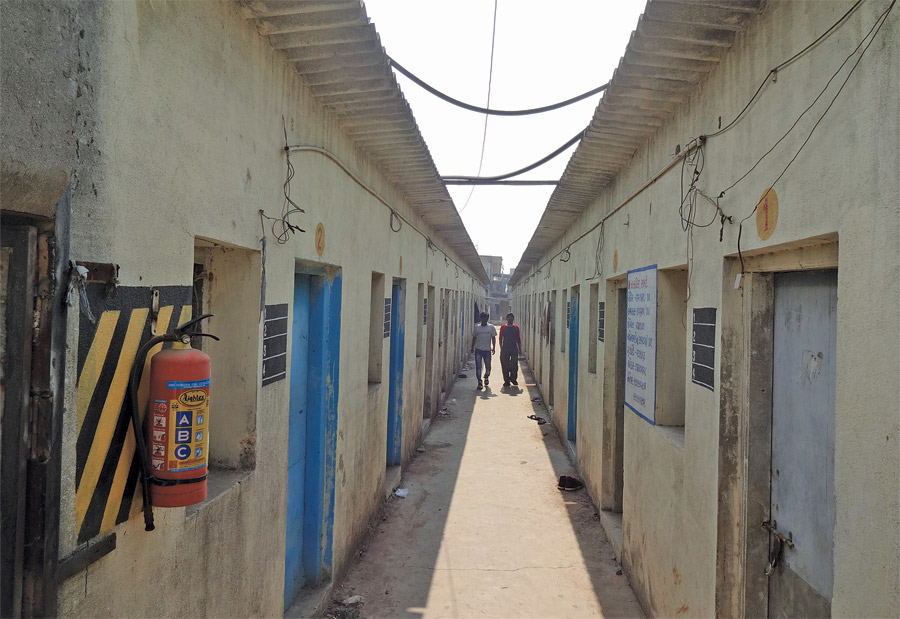
Apart from pressure of work in factories, one can understand conditions of the migrant workers who are forced by their landlords to buy everyday provisions from the shops run by them only and where grocery items are sold at inflated prices. Threat of being evicted remains on them always, leading to their frustration on slightest of pretext or provocation.
Responding to the query as to why these incidences are happening in the bigger factories, a medium sized garment exporter having a strong understanding of DelhiNCR factories and also factories in Gurgaon, adds on the condition of anonymity, “Workers are under great strain at the big factories where these things happen because there is immense pressure for more output and lesser holidays compared to other factories. This pressure provokes the workers to react on rumours and turn violent.” No doubt, workers are under stress – the impact of inflation, the desire to earn more and to save more for their families back home is compelling; besides even their landlords force them to buy grocery at their selfowned shops and there are very few options to live in accommodations provided by companies. All these factors are a potent combination for disaster!
One of the most common reasons for the initial panic is rumours of workers being electrocuted. Be it Orient Craft (20th June, 2015 and 28th March 2014) or Modelama Exports (January 2011) the rumours led to major loss of property and work time. The question that the NGOs and other social organizations are asking is why electrical wirings and potential areas for sparking are not a priority in safety measures, even though the factories are audited by various big buyers. Talking to number of companies, the basic justifications for repeated cases of electrocution are many, but the most common two cited by most are – Lack of basic safety precautions by workers, despite warnings, and the culture for juggad, where workers prefer to manage by themselves rather than take help – are mainly responsible for such incidences. “Migrant workers across all factories lack a sense of ownership and responsibility, they also are generally unresponsive to new ideas and have the nature of ye mera kam nahi hai (this is not my job). Even if management tries to involve workers, till they open up to accept ownership, things can’t be changed or improved completely,” commented an exporter on promise of anonymity.
“Till now there is no real impact of such heinous incidents on business as well as mind set of other factory workers in Gurgaon. Full presence of workers is observed right from the next day after such incidents not only in that particular area, but also in the other similar factories accompanied by normalcy in the entire area, so that such things don’t have longterm impact.” – Pritam Goel, MD, Lyra Industrials having factory in Udyog Vihar, Gurgaon
However, absolving the management from responsibility is also not fair. RC Bidhan, HCS, Additional Labour Commissioner/Additional Chief Inspector of Factories, Gurgaon says, “Training for safety measures is not as much and as frequently as it is required, especially with contractual workers, which is a major chunk of the workforce in Gurgaon. We have asked factories to focus more on induction training. Simultaneously, there is strong need to increase tuning with workers from the management side to decrease the distrust level; we have suggested garment exporters that at least once in six months they should have some get-together with workers.” The Labour Department has constituted a team to study about various aspect of such scenario including pressure on workers and influence of outside elements in factories. Exporters too need to introspect whether they are taking all necessary action for proper wiring in every corner and also if proper earthing systems are in place in their factories.
Increased focus of NGOs in Gurgaon is also counted as one of the reasons for increasing incidents, and while NGOs continue to put the blame on factories, factory owner feel that instead of working to find a solution, these NGOs only stroke discontent. A very recent report by People’s Union for Democratic Rights (PUDR), Delhi focusing on findings of an investigation of the incident of 12th Feb. 2015 at Richa & Co., entitled ‘Tailor Made Lives’ that analyses accidents and discontent among the garment industry workers in Udyog Vihar, Gurgaon stated, “The workers and local activists claim that workers are regularly harassed, beaten, not paid adequately and verbally abused by the company management and the bouncerturned-guards. It is quite common for the worker to be attacked by a pair of scissors, a handy tool, by the supervisor/management or the labour contractors. Women workers are often subjected to sexual abuse too.” According to PUDR this 20 pages report (available on apparelresources. com) was to understand the larger global context in which the garment industry is functioning today and the consequences of the same for the workers has serious allegations. “Till the export houses don’t have improved working conditions and provide sustainable jobs, how can one expect sense of ownership from workers? They don’t have any platform where they can share their problems and can expect solutions. How many factories have unions or will allow them to form unions,” questions Sharmila Purkayastha, Secretary, PUDR and Faculty, Miranda House. “Workers get more ‘militant’ as space for unionisation shrinks,” adds scroll.in.
A few days ago, Netherlands had extended its support for ensuring a ‘fair and true’ price for Bangladeshi apparels as the country had made a significant progress in transforming the sector that involves huge costs. Indian exporters are also raising questions; price of everything is increasing… Will buyers come forward to pay fairly, or will they reduce the prices further, putting more strain on a system which is already under a lot of pressure… Why is the buyer, who shows concern for compliance, cannot be a party to help implement the same honestly?