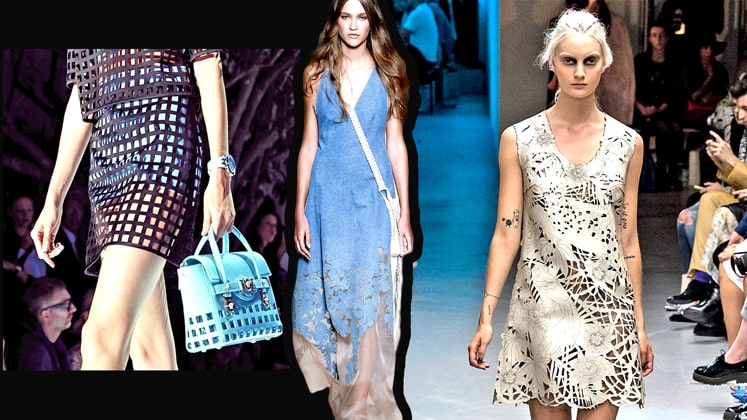
Gone are the days when leather, felt, velvets and rexens were considered winter-centric bases for garments. The deviating conventional thought-processes of designers and exporters are making way for heavier fabrics to move into apparel and home furnishing segments for summer collections as well. Creating trompe l’oile effect of delicate laces, designers and exporters are able to create an unending plethora of intricate detailing on bases like leather, leatherette and PVC. Laser cut technology is not only embracing our wardrobe with its beautiful surface ornamentation but has also become an integral part of designing for the upcoming seasons. Being prevalent in the runways of S/S ’15 RTW, laser cut picked up pace again after the slow fall last season and is working towards becoming a huge surface trend…
Be it garments, bags, shoes or home accessories, laser cut commodities have flooded the high streets and have become a major demand in the retail segment as well. Being prevalent in the runways of S/S ’14, laser cut came across as a technique with a promising future, but it took a backseat and has now come out strongly on the runways of S/S ’15. Sidelining the archetypical georgettes, rayons and poly-blends, unconventional fabrics like denims and suede have entered into the space of laser cutting. “Though the requirement of laser cut in felts and velvets is only at its initial stage but is still a major requirement with the buyers, not only for garments but also for home furnishings, gift items, labels and trims. The market of laser cutting is expanding everyday; and this technology is being combined with several others to achieve a unique effect of its kind,” explains Kunal Sawhney, Director, K. M. Tex, a 12-year-old laser cut service providing company functioning with 12 laser cutting and engraving machines from UK, US and China, have recently purchased a laser cut embroidery bridge machine owing to the rising demand in the industry.
The laser cut trend showed magnificent presence on S/S ’14 runways and was illustrated in countless possibilities, but the runways of S/S ’15 witnessed a completely different interpretation of designs and patterns. Alberta Ferretti presented an amalgamation of laser cut and layering on organza with denim. Giles combined felts and leather in matt with glossy finish and adorned them with floral laser cut panelling. On the other hand, Giorgio Armani experimented with velvet cut in shapes of flat chamfer boxes and joined together on the sides. Guy Laroche panelled the front solid strips of leatherette with laser cut panels on the sides. The reminiscent of the major hit from last season, 3-D flowers and textures could be easily traced in this season as well. Laser cut lace patterns were presented by Valentino, especially noting the specific mishmash of abstracted patterns with meticulous lace. The combination of engraving and laser cut was also seen in full force, as noticed in the collections by Kenzo and Honor. Catching attention for the first time, Proenza Schouler experimented with laser cut in argyle pattern over knits.
Corroborating with the runway trend, the industry is also showing inclination towards working with laser cut technology on a larger extent. Because of the direct beam used and the speed involved in cutting, the chance of contamination of the cut is very less, leading to subsequently producing high-quality work, owing to which exporters have opened up to the idea of using knits for laser cutting as well. With consumers becoming appreciative of these techniques, companies are adopting new problem-solving and economical technologies to manufacture these garments and trims. Companies like Mazak Optonics Corporations, have launched SUPER TURBO-X laser cutting system, which is the ideal solution for application, where material automation is a consideration. It features a proprietary vibration dampening frame and integrated laser resonator that ensure stable, high-accuracy cutting. The constant beam length construction provides uniform cutting performance across the machine table. This can be used to cut knits with great finesse.
 With use of heavier fabrics on an increase, laser cutting in layers requires high precision and clean output. Georgettes on felts or felt cut-outs on velvets, experimentation in fabric bases is paving a way for laser cut machine manufacturers to launch machineries solving the needs of the market. “Laser cutting machines are definitely the next big thing and these machines being fully automatic, involve less labour, which is an added benefit. “During 18 months in India, we have sold about 150 machines for various laser cut applications in textile and garments. Our MARS series X/Y plotter type cutting machines are able to achieve all sorts of intricate and complex designs,” informs B K Thakur, Sales Head, Golden Laser India Pvt. Ltd. Established in the year 2013, the company is a joint venture with Wuhan Golden Laser Co. in China, manufacturers and suppliers of laser cutting, engraving, marking and punching machines.
Doing out-and-out promotion of bridge laser embroidery machines and high-speed flying engraving machines for fabrics has made Golden Laser one of the most prominent names in the laser cutting industry. Hari Om Laser provides laser cutting and engraving service for textile, garments, wood, acrylic, rexin and other non-metal materials and caters to exporters like Gaurav International Gurgaon, Shri Bharat International Noida, Ambika Overseas Gurgaon, Verbs International Kolkata and Faye Bangalore. Jitendra Kumar, Director, Hari Om Laser, discussing about the sudden demand of laser cut in denims, felts and leather says, “We get bulk orders for laser cut designs, and now we can see a noticeable shift from light-weight poly blends, which we used to cut flowers from, to denims, velvets, suedes and leathers. The design is not concentrating only upon intricate laser cut structures but it is a play of engraving and laser cutting techniques together to create 3-D effect on a 2-D base.”
Laser cut might seem to be a seasonal fabric decoration trend, but its strong foothold in the fashion industry never let it fade away completely. Going through innumerable changes and renewals, laser cut always comes back with a bang and proves itself to be a technique staple which can be carried out in all varieties of fabrics!
Exporters like JJ Expo Impo, who believes in experimenting in their collections every season, have incorporated laser cut panels in different ways. “We use almost all kinds of embroideries incorporating fabric manipulations in all our collections. And as witnessed on the S/S ’15 runways, laser cut on knits, denims, felts and leather were gathering all the attention. Therefore taking care of our price points and buyers’ requirements, we picked up laser cut on leather and rexens, and have been patching them with other laser cut detailing,” says – Goonjan Kumar, Designer, JJ Expo Impo.
Laser cut might seem to be a seasonal fabric decoration trend, but its strong foothold in the fashion industry never let it fade away completely. Going through innumerable changes and renewals, laser cut always comes back with a bang and proves itself to be a technique staple which can be carried out in all varieties of fabrics!