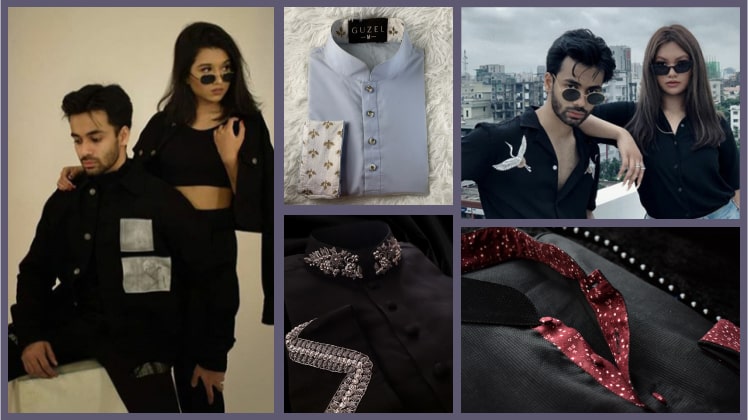
The Bangladesh apparel market is awakening to a new era of homegrown fashion with multiple promising new designers and labels dawning on the horizon. What was once considered to be amongst the top manufacturing hubs of the world is slowly shedding of fits limiting tag by expanding into new dimensions and nurturing fashion design talent within the country.
It is not routine that one comes across a story that is as inspiring as home-grown fashion label Guzel, founded by Nafiz Imtiaz Chowdhury. Incepted with a vision to set a standard in modern fashion, Guzel aims to provide distinctive made-to-measure services as well as an exclusive collection of ready-to-wear fashion for both men and women. Evocative of class and contemporariness, Guzel’s designs guarantee complete individuality and freedom of expression that emit Bangladesh’s rich culture with an avant-garde twist within each and every stitch.
Raised by a single mother who has been in the clothing business for years, embarking into the fashion and retail world was more of a passion than a business idea for Nafiz. Growing up, he spent most of his time painting and loved experimenting with different colours.
“Interestingly, pursuing fashion was never my first career choice, but it has always existed somewhere in the back of my mind,” Nafiz said, adding, “It may not be the ideal career path in the eyes of many, especially in a country like Bangladesh, where people opt for more promising and safer careers like medicine and engineering; however, very earlier on into my college years, I realised that nothing other than the fashion business interested me.”
Also Read: Keeping the hopes high amidst COVID-19: Yash Dongre
Nafiz’s childhood environment geared him for his big entry into the world of fashion. Surrounded by a family who has been in the garments business for over 10 years, Nafiz grew up observing how things work in this area and learnt the basics of the business from a young age.
After graduation, Nafiz approached his mother seeking investment to start off his business – a step that left his mother shocked and astounded given that an 18-year-old boy wanted investment for a start-up whilst his friends were going for higher education abroad.
However unconventional, Nafiz was extremely confident about his plan since he wanted to follow his dream and pursue what he loved doing. Online training classes under Marc Jacobs and Diane Von Furstenberg coupled with his on-the-job learning primed Nafiz to start his own label.
“As clichéd as it may sound, I’ve been designing my own punjabis since the age of 13 and with Eid being so close, I just knew that this is what I wanted to do,” Nafiz said, stating, “The first day of fabric sourcing took me 9 hours and not once did it feel unfamiliar out on the field! My first exhibition took place in May 2018 and I returned home with three times the investment my mother had put in. And just like that, we knew I had made the right decision.”
Target Market

Guzel targets both men and women, aged between 16 and 70 years, who tend to embody confident style. These are people who browse through luxury brands online at least 4 hours a week. They can distinguish between quality and design when they see it and spend more on an individual piece rather than hoarding their wardrobes with fast fashion pieces. At the same time, these consumers do not want to break the bank. They have the creative imagination to alter their designs in order to add a touch of their own personality to it.
“As a label, Guzel aims to provide a highly personalised service that we believe shapes a more memorable experience for our customers. For us, each customer is unique, and we curate keeping in mind their choices and demands on an individual level,” Nafiz corroborated, saying, “Our designs are not only gender-neutral but also neutral with regard to age, owing to our meticulous selection of colour and designs.”
Also Read: Torqadorn by Tanvi Sethi: The prêt-à-couture push redefining power dressing in India
Product assortment and pricing
Best known for its men’s ethnicwear which comprises kurtas, Nehru jackets, sherwanis, etc., Guzel is priced at Taka 4,000 to 8,000 for its kurtas; Taka 6,000 to 15,000 for its Nehru jackets; Taka 2,000 to 8,000 for its unisex shirts; and between Taka 6,000 and 50,000 for its designer jackets. Guzel sherwanis, which are mostly made-to-measure/bespoke pieces, range from Taka 20,000 to 1,00,000, depending upon the intricacy of embroideries and fabric used.
No doubt that ready-to-wear is an easier and more accessible option for customers in the market; however, made-to-measure/bespoke pieces allow customers to get exactly what they have in mind. This service is targeted towards consumers who are more conscious about their styling and fit.
Assortment Calendar And Product Planning
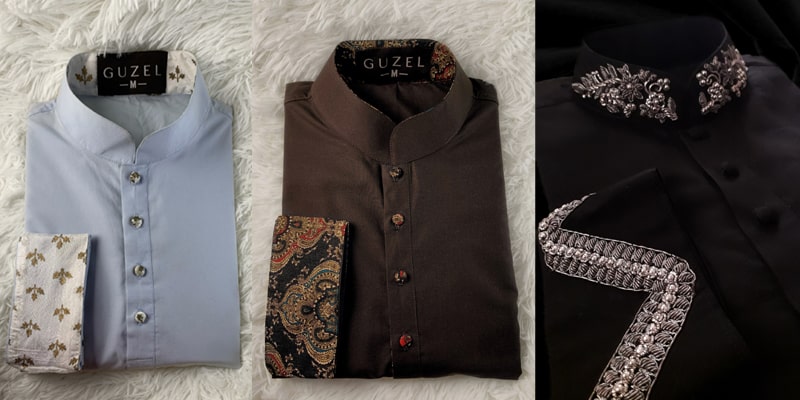
The number of styles within a product category varies. On an average, Guzel introduces anywhere around 10 to 15 styles in men’s kurtas, 3 to 5 styles for Nehru jackets, and around 3 to 6 styles for unisex shirts and designer jackets per drop.
The label works on a model of five collections per year which include three festive collections for men’s ethnicwear for three different occasions, namely: Boishakh (Bengali New Year), followed by Eid which occurs twice a year. Apart from these, a separate collection each for the Spring/Summer and Winter seasons are created – these drops focus more on modern looks rather than traditional styles. “We make very limited pieces per collection since we don’t want our customers running into each other wearing the same outfits. We also do not replenish a collection but rather work towards the next season/collection, keeping the designs up-to-date,” Nafiz explained.
Techniques and details
Techniques include pleating, knotting, zardozi, embroidered motifs and patches, as well as eclectic prints. These are the USPs of Guzel’s designs. Known to amalgamate tradition with modernity, Nafiz employs techniques that date way back, by giving them a contemporary spin to appease the audience of today. “Craftsmanship is something we do not compromise on. Because every piece needs to be exactly the same, we employ highly skilled workers that specialise in one particular technique,” Nafiz stated.
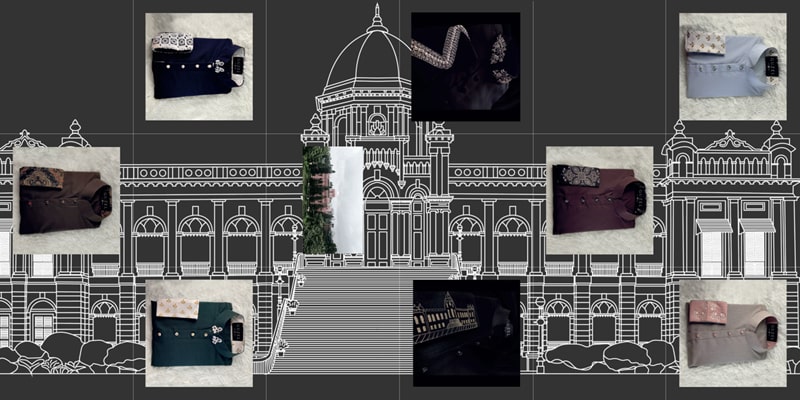
“The whole idea is to keep up with the ever evolving fashion trends. I love pushing the boundaries and creating designs that people haven’t thought of yet. I admire ancient architecture the same way I do modern fashion, and I try to blend the two in my designs. Moreover, the culture, tradition and history of my country inspire my designs in many ways.”
Manufacturing and sourcing
In a manufacturing hub like Dhaka, it can be extremely challenging to find the right people to make clothes with so many skilled craftsmen to choose from. It took a while before Nafiz finally found adequately skilled kaarigars who understood Guzel’s techniques, and since 2019, all of Guzel’s apparel is manufactured entirely in-house, right from the prints and embroidery to sewing and tailoring.
“Dhaka is a place where most people working in the fashion and apparel industry know each other. If you do not have everything in-house, it is very likely that some brands/designers will be making the same thing as yours and ensuring a similar quality,” Nafiz said, adding, “It is, therefore, extremely prudent to oversee your entire production process on an individual level in order to succeed.”
Commenting on his favourite go-to hubs for sourcing fabric and raw materials for Guzel, Nafiz said, “I absolutely love hand-picking fabrics from the streets of Islampur, known for its fine kurta fabrics. Chadni Chawkh Market is also very famous for their rich fabric collection along with some streets in Mirpur. The feeling of shopping from these places is surreal.”
In Nafiz’s opinion, Islampur definitely performs better than Chadni Chawkh Market in terms of the base fabrics whilst the latter is more ideal for prints, silk, lace, embroidered fabrics, etc. In addition to these, Guzel works with two-three factories that provide exclusive base fabrics for the label.
Bestselling pieces and trendsto look out for
Guzel’s bestselling pieces boast of its kurtas, and if we go into details, its customers have a tendency to sway towards the colour black. Usually, this time of the year is the busiest with the two Eids just around the corner. The wedding season immediately follows wherein consumers particularly look forward to Guzel’s kurta and Nehru jacket designs. In the case of womenswear, the bestselling pieces include Guzel’s denim jackets from the 2019 winter collection.
According to Nafiz, trends from the ’70s have already made a comeback on the fashion scene and are something that is only going to further flourish in the time to come. “For men, monochromatic as well as unstructured suits will also be seen in the future, or at least I hope they will (chuckles)! For women, puffed sleeves and embellished pants are currently trending and I don’t see them fading away anytime soon. Neons and tie and dye prints will also continue making a statement.”
The impact of COVID-19 on fashion
COVID-19 has affected the fashion industry on the same level as it has affected other industries the world over. Given the growth trajectory, 2020 looked like a very promising year for the industry, but the unprecedented crisis raises the question – whether one should change the way they consume fashion. Nafiz believes that the pandemic has given fashion designers an opportunity to revive their passion and create new designs with an open mind during this period of quarantine. “I anticipate a change in the way people dress which will surely depend on what designers come up with. The future of fashion is very confusing as of now, since brands are planning to slow down production and are scheduling new releases only post COVID-19. There are very slim chances that consumers will shop from physical stores, but would rather continue to depend on online stores even after the crisis ends. However, with the right changes in business acumen during this phase, we can expect positive outcomes in the long run,” Nafiz said.
Available for purchase via its own e-commerce and social media platform on Instagram (@guzel_bd), Guzel has also recently partnered with Grand Boulevard Events for retailing its products.
This fresh and upcoming homegrown fashion label is receiving much love and attention from its customers which is propelling Nafiz’s steady expansion plans forward. This past Eid, Guzel’s 2-day Eid exhibition had customers lining up outside the venue even before their team reached there and the collection got sold out within 2 hours on the first day itself! A huge pat on the back, Guzel is a heart-warming story of a mother and a son working passionately towards their dream and creating some worthwhile fashion in the process.
Also Read: How RISE is amalgamating streetwear fashion with traditional styling