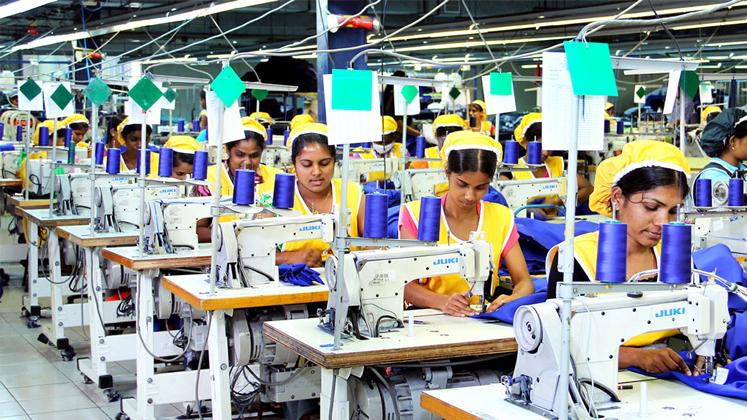
After battling the pandemic fallouts at home (lockdowns, factory closures and Covid restrictions) and at export destinations (store closures and dwindling demand for apparels on account of the pandemic) for long, Bangladesh is making a strong comeback in terms of exports at last.
Bangladesh’s exports in the month of September fetched US $ 4.16 billion, the highest single-month receipts, riding on a spectacular performance by the apparel sector even as the monthly highest earnings earlier were recorded in July 2020 with exports worth US $ 3.91 billion.
The export earnings in September of the current financial year of 2021-22 grew by 38 per cent or US $ 1.14 billion year-on-year from US $ 3.01 billion in the same month of the past fiscal year, as per the data of the Export Promotion Bureau (EPB), which maintained apparel exports in September 2021 increased by 41.66 per cent or more than US $ 1 billion to US $ 3.42 billion from US $ 2.41 billion in the same month of 2020 even as exports earnings in July-September of FY ’22 increased by 11.37 per cent to US $ 11.02 billion from what was US $ 9.89 billion in the same period of FY ’21.
“Export earnings from RMG grew by more than US $ 1 billion in September as both the unit prices of products and the export orders increased in recent times,” claimed Bangladesh Garment Manufacturers and Exporters Association (BGMEA) President Faruque Hassan even as exporters maintained improving pandemic conditions in the export strongholds helped boost demand for apparel products while closure of factories in competing countries due to the pandemic was also an advantage for Bangladesh to gain more export share in the global market.
Also, to be taken into account in terms of enhanced export earnings, is increase in prices of raw materials, which pushed the unit prices of readymade garment products while Bangladesh has also been receiving increased number of work orders that reflected on the export data.
Nevertheless, shrugging off the impacts of the pandemic, all major exportable items like knitwear, woven garments, home textiles, have started to perform well even as speaking to the media, President of the Federation of Bangladesh Chambers of Commerce and Industry (FBCCI) Md Jashim Uddin underlined that it was a positive sign for the exporters and also for the country that the export operations are bouncing back.
The chief of the country’s apex trade body opined that the various stimulus packages being provided by the Government to the affected industries and businesses have resulted in a turnaround of the export-oriented sector even as referring to his recent visit to the USA, Jashim said he had witnessed huge demand of goods among the buyers as their stores now lack goods which are being imported from countries like Bangladesh.
It may be mentioned here that Bangladesh’s readymade garment exports to the United States in January-August of 2021 increased by 24.11 per cent or US $ 840 million to US $ 4.32 billion from US $ 3.48 billion in the same period of 2020; although the RMG exports to the US in July grew by 35.2 per cent, the export registered a minimal 5.4 per cent growth in August as the production in factories remained suspended for 10-15 days in Bangladesh in July due to Eid-ul-Azha holidays and Covid restrictions.
The US Department of Commerce’s Office of Textiles and Apparel data showed that in terms of volume, the apparel export to the US from Bangladesh in the first eight months of 2021 grew by 32.76 per cent from that in the same period of 2020.
“Apparel export to the US in the month of August registered a minimal growth due to the factory closures in Bangladesh in July and our shipment data of July was reflected in the US data in August,” BGMEA Vice-President Shahidullah Azim said, while adding the export growth in the US market would increase more in the coming months as buyers were placing an increased number of work orders.
Given the export performance, one would expect that all is now well with the industry. However, far from it, the industry is still plagued by a multitude of issues, all of which have the ability to hamper the overall performance of the sector or even to derail the recovery process.
Rising volume of air shipments overwhelms HSIA …
It may be mentioned here that it’s not been long that the industry have had to deal with container congestions at the transhipment ports — as there is no deep seaport in Bangladesh, mother vessels cannot come to the Chittagong Port and therefore, export and import consignments have to change vessels at transhipment ports in Singapore, Malaysia and Sri Lanka. Besides, exporters, importers had also been hit by this crisis as raw materials (meant for industrial production) got stuck at the ports amidst uncertainties regarding arrival of cargo containers at the Chittagong Port owing to container congestion, and shortage of space on mother vessels and empty containers at transhipment ports — with devastating consequences and partly to avoid which, brands and retailers are now resorting to airlifting consignments to keep their date with the upcoming festival season as the ripple effects (of the container congestion) continue still. Rising volume of air shipments, lack of storage facility and faulty equipment at Dhaka’s Hazrat Shahjalal International Airport (HSIA) have given rise to all new challenges for the apparel exporters as HSIA is failing to accommodate the increased volume of export-bound goods thereby piling up losses on suppliers as they are struggling to ship merchandises on time.
Plus, there are issues with the Explosive Detection System (EDS), which is further complicating things.
Also Read: Promoting the industry through channels that matter!
The issues at HSIA reached such proportions that Adviser to the Prime Minister on Private Industry and Investment Salman F Rahman had to pay a surprise visit to the Dhaka airport to take stock of things personally even as he blamed the authorities over their failure in fixing the damaged EDS — four EDS machines had been malfunctioning at the Hazrat Shahjalal International Airport (HSIA), slowing down the export of goods — used during the export of goods by air.
Expressing his displeasure, Salman F Rahman said major European buyers, especially Inditex Group, C&A and H&M, had complained of not getting their products on time even as domestic traders had also made the same complaints, which is why he had decided to visit the Airport Cargo Village himself.
“We are going to be a middle-income country. Why is the situation here like this? It is a matter of great shame. You [the authorities] will not improve the system and nor will you allow others to do so,” reportedly maintained Salman F Rahman, even as reports suggest four machines at the cargo village had been damaged while two were in operation earlier, but one had been shut for six months, while the other had also started to malfunction while the remaining two machines that had been installed six months ago, were yet to be validated by the company which installed the two.
“I am very disappointed. If the validation is done next October, it will be possible to launch the new machines in the first week of November. And the old machines have to be fit for operation in the next seven days,” underlined Salman F Rahman, adding, “The image of the country is being ruined. The biggest problem in the private sector now is the issue of exports from Dhaka airport.”
If you can’t fix the problems at the airport, there will be no extra business opportunities, he said further even as the BGMEA has urged the Government to take immediate steps to fix the faulty EDS while also calling for increasing the number of scanners to expedite the scanning of export cargoes.
BGMEA President Faruque Hassan made the requests recently in a meeting with Civil Aviation and Tourism Secretary Md. Mokammel Hossain even as Vice-Presidents of BGMEA Shahidullah Azim, Khandoker Rafiqul Islam, Md. Nasir Uddin and Biman Bangladesh Airlines Managing Director Dr Abu Saleh Mostafa Kamal were also present at the same.
High ocean freight charges and declining price points continue to concern!
Meanwhile, reports suggest the increase in shipping charges in view of the container congestion earlier was yet to show signs of getting back to normal even as leaders of the Shippers’ Council of Bangladesh (SCB) maintained that exports were being hampered due to shortage of containers at the ports in the current situation and traders were facing losses due to sudden increase in ocean freight charges of export goods by ship owners while also expressing deep concern over the matter and immediately demanded the concerned authorities to fix the ocean freight charges at a reasonable rate.
The observations were made in the 8th meeting of the Board of Directors of Shippers’ Council of Bangladesh (SCB) recently even as clamour is growing strong for fair pricing from the brands and retailers, in view of the faltering price points, which continues to haunt the garment makers!
The age-old issue of faltering price points seems to have remained unchanged with many in the industry even claiming that buyers were still offering prices that were 10-15 per cent below the pre-pandemic levels even if a very small number of suppliers were getting orders at the previous rates or even higher.
“Selling products at a price lower than the cost of production will not benefit any in the long run rather it will only make the situation more difficult,” underlined Faruque Hassan while adding even as Bangladesh is taking many steps and investing to make the industry and the supply chain sustainable, the price of clothes in the United States fell by 8.04 per cent in one year, while sharing their viewpoints on the condition of anonymity, some industry leaders underlined it was high time to negotiate with buyers for better prices even if they said manufacturers should say no to buyers if they are not willing to pay ethical prices.
Although the foreign brands and buyers are vocal about fair wages of garments workers of Bangladesh, they hardly talk about fair price of readymade garments (RMG), stated representatives of the country’s RMG sector and experts while taking part at a recent seminar, adding that buyers should realise that in order to pay fair wages to workers, they should also pay fair price for the products.
“The buyers who speak about ethical business, we saw their stance during the Covid pandemic, when they cancelled and stayed orders and delayed payments,” maintained Mohammad Hatem, the First Vice-President of Bangladesh Knitwear Manufacturer and Exporters Association (BKMEA).
What is perhaps adding to the manufacturers’ woes further is that garment makers are also forced to deal with rise in the cost of production fuelled by hikes in yarn prices and freight charges in the wake of a recovery in export even as some entrepreneurs claimed that the cost per unit soared by as much as 30 per cent from that a year ago on the back of significant increase in cotton prices to add to which was increase in the freight charges as well.
Heightened cotton prices take toll!
“The per unit cost of production increased between 20 and 30 per cent depending on the product for different reasons,” claimed the Chairman of Envoy Group, Kutubuddin Ahmed even as reports suggest cotton futures are trading at their highest price in about a decade, which has led the spinners in Bangladesh hinting at sitting with the garment makers’ bodies to work out the new price points of raw materials while also calling the garment exporters to negotiate prices of apparel items with buyers in view of the cotton prices starting to rise again in global markets.
As the global cotton-price index hit a decade-high, its cascading effect would be felt on the entire industrial chain, textile makers warn even as the Bangladesh Textile Mills Association (BTMA) underlined the price spiral of imported cotton could boost the price of locally produced yarns by 15 per cent, and, in turn, it would add up to the prices of exportable readymade garment products and, went on to ask the apparel exporters to take care to negotiate garment prices with the foreign buyers for a raise to make up for the possible production-cost hike and advised the garment exporters to be cautious about pricing at the time of taking fresh orders.
The global cotton index remained below 100 points in August and jumped over the mark at the end of last month and hit 107 points on 1st October; BTMA President Mohammad Ali Khokon said that on 4 October 2012, the cotton index counted 72.65 points.
“The 107-point index is the highest during the last one decade… If the index sustains over 100-point marks, we will have no other choice but to raise the rate by additional 15 per cent,” he said while adding the locally produced yarn prices might be hiked when delivered in November and December, and observed further that local spinners have hardly any control over fixing yarn price as cotton is an international commodity.
“…we need to sit again with the garment exporters as they are the main customers of the locally produced yarn. We need to make them aware of the upward trend of cotton prices in the international futures markets,” he said.
It may be mentioned here that a consensus on the price was reached on 21st August among leaders of the BTMA, BGMEA, Bangladesh Knitwear Manufacturers and Exporters Association (BKMEA) and Bangladesh Terry Towel and Linen Manufacturers and Exporters Association (BTTLMEA) where it was decided that the widely consumed 30 carded yarn will be sold at US $ 4.20 per kilogramme (kg) if the cotton prices ranged between US $ 0.85 and US $ 1 per pound in international markets even if the leaders also decided that if the price of cotton went over US $ 1 per pound, the spinners would be able to bargain a price hike of yarn with the buyers and conversely, if the cotton price went below 85 cents per pound, the buyers would be able to work out a price reduction with the spinners.
Apart from meeting with the garment makers’ body, the local spinners have also called on authorities concerned to address the barriers they are facing in importing cotton from US to help the smooth supply of the main raw material used for RMG manufacturing while also urging the US Government for duty concession on RMG products made from US cotton to enhance the bilateral trade.
Mohammad Ali Khokon requested the Government, USDA, Cotton Council International (CCI), Bangladesh Cotton Association (BCA) to look into the matter seriously.
Gas shortage affects textile production
At a time when the industry is getting significant volume of work orders from the global buyers, not all are able to make the most of it as production in textile mills in industrial hubs of Savar, Narayanganj, Dhamrai, Manikganj, Gazipur and Chittagong has been affected severely due to a shortage of gas supplies to the industrial units even as many were said to be running at 50 per cent to 60 per cent capacity because of the low pressure of gas.
Consequently, garment makers are made to deal with shortage of raw materials.
Meanwhile, reported power cuts in China, which is a major source of raw materials for the Bangladesh garment industry, have reportedly started to affect Bangladesh’s garment and other industries reliant on raw material supply from the country, a blow that could derail the recovery of the economy from the Coronavirus pandemic, even as currently, 95 per cent of the man-made fibre yarn is imported from China.
“I don’t know when I will be able to supply fabrics to our clients as our factory in China is not running in full swing because of the power cuts,” claimed Rassel Khandokar, Country Marketing Representative of Bonher Textile, a Chinese textile supplier, which supplied two million yards of fabrics in 2019 to garment factories, adding, “If we make any delay in supplying fabrics, the shipments from Bangladesh will also be delayed. So, a backlog will be created, and the local suppliers will face suspension or cancellation of orders and discounts.”
On and off transporters strike making life difficult…
Now if all these problems were not enough, the on and off transporters strike is adding a new dimension to the industry’s worries, so much so that the garment makers have urged transportation service providers to refrain from announcing protests such as strikes that disrupt the country’s international trade to allow the economy to recover from pandemic-induced losses.
“It is unfortunate…,” said Syed Nazrul Islam of BGMEA at a view-exchange meeting recently while adding some organisations related to import and export-based logistic support like trucks, covered vans and prime movers very often enforce work abstentions, disrupting the trade even as two organisations of owners and workers of these vehicles observed a 36-hour work abstention since 21 September over a 15-point demand, badly disrupting goods transportation and operations at the Chittagong Port while close on the heels of the same, Bangladesh Truck-Covered Van, Tank Lorry, Prime Mover Owners and Workers’ Coordination Council called a 48-hour work abstention from 27 September over almost similar demands.
The global pandemic came down heavily on the garment sector while many factories faced closures, said the BGMEA leader. He added that since the onset of COVID-19, at least 281 factories in Dhaka and 30 in Chittagong have had to shut down while adding that the sector has faced the disaster with prompt support from the Government and currently trying to recover by welcoming a new flow of orders even as he rued the fact that such uncalled for strikes by the transporters are hitting the garment makers harder!
Further, the reports that the International Accord on Health and Safety for Textile and Garments Industry is reportedly all set to get going in Bangladesh also led to a feeling of discontent and confusion amongst many.
“I don’t know what they’re doing in other countries, but this Accord will not hold in Bangladesh,” reportedly underlined the BGMEA chair, adding, “Here owners and workers, buyers and brand representatives formed the tripartite RMG Sustainability Councils, or RSC, to conduct reforms.”
As is perhaps apparent, the BGMEA is not in favour of the implementation of International Accord in Bangladesh, even as it reportedly maintained that apart from the RMG Sustainability Council, there is no licensed entity to oversee safety issues for the country’s readymade garment sector.
“The claim that the International Accord agreement is being implemented in Bangladesh by the independent national tri-partite RMG Sustainability Council is misleading,” Faruque reportedly underlined even as he maintained the press release by the Accord Foundation declaring formation of the International Accord might have been confusing for many and might give the impression of a poor partnership.
Given the turn of events, one is but given to understand that despite exports coming back on tracks and global buyers showing their faith in Bangladesh once again by placing substantial volume of work orders, the industry is yet to settle down in the true sense!