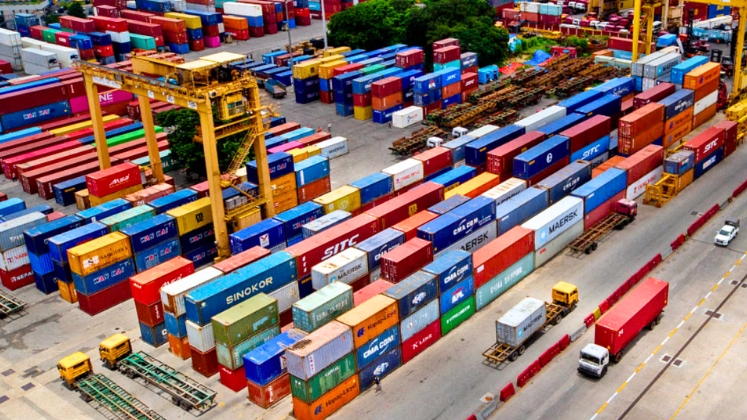
A large queue of ships has formed at the outer anchorage of the Chittagong port; berthing has been delayed by up to nine days due to severe congestion in the container yards and operational challenges brought on by the quota reform movement last week.
As of this afternoon, at least 13 container ships were awaiting berthing, while others were stranded at jetties unable to discharge imports because of yard space limitations.
After nearly five days of nationwide turmoil and curfew, delivery of imports from the yards resumed on the evening of 23rd July. However, the pace was slow as vehicles were clogging the roads to accept containers.
There were 35,421 TEUs (twenty feet equivalent units) of full container load (FCL) shipments, meaning containers entirely occupied by a single shipper’s goods, at the import yards till Sunday morning.
This is over 88 per cent of the yards’ capacity to store 40,368 TEUs.
Due to space restrictions, vessels are now required to stay at the jetties for three to five days, as opposed to the typical 48 hours after unloading imports and accepting exports. And this is what caused the lengthy backlog of approaching ships.
For example, the MSC Qingdao, flying the Panamanian flag, arrived at the outer anchorage on 21st July and as of Sunday has not been assigned a berth.
As of 26th July, SOL Resilience and SOL Reliance, respectively, have arrived from Singapore and Colombo. According to their local agency, berthing would not be feasible before 31st July.
Port users mostly representatives of various ship-operating companies identified three primary causes for why ships need to spend more time at the jetties.
Firstly, shipping agents were unable to promptly receive import discharge permissions as they could not share documents, including details of shipment contents, with the authorities for a five-day internet blackout. Similarly, Chittagong Port Authority could not access the naval authority’s approvals for the unloading of dangerous cargo.
Secondly, deliveries were suspended for the unrest and curfew in the port city, leading to severe space constraints at the yards and subsequently barring the unloading of containers from vessels.
Thirdly, the disturbances and the curfew also caused havoc with off-dock operations, making it impossible to send out export containers and forcing ship operators to postpone planned departures.
In addition to making importers wait longer to get their cargo, such berthing delays are costing ship operating companies money in lost charter hiring and servicing revenue.
As such, delayed berthing leads to costs of at least $15,000 to $20,000 per day in charter hire, not to mention the losses from service failures, said Muntasir Rubayat, director of the Bangladesh Shipping Agents Association.
Additionally, he said, Bangladeshi exporters suffer large losses as a result of delays in getting clothing items to their destinations.