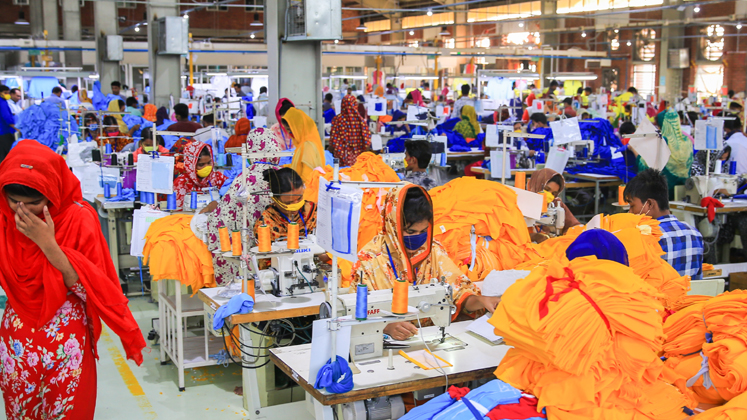
Bangladesh apparel and textile sector seems to be caught in a catch 22 situation, when it comes to the issue of gas!
It was not very long ago it was reported that Gazipur, which is the country’s major industrial hub and home to some of the biggest textile and readymade garment factories, was plagued by gas shortage — gas is mainly used in industries for generating captive power as their demand for uninterrupted electricity supply could never be met through the national grid — hampering production drastically, which was reportedly triggered by the Government’s sudden decision to stop importing liquefied natural gas, which account for about 40 per cent of the demand.
“There should not be any gas crisis unless industries are overusing it,” reportedly underlined Energy and Mineral Resources Division Senior Secretary Anisur Rahman then even as the energy division reportedly cancelled the routine import of LNG for September following an instruction from the Prime Minister’s Office in July for stopping its import due to an abnormal price hike in international spot market, he said while also adding that they resumed LNG import on an emergency basis to tackle the crisis.
The LNG price started to shoot up in the spot market in January as countries around the world scrambled to return to normal life from the Covid pandemic, causing a huge surge in the demand for fossil fuel.
However, the gas crisis has apparently come in the peak of the apparel export season — the period between August and December is considered peak import season for the European market where sales go up on the eve of Christmas and other holidays — as per industry people.
“…many of our factories are unable to use three fourths of their capacity due to the gas crisis,” underlined Bangladesh Textile Mills Association Secretary Monsoor Ahmed then while adding the number of textile factories in the areas hit by the gas crisis would be around 75, while underlining that some of them are the biggest factories in the country even as BTMA Director Saleudh Zaman Khan on his part maintained, “The crisis hit the apparel sector amid a very high export growth with regular buyers doubling their orders and many more new buyers giving orders,” even as reports suggests the supply of LNG fell down to 600 million cubic feet a day in early September against a regular supply of 1,000 mmcfd even as LNG supply has reportedly been raised to 900 mmcfd since 25 but the gas crisis has continued, with the gas pressure reportedly falling to 1-2 pounds per square inch from 7-8 PSI suddenly and staying there for an hour or so, claimed Mosharaf Hossain, Chairman of Mosharaf Group, one of the biggest industrial gas consumers.
It may be mentioned here that apparel firm Mosharaf Group needs to run a 24 MW power plant with gas for operating factories and every time gas pressure falls, the power plant suffers damage.
It is not only Gazipur, rather production in textile mills in many areas in Savar, Narayanganj, Dhamrai, Manikganj, and Chittagong have reportedly been affected severely due to a shortage of gas supplies with textile millers expressing apprehension they will lose work orders if production cannot be continued as many have reportedly been running at 50 per cent to 60 per cent capacity because of the low pressure of gas.
Echoing the concerns of Mosharaf Hossain, Khorshed Alam, Chairman of Little Star Spinning Mills Ltd., reportedly stated the production in his factory had been lowered to 13,000 pounds from 22,000s pound per day even as his daily production loss at his Ashulia-based spinning mill, which mainly produces 80 carded yarn, amounted to Taka 26 lakh because of the shortage of gas supply and, his factory was said to be running at 60 per cent capacity for many months.
The Titas Gas Transmission and Distribution Company Limited (TGTDCL) only gave assurance to him of supplying gas at adequate pressure but the assurance was yet to materialise, complained Khorshed even as the BTMA, which is a platform for the primary textile sector comprising spinning, weaving and dyeing, had reportedly even sent a letter to Tawfiq-e-Elahi Chowdhury, Energy Adviser to the Prime Minister, seeking a solution to be supplied higher pressure of gas to run their industrial units even as Ali Iqbal Md Nurullah, Managing Director of the TGTDCL, on his part reportedly stated the improvement of supply of gas was dependent on availability of gas in the pipelines.
According to reports, currently, some 450 spinning mills supply around 80 per cent of the demand for yarn of the local knitwear factories and they are said to be the main consumers of the gas.
Meanwhile, with the situation showing little signs of any marked improvements, the Government reportedly decided to procure three cargoes of LNG from the spot market — as per reports, Prime Minister Sheikh Hasina had given her nod for importing LNG even as the Cabinet Committee on Public Purchase approved 12 proposals, including the import of LNG, as part of which the state-owned Petrobangla was supposed to import some 33.60 lakh MMBtu LNG from the international spot market through quotation while Vitol Asia Pte, Singapore, was supposed to supply the bulk LNG at a rate of US $ 29.89 per million British thermal units (MMBtu).
It may be mentioned here that spot markets are prices for immediate delivery, whereas future markets are for delivery for some time in the future and these are two very distinct markets that are fundamentally different in the natural gas market.
The Government’s decision to purchase LNG from the spot market, however, evoked mixed reactions from industry leaders and experts even as speaking to the media, even if both the groups lauded the move, some were sceptical as well.
Meanwhile, as per people in know of things, the Government reportedly provides maximum gas for power generation every summer but this year, that is not the case. Instead, the gas crisis has reduced power supply from the power plants even as reports state that the daily gas demand of the country’s power plants was around 225.2 crore cubic feet, while in contrast, Petrobangla was able to supply 130-140 crore cubic feet even if it re-increased the supply of LNG to the national grid in July this year as LNG prices continued to rise.
Meanwhile, speaking to the media, Energy Advisor to Consumer Association Bangladesh (CAB) M Shamsul Alam said: “Purchasing from the spot market would be beneficial, I have doubts. We don’t have that capacity to perceive the essence of the market,” even as he went on to reportedly add, “I am cynical regarding the matter. The skill, expertise and efficiency required to purchase from the spot market is absent, although the strategy and the standard purchase procedure has been explained.”
Reports suggested however that earlier, it was decided not to buy the product from the spot market till next December due to the rise in LNG prices but the energy division reportedly backtracked on the decision, citing gas shortage even as due to the gas shortage, the textile and apparel sectors of the country felt the pinch as they were in fear of losing work orders if production cannot be continued.
The decision of buying LNG from the spot market may help the apparel and textile sector to overcome this shaky situation, reportedly felt the apparel makers even as Shahidullah Azim, the Vice-President of the Bangladesh Garment Manufacturers and Exporters Association (BGMEA), reportedly maintained that the decision to buy LNG from the spot market will be much better for the apparel sector as the sector was suffering the most due to the gas crisis.
“We are also suffering as textile millers will not be able to supply the yarn on time again if there is no quick solution to this problem, which will further hamper our production. The timely shipment of the huge amount of purchase orders will be affected,” reportedly underlined the BGMEA Vice-President even as earlier, Mohammad Ali Khokon, President of the Bangladesh Textile Mills Association (BTMA), said in a statement that the spinning, weaving, dyeing-printing-finishing industries of Bangladesh are run on the basis of captive power generation, where gas is the main fuel and the gas supply has been severely disrupted recently, where some factories run their production by shutting down 70 per cent of their machinery, he added.
“Despite the increase in the price of cotton in the international market, we have kept the price of yarn at a tolerable level to take forward the garment industry, which is the major source of export earnings of our country,” he added.
He feared that if the issue of gas shortage would be prolonged, the production of yarn would be disrupted significantly, which would have a negative impact on the country’s garment industry.
According to the BTMA, some 450 spinning mills have been supplying 80 per cent of the demand for yarn of the local apparel factories currently who are the main consumers of natural gas.
Given the existing situation, Bangladesh does not seem to have much of choice but to resort to buying gas from the spot market notwithstanding whatever its impacts are; after all RMG industry is the backbone of the country’s economy and when exports are on a rebound after a prolonged lull, supporting the industry is perhaps paramount now.