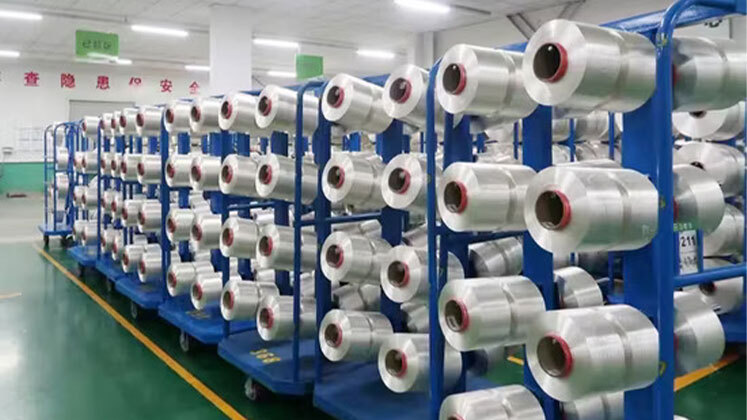
The commerce ministry has recommended that the National Board of Revenue (NBR) withdraw the bonded warehouse facility for duty-free imports of certain categories of yarn, a move that has drawn support from local spinning mills but triggered concern among apparel manufacturers over rising costs and export competitiveness.
In a recent letter to the revenue authority, the ministry proposed ending duty-free imports of yarn in the 10 to 30 count range, a medium-to-coarse category widely used in knitwear production.
The recommendation follows sustained pressure from domestic spinners, who have argued that an influx of cheaper imported yarn—particularly from India—has severely strained the local spinning industry. The commerce ministry noted that imports of yarn have surged sharply in recent years, warning that at least 50 spinning mills have already shut down and that further closures could follow if the trend continues.
Local spinners have welcomed the proposal, but readymade garment exporters cautioned that restricting access to duty-free yarn could destabilise Bangladesh’s largest export sector at a time of global demand uncertainty and intense price competition. Leaders of the Bangladesh Garment Manufacturers and Exporters Association (BGMEA) and the Bangladesh Knitwear Manufacturers and Exporters Association (BKMEA) expressed concern over the move and announced plans to hold a press conference on the issue.
BGMEA director Faisal Samad was cited as saying that suspending duty-free yarn imports would force garment manufacturers to depend more heavily on domestic suppliers at a time when local yarn prices are already rising. BKMEA executive president Fazlee Shamim Ehsan noted that imported yarn accounts for nearly 30% of Bangladesh’s total yarn demand, valued at roughly US $ 1.5 billion, with the bulk sourced from India. The remainder is supplied by local mills.
Ehsan was quoted as saying that domestic spinners had already begun quoting prices higher by US $ 0.25 to US $ 0.30 (Taka 30–36) per kilogramme following the proposed restriction. He argued that harming the export-oriented garment sector to protect spinners was not the right approach, suggesting that targeted incentives of four to five% could instead have been extended to primary textile producers.
According to BTMA estimates, Bangladesh consumes around 400 crore kilograms of yarn annually, with approximately 46% sourced from India. The association has claimed that Indian exporters have been selling 30-count yarn in Bangladesh at US $ 2.50 to US $ 2.60 per kilogramme, compared with US $ 2.90 to US $ 2.93 per kilogramme in the Indian market, attributing the price difference to heavy incentives. BTMA said the situation has left domestic spinners with unsold yarn stocks worth around Taka 12,000 crore by the end of December.
The commerce ministry echoed these concerns in its communication to the NBR, cautioning that rising dependence on imported yarn could lengthen lead times, reduce local value addition and exert pressure on foreign exchange reserves, ultimately undermining competitiveness.
Exporters, however, maintain that limiting access to competitively priced yarn could weaken Bangladesh’s position in global apparel markets, where buyers remain highly price-sensitive. BTMA president Showkat Aziz Russell said the issue should also be viewed in the context of Bangladesh’s impending graduation from least developed country (LDC) status.
Russell was cited as saying that exporters would need to comply with “two-stage transformation” rules—using locally spun yarn rather than imported cotton—to retain preferential market access in destinations such as the European Union, the United Kingdom and Japan after graduation. He also noted that securing GSP Plus status from the EU would require at least 40% local value addition, compared with current levels of around 35% overall.
Local spinners primarily produce 30-count yarn for garment exporters. While domestic mills can meet about 90% of yarn demand for knitwear and 45% for woven garments, the remainder continues to be sourced from India, China and Pakistan.
Spinners said that in fiscal year 2025–26, Bangladesh imported about US $ 2.0 billion worth of yarn from India, while local mills consumed roughly 1,600 tonnes daily. Bangladesh remains the largest destination for Indian yarn exports, accounting for 44% of shipments, followed by Cambodia at 21%.