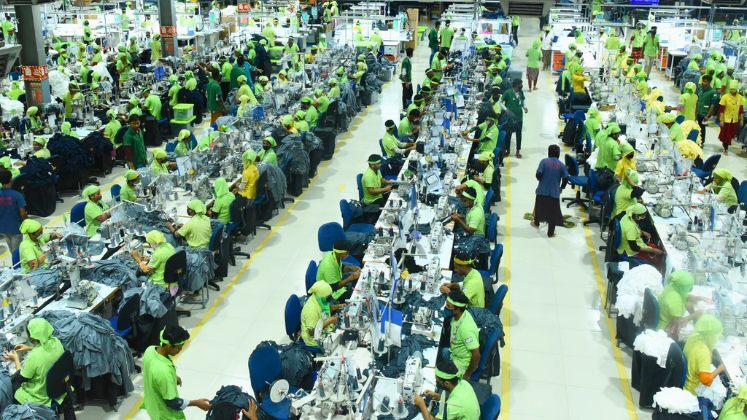
A new mid-2024 survey of 1,000 ready-made garment (RMG) workers from Rampura, Ashulia, Gazipur, Narayanganj and Chattogram suggests climate change is already taking a heavy toll on workers’ health, safety, and performance. The findings were presented in Dhaka on Sunday at a dialogue titled Just Transition and the Interplay of Climate Change, Labour Rights, and Gender in the Garment Industry, organised by the Bangladesh Center for Workers Solidarity, the Centre for Labour and Development, and The Business Standard.
Key results show that nearly all respondents (98%) noticed changes in workplace temperatures. Of these, 85% reported extreme heat, 78% observed more climate-related illnesses, and 41% said they faced frequent insect infestations at home.
The report links rising temperatures and related health issues to reduced productivity. About 27% of workers said their productivity declined sharply, while 29% reported a slight decrease. Female workers were disproportionately affected, with 17% more women than men indicating significant productivity drops. Illness-driven sick leave was common, with 46% reporting time off due to health problems.
Gender-based harassment remains widespread in the sector, with 80% of female respondents describing harassment or discrimination at work. Rest breaks were also a concern, with 46% saying they did not receive adequate breaks, a figure rising to 75% in Ashulia. About 73% said they were not union members, and nearly half (49%) felt uninformed about workplace health risks.
While two-thirds (61%) acknowledged the existence of some complaint mechanisms, 39% said no system existed to address harassment effectively.
The study also noted climate shocks as a driver of rural workers entering factories, with three in four respondents saying climate events devastated their traditional livelihoods in farming, fishing, or other sectors.
Dhaka University law professor Mohammad Golam Sarwar, who heads the Centre for Labour and Development, told the gathering that climate change is directly eroding workers’ rights.
Kalpona Akter, executive director of the Bangladesh Center for Workers Solidarity, warned against allowing economic growth to come at workers’ expense. She emphasised that workers’ voices are underrepresented in global climate and transition discussions, and said many “green” factories still rely on largely “grey” jobs.
Solidarity Centre’s AKM Nasim criticised the 2022 labour rule amendments for weakening safeguards, noting that factories are no longer required to provide cool drinking water.
Participants from factory management and government also joined the dialogue. BKMEA President Mohammad Hatem acknowledged ongoing sectoral transformation since the Rana Plaza disaster but criticised certain eco-friendly factory policies. He urged workers to be responsible, arguing that “responsible unions” are not inherently opposed to reform, but claimed some unions disrupt production over minor issues.
Senior officials from the government, Shah Abdul Tarique, additional director general of the Department of Labour, and Md Mahfuzur Rahman Bhuiyan, joint inspector general of the Department of Inspection for Factories and Establishments—also spoke at the event.