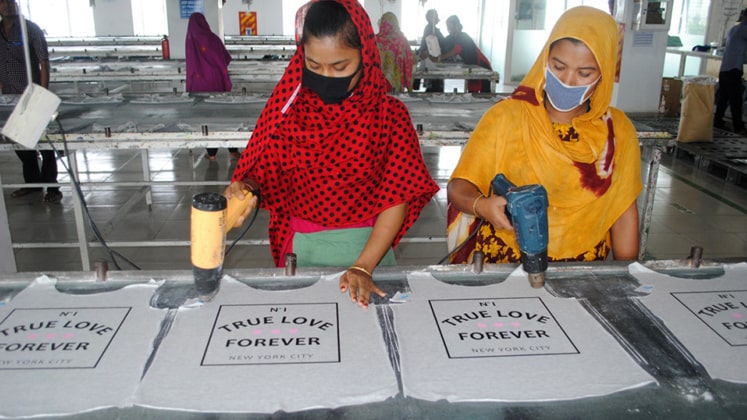
However, BGMEA has reportedly claimed that the female ratio is much higher than the MiB survey and added that the previous perception of higher ratio of female in the garment industry was not backed by any survey or database of workers, so the narrative of declining female workforce derived out of the relatively less ratio of female in this sector is not the fact.
“A comparative review of the recent studies on RMG industry, particularly on the gender distribution of the workforce, reveals the similar picture of male-female ratio as drawn by MiB,” stated BGMEA President Dr. Rubana Huq, adding while the finding of the MiB suggests the ratio of male and female to be 41.7 and 58.3 per cent respectively, another recent survey report by the Asian Centre for Development (ACD) found it to be 40.8 and 59.2 per cent.
Therefore, on an average, the male-female ratio of 40 and 60 per cent can be generalised across the industry as per our understanding, said the BGMEA supremo.
The presence of female workers in the garment industry has dwindled to 58.3 per cent this year, a far cry from previous claims of 70-80 per cent of the past. The figure was derived from a survey undertaken by the Mapped in Bangladesh (MiB), which revealed the findings recently.
MiB is a four-year research initiative started in 2018 by the Centre for Entrepreneurship Development of Brac University, to map the export-oriented RMG industry across the country digitally. Laudes Foundation and the Netherlands fund it while the garment makers’ body in the country, the Bangladesh Garment Manufacturers and Exporters Association (BGMEA) and the Bangladesh Knitwear Manufacturers and Exporters Association (BKMEA), are the strategic partners.
As per the survey findings, there are 3,223 export-oriented apparel factories engaged in the apparel making process. Of the total factories, 1,171 are located in Dhaka, 1,053 in Gazipur, 614 in Narayanganj and 386 in Chittagong. Further, out of the 3,223 factories, some 1886 are members of BGMEA, 512 members are of BKMEA while 251 units have both BGMEA and BKMEA affiliation, according to MiB. The remaining 574 are not members of any of the two trade bodies.
In these factories, over 2.56 million people are employed, of which 1.49 million, or approximately 58.3 per cent are female.
The sweater and knit composite segment, however, have more male (60.5 per cent) and (50.3 per cent) respectively than female, the MiB survey reportedly found even as female participation is higher in woven and knit garment (65.3 and 61.8 per cent respectively), as per the survey report.
“We have collected the information from the onsite factory to factory visit. And the statistics show that 41.7 per cent are male and 58.3 per cent are female workers,” MiB Project Manager Syed Hasibuddin Hussain underlined, adding, “To change the narrative about the RMG sector, it needs credible data on the number of factories, their locations, number of workers and more.”
Earlier, a survey conducted by the Asian Center for Development in 2015 reportedly found 65 per cent female workers in Bangladesh’s readymade garment sector against the reported claims that more than 80 per cent female workers worked in the sector while the International Labour Organisation’s baseline study, however, found that women represented 61.17 per cent of the sector’s workforce in 2018, a decline from 63.4 per cent in 2010.
The proportion of women workers in the surveyed RMG enterprises declined between 2010 and 2018, said the ILO study published this year.
Also, a survey conducted by the Centre for Policy Dialogue (CPD) in 2018 underlined that out of 3,596 active garment factories in Bangladesh with 3.5 million workers, 60.8 per cent were female and 39.2 per cent were male while in its previous survey in 2015, the workers were reportedly 36 per cent male and 64 per cent female.
The President of the Sommilito Garments Sramik Federation, Nazma Akter, on her part underlined, “Previously, female workers were mostly engaged in works such as marking, levelling and spin cutting. But modernisation or technology adoption has displaced most of these workers.”
On the other hand, the female workers did not get proper training to make them adequately skilled to run the updated machinery or to cope up with the changing pattern of work with the latest technology. As a result, they lagged and dropped out, Akter said.
“If women’s participation in work, especially in the apparel sector, drops, it will hinder the empowerment and increase the disparity between men and women. Without any delay, the Government and sector people should take policy measures including skill training in retaining women participation,” Akter said.
Meanwhile, interacting with the media, CPD Research Director Dr. Khondaker Golam Moazzem said the decrease in women share does not really mean women workers are decreasing. It means the growth of male workers is increasing compared to female, which resulted in a change in the male-female ratio.
Terming it a major instrument of women empowerment, he said, the Government should look into the ratio change critically to ensure adequate female participation.
“There has been a surge in skill orientation in RMG items manufacturing, prompting skill upgrade of workers,” he said, adding female workers are getting on-the-job training while male workers join the workplace with some training outside. This skill orientation creates demand for skilled workers and it also increases the workers’ length of stay in the garment sector, felt the CPD Research Director while underlining that fresh workers’ opportunity to join the sector has become relatively squeezed.
This has created competition and males are getting more opportunities than female, said Dr. Khondaker, adding the garment sector has become relatively attractive to male workers due to wage hikes in 2013 and 2018 as well.
From a gender and empowerment point of view, the sector is considered a female-oriented sector. But gradually skill upgradation is occurring in the apparel sector. Skill requirement has increased in production as there is more variation in products but on a limited scale. So, for getting jobs or a top position, skill is an issue. “Men are more aware or skilled in machines than women. But the female workers do not have this type of skill due to lack of training,” said the economist, adding as a result, it has been difficult for women at the entry level.
To address these issues, outside training is very crucial, he added and called for Government’s focus on these issues.
It is pertinent to note here that women have been at the forefront of Bangladesh’s apparel manufacturing sector for long. But the new era of the fourth industrial revolution, categorised by not just technological innovation but also a fusion of technologies, has posed new challenges for all and, in the given context a clear understanding of automation, use of modern technologies and presence of skilled human resources are very important.
According to the BGMEA President Dr. Rubana Huq, around a quarter of garment manufacturing activities in Bangladesh will be automated by 2023, up from 8 per cent now. So, workers, especially females, need to be skilled and reskilled so that they can continue to do this important business, she said while calling upon the different agencies to disseminate education for skilling the enormous number of female workers as they have been tremendously contributing to the industry.