That Bangladesh garment industry is going through some unprecedented times is common knowledge. Though somewhat anticipated, the impact of COVID-19 has been way more worse than initially thought!
It will not be an exaggeration to say that the extensive order cancellations by global buyers and lack of fresh orders have emerged as the major impediments to the industry’s survival which had to suffer an export debacle with earnings from apparel exports in FY 2019-20 falling by 18.45 per cent to register US $ 27.83 billion as against US $ 34.13 billion of FY 2018-19.
The massive loss of US $ 6.3 billion, if at all, sounded the death knell for many small and medium-sized players, who had already been struggling to cope with increased overheads, operational costs and falling profit margins. It was just a matter of time before they wound up business for good. The recent turn of events has also been difficult for the so-called big and prosperous conglomerates to withstand. The result – if manufacturers had to suffer significant business loss, workers are worse off.
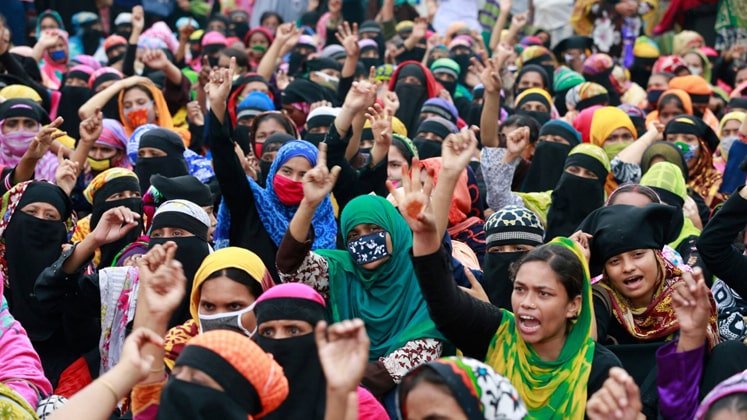
As per some estimates, the repurcussions of the coronavirus pandemic had started manifesting already with as many as 21,331 workers, mostly from the RMG sector, having lost their jobs already. However, if labour leaders are to be believed, the number of retrenched workers could be much higher and increasing with each passing day.
Also Read: Work Orders: Could Bangladesh expect a turnaround anytime soon?
In such a situation, it is not possible for the industry alone to find the way out, and needs multi-pronged initiatives from the stakeholders to bail the industry out. If the Government has already done its bit by coming up with the coronavirus bailout package to help the export-oriented industries pay wages to their workers for a period of 3 months, many international bodies are now joining hands with the industry to find the feasible ways out. The European Union had already pledged a €113 million grant for retrenched workers and now the International Labour Organisation (ILO) has come up to partner with the Bangladesh Garment Manufacturers and Exporters Association (BGMEA) and the Bangladesh Knitwear Manufacturers and Exporters Association (BKMEA) to create learning hubs for apparel workers that may hold them in good stead in this crisis period.
Recently, the ILO – in association with BGMEA and BKMEA – has launched a comprehensive safety and training package to help the RMG industry better protect and monitor workers and their working conditions during COVID-19.
As more and more workers return to work, the RMG ‘Learning Hub’, the ILO underlined, will focus on three core areas: raising COVID-19 prevention awareness among workers and factory management, ensuring COVID-19 Occupational Safety and Health (OSH) preparedness guidelines are being followed and continuing to promote strong social dialogue in the workplace.
Developed by the ILO, the ‘Learning Hub’ will serve as a one-stop virtual platform and has been made possible through US $ 750,000 of financial support from Sweden and Denmark.
Additionally,US $ 250,000 has been contributed by several existing ILO funding partners, namely Australia, Canada, the European Union (EU), Germany, Netherlands, Switzerland, US Department of Labor (USDOL) and the Department for International Development (UK Aid).
To launch the innovation, the ILO recently organised a ‘virtual’ webinar featuring Charlotta Schlyter, Swedish Ambassador in Bangladesh; Søren Asbjørn Albertsen, Sector Counsellor of the Danish Embassy in Bangladesh; Tuomo Poutiainen, ILO Country Director, Bangladesh; BGMEA President Dr. Rubana Huq, and BKMEA Vice President Mohammad Hatem.
The first phase of the one-year initiative (July 2020 – June 2021) will start with the ‘virtual’ training of 150 BGMEA and BKMEA-nominated ‘master trainers’ followed by a ‘training of the trainers’ rollout. Once the current situation permits, the safety training sessions will be physically rolled out to BGMEA and BKMEA factories.
“I want to reiterate Sweden’s strong commitment to supporting Bangladesh and the RMG industry in its quest to strengthen labour rights and social dialogue,”said Swedish Ambassador Charlotta Schlyter at the event, adding, “This is really a time when cooperation between the ILO and key stakeholders is more important than ever.”
The ILO Country Director in Bangladesh, Tuomo Poutiainen, on his part, said “Our joint response is focused on providing the ‘best practices’ to RMG factories to support a safe and stable return for their workers. The ILO is also working with other sectors, as well as the Government and workers’ representatives to ensure that this critical and timely information reaches as many workers as possible.”
Ensuring that BGMEA is wholly committed to facilitating and scaling up this project and applauding the ILO for steering this timely and important initiative, Dr. Rubana Huq said, “This joint COVID-19 industry response between the employers and the ILO sets a significant landmark in our efforts to protect workers’ lives and livelihoods,” while her BKMEA counterpart, President AKM Salim Osman maintained that the safety of workers and supervisors is the utmost priority during this pandemic and he hoped that the virtual training will be an effective tool to enhance the capacity of the trainees and help the RMG industry overcome the ongoing crisis.
The big question now is on the EU’s €113 million grant for garment workers, which as per reports, shows little signs of materialising soon after the Bangladesh Government reportedly expressed its unwillingness to develop a model for the wage disbursement, as it is more interested in creating a welfare fund for the workers with the grant.
It may be mentioned here that EU, the largest export destination for the country’s apparel offerings, has decided to provide Bangladesh with a €113 million grant to pay 3 months of wages to 1 million workers laid off by the readymade garment factories amidst the coronavirus pandemic. Under the grant, a worker will get Taka 3,000 a month for June, July and August.
The EU’s kind gesture to provide financial assistance to the industry in such trying times has been praised by all quarters including the labour leaders and trade unions. “The EU is front-loading €93 million to support the export sector and the rest goes to the social safety net. The EU is currently still in discussion with the ERD about the modalities of this fund utilisation. We will keep everyone updated after the Government finishes the negotiations and loops us, the private sector, in, as the fund will be disbursed through our database,” said Rubana then.
However, months down the line, the project is still on the backburner, causing many hardships to various apparel workers, who were looking forward to get some financial aid. Now, industry insiders say that the Government has its own reasons for mooting the idea of creating a welfare fund, as it fears that anarchy could set in, in the industrial sector if the terminated workers are compensated with partial wages.
Besides, the Government also reportedly thinks that factory owners will feel encouraged to go for more retrenchment once the money distribution begins.
As per Gauranga Chandra Mohanta, Additional Secretary and European Union Wing Chief of the Economic Relations Division (ERD), a letter has been sent to the EU, seeking to create a welfare fund for the sacked industrial workers. However, the EU was yet to respond to the Government’s proposal.
In such a scenario, stakeholders, including trade union leaders, exporters and people connected with the EU mission, have said procrastination in making decisions and the bid to create a welfare fund will make things uncertain for the workers.
“With workers’ resentment growing, caused by work order cancellations in the RMG sector by global buyers, we wrote to the EU for financial help to pay the laid-off workers,” stated China Rahman, General Secretary of IndustriAll Bangladesh Council (IBC), adding that at the end of March, the EU came up with the grant, but it is yet to start the process of compensation.
Meanwhile, commentating on this delay, President of Sammilito Garments Sramik Federation, Nazma Akhter said that workers were facing severe cash shortages as they try to lead life since they have not had jobs for the last few months.
“If they do not get money during the crisis, what will they do with the funds,” questioned Nazma, saying it is unexpected that even after 3 months, the workers are yet to see progress in getting the benefits of the grant.
Now, if and when things would get sorted out is still uncertain, but one thing is but sure that retrenched garment workers are in for some hard times, till the Bangladesh Government and EU are able to reach a mutually agreeable decision on this issue.
Also Read: A new financial year starts for Bangladesh amidst coronavirus-induced uncertainties