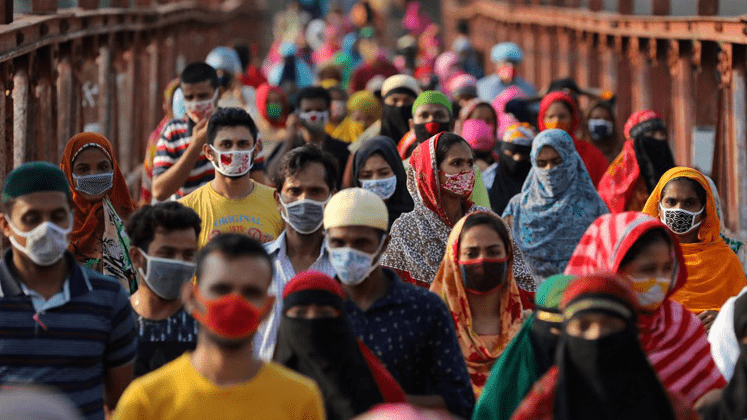
The last one year has been very hard on the garment workers, thanks to the COVID-19 pandemic. Even though the Bangladesh Government came up with a stimulus package to help the entrepreneurs pay the workers’ wages, it was allegedly not of much help to guarantee their jobs as some reports suggest that hundreds of thousands of workers in the readymade garment sector have been laid off since last year even though the exact figure of the retrenched workers is an intensely-debated issue still.
Meanwhile, as per a study carried out by the Centre for Policy Dialogue or CPD, around twenty-five per cent of garment factories received loans from the taxpayer-backed stimulus package retrenched workers, which it underlined was in breach of the laid down conditions while adding that the retrenchment indicates that the stimulus package could not guarantee jobs as many factories terminated workers even as factories had agreed that they would not lay off anybody while availing the stimulus fund.
It may be mentioned here that the Government has allocated Taka 10,500 crore to the garment industry as the stimulus package to help them pay wages and allowances to their workers since the crisis hit the country in March.
CPD Research Director, Khondaker Golam Moazzem, shared the findings of the survey — the survey was carried out on 102 garment employers, 301 employed workers, and 100 unemployed workers in Dhaka and Gazipur districts even as several stakeholder interviews with representatives of brands, Government officials, workers and employers were conducted to complement the analysis — recently at a webinar on Corporate Accountability of the RMG sector in view of Covid-19 Pandemic: Challenges in Ensuring Workers’ Well-being .
Underlining that job loss was a regular phenomenon in 2020, the CPD Research Director stated that in case of job loss, 59 per cent of the workers received the salary only, while 18 per cent got nothing from their employers while adding unemployed workers tried to survive by engaging in different temporary and low-paid jobs.
He further maintained that the accountability of employers, the Department of Inspection for Factories and Establishments (DIFE), and the brands lacked in these regards and went on to add that the impact of COVID-19 was comparatively higher on the workers who lost jobs and remained unemployed in the months of April and May in 2020 witnessing the highest job loss even as the garment workers lost their jobs in all other months as well, the survey report showed.
Meanwhile, an estimate by the Bangladesh Centre for Workers’ Solidarity (BCWS) has put the number of workers who lost their jobs in one year, till April at, minimum of 300,000 even as it maintained that many received no salary and severance pay and those who retained their jobs, had to take a significant pay cut.
Workers suffered a 35 per cent pay cut during the shutdown last year, according to an estimate of a recent report and BCWS. The report titled The Weakest Link in the Global Supply Chain: How the Pandemic is Affecting Bangladesh’s Garment Workers, unveiled recently, revealed that RMG factories have sacked or furloughed on an average 10 per cent of their workers and may let go a further 35 per cent of their workers in the future if the current situation — fewer orders, price reductions on new orders and delayed payments — does not improve. It also referred to data from a survey by the Centre for Global Workers’ Rights last year that found 72.4 per cent of furloughed workers did not get their due salary and 80.4 per cent of laid off workers did not get their severance pay.
The report was brought out by the Institute for Human Rights and Business and the Subir and Malini Chowdhury Centre for Bangladesh Studies at the University of California, Berkeley, with support from UNDP Bangladesh and the Swedish Government, which added that many of these workers are still unemployed or are working as day labourers as RMG factories are at present barely recruiting workers.
In the meantime, labour leader and BCWS Executive Director Kalpona Akter reportedly alleged, “In most cases, very rich industrialists who can pay their workers for months without running their factories received the stimulus package last year even as small and medium-scale factories who are mostly sub-contractors for bigger factories did not get any assistance and had to close their operations or minimise production costs.”
Kalpona Akter also reportedly accused buyers of not acting responsibly. “According to our estimation, more than 50 per cent of suppliers had to accept orders below average cost and many brands cancelled orders last year,” she maintained while adding that the apathy of brands and industrialists’ indifference towards workers’ rights resulted in mass layoff of workers and massive salary cuts in this sector even as Begum Shamsunnahar Bhuiyan MP, Executive President of Mahila Sramik League and a member of the parliamentary standing committee on the Ministry of Labour and Employment, on her part added, “We have already asked the industrialists to pay salaries and festival bonuses by 10 May. They are again demanding an additional Taka 10,000 crore stimulus package from the Government to pay the salary and festival bonus….”
The existing status of the garment workers on account of the Coronavirus pandemic has brought the focus back again on the social protection programmes even as the Bangladesh Apparel Workers Federation (BAWF), an affiliate of IndustriALL Global Union, has called upon the Bangladesh Government to adopt social protection programmes to guarantee the livelihoods of workers and their families.
In a letter written in this direction — on behalf of the Bangladesh Apparel Workers Federation, President Md Towhidur Rahman and General Secretary Tahmina Rahman signed the letter — to the State Minister for Labour and Employment, Begum Monnujan Sufian, BAWF called upon the Government to initiate a consultation process with the unions to ensure that workers are protected in times of calamities such as the present ongoing pandemic even as it maintained that social protection was emerging as a key policy issue in South Asia, and social protection policies and programmes in Bangladesh need to be scaled up and become more systemic, transparent and inclusive.
And to achieve the same, BAWF stressed on increasing investment in social protection, ensuring that the coverage is as comprehensive as needed, both in terms of targeted people and areas, and ensuring proper implementation is needed while the BAWF letter written in this direction underlined that the share of GDP spent on social protection hovers around 2 per cent in most countries in South Asia, compared to a global average of 11 per cent, so there is a major need to increase Government spending on social protection programmes.
The letter further stated that trade unions need to be part of the process of instituting better and more comprehensive social protection programmes even as it went on to highlight the loss of wages from 8 per cent – 16 per cent across the region in the last decade as a result of precarious employment.
Millions of workers across the region lost wages in April-May, largely due to non-payment of wages by employers and that is why trade unions are now focusing on social security and social protection, the letter stated.
Going by the findings of the various researches and what the experts have to say on the condition of the garment workers on account of the continuing pandemic, one would agree, it is but imperative that the stakeholders think of ways and measures that can change the current status of the garment workers, and strengthening the social protection programmes, undoubtedly would be a great move in this direction.