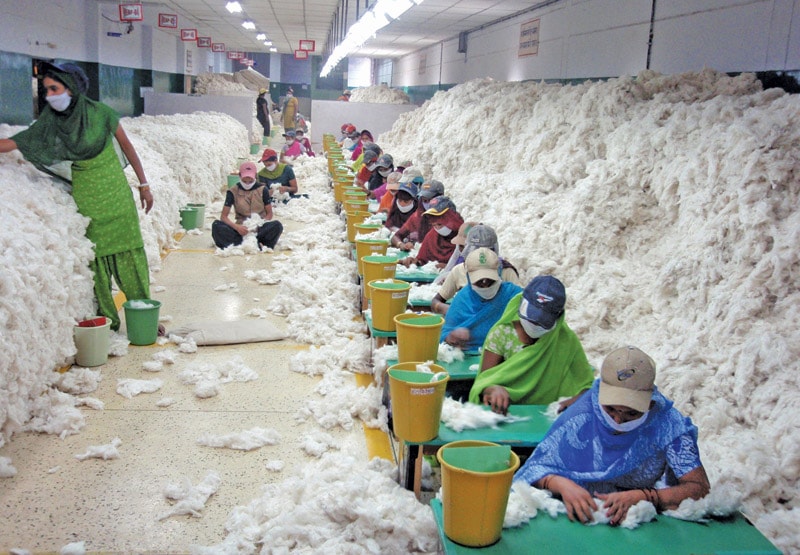
 Within the last six financial years, India has traversed from being leading exporter in cotton to being its major importer. From producing 367 lakh bales in 2011-12 to producing 338 bales each in 2015-2016 and 2016-17 and consequently leading to India’s import from 7.51% to 15% for 2015-16. Meanwhile, the exports came down from 130 lakh bales to 68 lakh bales due to the growing local consumption of cotton which rose from 250 lakh bales in 2011-12 to 310 lakh bales in 2016-17.
Cotton based textiles has been the main stay of Indian textiles over the decades. India is one of the few nations where textiles is still skewed in favour of cotton (60%) as against the world where man-made has a 60% plus share while cotton is sub 40%. One of the major reasons for this is our large cotton crop grown across 10 states. Although there was a rise in additional production from the year 2012-13 to 2013-14, taking it from 270 to 298 lakh bales, it started tickling from 2014-15 to 286 lakh bales before drastically going down to 338 lakh bales, and has stagnated at that point up till now.

One of the largest and important questions in all sectors of the economy has been – how much role should the Government have? This question has caught momentum with the liberalization of our economy in early 1990s. The cotton textile world is no exception, where the debate has been whether the Government should leave the cotton fibre economy on its own – to grow, develop, stabilize and find its own direction and level.
On account of such major fluctuations in such a small time span, Sanjay Jain, President & Deputy Chairman, Northern India Textile Mills’ Association (NITMA), suggested that the Government like in other agricultural crops needs to ensure sufficient availability of cotton at competitive prices to the industry, otherwise the industry would find it difficult to move up the value-added chain and become a large manufacturer of textile products like China, Bangladesh etc. It could instead be rendered as a supplier of raw material like African or CIS nations.
Some measures put forward which need to be avoided while intervening in the cotton industry are:
• That Government should not get burdened with unmanageable stocks like China.
• Cotton quality and supply flow for industry should not get impacted.
• There should be no discrimination and the industry should not be forced to buy cotton above international prices.
Moreover, the initiatives suggested by Sanjay, primarily focus on the price stability in the cotton industry. “That could be achieved by ensuring at least one and a half months of cotton usage stock, i.e. 40 lakh bales should stay (with) in the country.”
The other initiatives, Sanjay believed, which would help in restoring the lost advantages are:
• Allow funding for cotton stock at subsidized rates, preferably 2 per cent below the base rate for the period October-April, so that industry can stock cotton and ensure farmers get a better price.
• CCI (Cotton Corporation of India) like FCI (Food Corporation of India) should play a constructive role by creating a buffer stock when prices are low and ensure cotton security and price stability.
• Ginners should be made to compulsorily declare their pressing numbers online along with stock figures to ensure arrival data is accurate.
• Impose import duty on edible oils so as to ensure the cotton economics is improved.
• A system of direct subsidy should be started for farmers when cotton (kapaas) prices fall below MSP.
• A more scientific and transparent system needs to measure crop forecasts and crop arrival, to determine area under cultivation, to pick best practices from other countries, to check contaminations, to make data available to industry within a week of preceding month, etc.
• The research grant to CICR (Central Institute for Cotton Research) should be reinstated to Rs. 3 crore.
• Standardization of cotton in terms of moisture, trash and packing to ensure cotton retains its archaism of “white gold”.
• A Cotton Board should be created with a clear mission and goal to take India’s productivity to 1,000 kgs of lint/hectare grown by year 2020.
Sanjay also notified that a long-term comprehensive cotton policy should come into practice along with a defined roadmap to make India No. 1 cotton producer in the world. Lastly, he suggested that in order to meet these objectives, renovation of CCI (Cotton Corporation of India) and CAB (Cotton Advisory Board) is a must.
Today’s status
• India’s cotton crop remains stagnated since last two years. From 398 lakh bales in 2013-14, it halted at 338 lakh bales 2016-17.
• Surplus cotton dwindled, forcing industry to import at the end of the season.
• Value adding industries, such as spinning, are suffering in spite of strong cotton crop. Reason being slippages in NPAs which were recorded highest in 2015.
• India has one of the lowest stocks to use ratio in the world – 12 to 15% against world average of 80%.
• Domestic cotton prices are way above the international prices.
Today’s concerns
• Insufficient surplus cotton, and the meanwhile increasing export rate of the product which leads to importing cotton at higher prices at the end of the season.
• India’s competitors (Bangladesh, Pakistan) buying 20-30% of its product, forcing industry to import later at higher prices.
• The cotton balance sheet of 2016-17 shows 10-15% low sowing and lesser opening stock.
• No proper mechanism for measuring arrivals and forecasting of crop, thereby, leaving room for misinformation and rumours.
• No vivid cotton fibre policy.
Suggestions
• Allow funding for cotton stock at subsidized rate, preferably 2% below the base rate.
• Role of CCI like FCI is a must in order to create a buffer stock when prices are low.
• A system of direct subsidy should be started for farmers when cotton (kapaas) prices fall below MSP.
• A more scientific and transparent system needs to measure crop forecasts and crop arrival, to determine area under cultivation, to pick best practices from other countries, to check contaminations, to make data available to industry within a week of preceding month, etc.
• The research grant to CICR should be reinstated to Rs. 3 crore.
• Renovation of CCI and CAB is a must.
• Standardization of cotton in terms of moisture, trash and packing in order to ensure cotton retains its archaism of “white gold”.
• A Cotton Board should be created with a clear mission and goal to take India’s productivity to 1000 kgs of lint/hectare grown by the year 2020.
• Creation of a comprehensive cotton policy along with a defined roadmap to make India No. 1 cotton producer in the world.