AOB caught up with a few overseas yarn and fabric manufacturers/suppliers during the 10th Dhaka International Yarn & Fabric Show to get their perspective on the Bangladesh market and the potential that it holds…
At a time when Bangladesh readymade garment industry has stepped up production to increase apparel exports to achieve the target of US $ 50 billion in exports by 2021, it has opened new opportunities for yarn/fabric manufacturers and suppliers – domestic and overseas – to make the most of it to increase their market share in the country. Apparel Online Bangladesh spoke to some of them to know more about the existing market for yarns and fabrics, and the prospects that they see here.
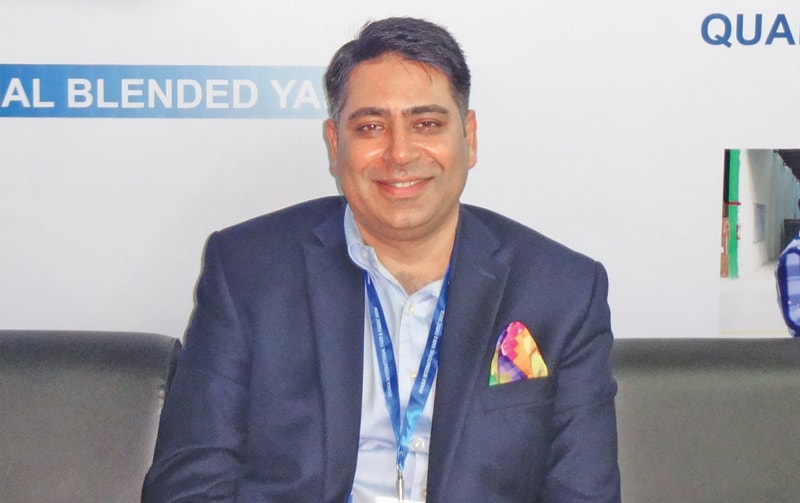
“Over a period of time Bangladesh has moved from basic yarns (cotton) to more value-added varieties like mélange, slub yarns, etc. There is a very clear migration of manufacturers from basic towards value-addition…,” underlines Vivek Verma, Managing Director of India-based Square Corporation, which offers all types of 100% cotton (carded & combed), mélanges, dyed yarns, core spun yarns, slub yarns, organic yarns, synthetic yarn (for knitted & weaving in both single and multifold types along with comber noil, fibres and fabric) besides value-added offerings like jute yarn, bamboo yarn, bamboo blended yarn, PVA yarn, neppy mélange, slub mélange, jaspe, lurex, wool touch mélange, jaspe with neps and slubs to cater to brands such as H&M, Tom Taylor, Jacks & Jones, Esprit and the likes through its clients in Bangladesh.
Verma’s opinion on increasing demand for specialized yarns was also echoed by Suraj Jyoti, Director (Import & Export) of Ludhiana (India)-based Excel Enterprise, which supplies BCI yarns, organic yarns, PIMA yarns, GIZA yarns, dyed yarns, mélange yarns (fibre & top dyed), acrylic & acrylic blended yarns, sublime yarns and fancy yarns like bamboo, modal, tencel, slub yarns to its clients in Latin Amercia, Europe, Egypt, Korea, China, Bangladesh, Pakistan, Singapore, etc. “Conventional yarns are slowly giving way to the fancy ones… We have already received some enquiries pertaining to fancy yarns like slug, injection yarns not only from the big garment manufacturers but even the mid-level and smaller ones during the 10th Dhaka International Yarn & Fabric Show (held between August 31 to September 3),” maintained Suraj Jyoti.
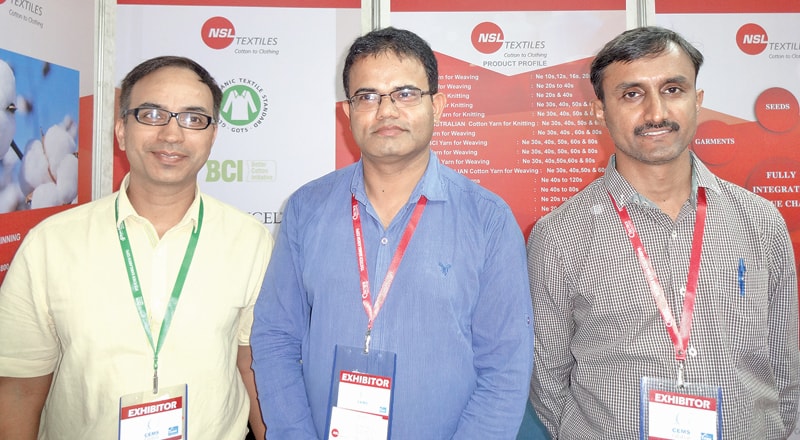
NSL Textiles (a part of US $ 1 billion NSL Group from Hyderabad, India and a 2,80,000 spindle-strong company), represented by M. Nagesh (DGM – Yarn Marketing) and Santosh Kumar (AGM – Yarn Marketing) at the Yarn & Fabric Show, highlighted the company’s immense prospects in the Bangladesh market. “We have a very strong presence in Bangladesh and cater to some top-of-the-line garment manufacturers,” Nagesh said. NSL Textiles offers single carded, combed and combed compact (in the range of 20s-100s), Eli and double yarn (in the range of 2/20s to 2/120s), OE yarn and dyed yarn alongside poplin, twills, classic oxford, pin-point oxford as well as fabrics in fancy structures like Royal Oxford, Matt, Herringbone, Satin, Gabardine, Tussore, Bedford Cords and Dobbies.
“Our business in Bangladesh is very consistent and growing at the rate of 8-10 per cent every year. However, of late there is a lot of competition from the local spinning industry, the overall spindle strength of which would be around 13 million. But still the rate of consumption and demand is very high compared to the local availability. So, we have very good prospects in Bangladesh for at least another 3-5 years,” explains the MD of Square Corporation, adding it is the stability of the Bangladesh market, which makes it even more enticing. “We do annual business of 1,100-1,200 containers in Bangladesh out of the total 3,500 containers globally and Bangladesh contributes 33 per cent to the company’s turnover. But, more importantly, it is the market consistency which makes it even more interesting. China in one point of time consisted 60 per cent of our market share which is less than 30 per cent, whereas share in Bangladesh has increased from 30 to 33 per cent now,” explains Verma. Square Corporation as such readied a two-pronged approach to increase its market share. “Number one, we are trying to penetrate into more number of clients to increase our client-base while also retaining our old patrons,” underlines Verma.
Diminishing margins in readymade garments is a major reason behind more and more apparel manufacturers getting into fashionable and high-end products that has in turn propelled demand for specialised and fancy yarns and fabrics, feels Vivek. “Manufacturers in Bangladesh are actively trying to move up the value chain as there are only two ways to improve turnover, first is by increasing the volume; and second, by increasing the unit price and which is only possible through value-addition. So, these garment makers are working on both these options actively,” maintains Verma on a concluding note.