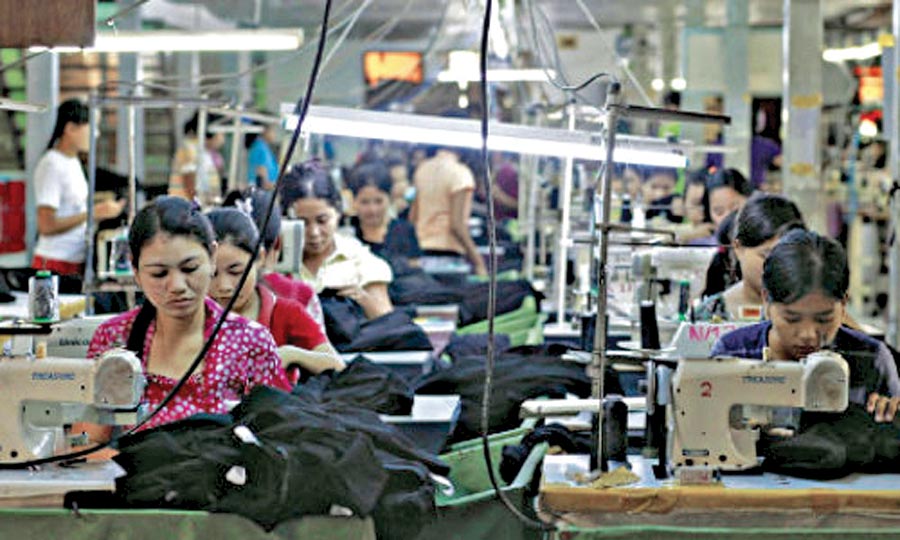
In the quest to find the cheapest and politically stable apparel manufacturing destination in South-Asia, fashion retailers and brands from around the world are now turning their eyes on Myanmar (Burma), which has been politically isolated for over a decade by the western world, exploring the opportunities that exist or could develop over the next few years…, a research by Team StitchWorld.
The turning point came in late 2011, when envoys from Europe and the United States began visiting the nation to see how ‘changes’ were being implemented. On 22nd April 2012, the EU decided to lift sanctions on the country; the US too followed suit and in November 2012, took a step toward normalizing economic relationship with Burma by issuing General License No. 18 (GL 18) to broadly authorize the importation of Burmese-origin goods, except jadeite and rubies, into the United States for the first time in almost a decade. This sudden softening of stand has brought the country into the limelight. And with a history of garment manufacturing and high literacy rate, Myanmar is being seen as a potential base for the industry..
[bleft]“Around 50 garment factories are coming up in Pathein township in Ayeyarwady Region, the first of which will be operated by Delta Industrial Group (DIG) and will start commercial production soon. We anticipate that there will be more than 700 new factories by 2015 that will employ more than 1,00,000 people.” – U Aung Win, Vice Chairman, Myanmar Garment Manufacturers Association[/bleft]
In the past, from the mid 90’s to 2001, the United States was a major export destination for garments manufactured in Myanmar. However since sanctions, the journey of the industry has been slow and painful with FY 2011-2012 closing at US $ 846 million worth of apparel and textile exports, growing at a CAGR of 16.1% from US $ 400 million in 2007-08. Dominated by woven garments, which account for more than 90% of the total manufacturing, key export markets for the country are Japan (US $ 348 million) and South Korea (US $ 232 million), with remaining exports going to Brazil, Argentina, South Africa, UK and Turkey.
There are approximately 400 garment manufacturing units, each with a varying number of machines, catering mostly to the domestic market and with a vast scope for improvement on the efficiency, processes, quality and compliance front. Taking advantage of the cheap labour a few suit manufacturing factories have been setup by Japanese and Korean companies that cater to their home markets. Korea based, Opal Int’l Co. Ltd. is one of the largest apparel manufacturers of the country with 2000 sewing machines, 2 sewing facilities and a turnover of US $ 30 million. Besides this, Lat War Co. Ltd., ADK Garments, MP Group and Hallmark Manufacturing Co. are among the reasonably sized companies with good setups in the country.
What makes Myanmar an Attractive Production base for Garments…
Favourable labour situation
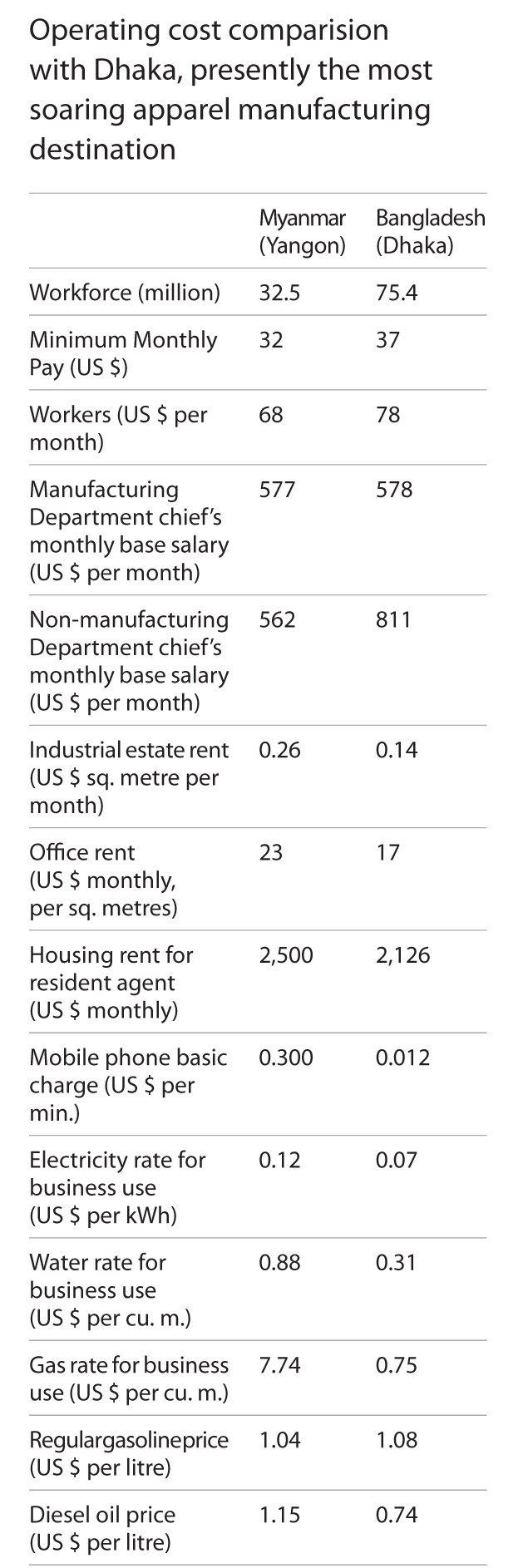
A labour force numbering about 33 million with an average age of 27 years and a literacy rate of nearly 90% is touted as one of the most favourable assets for Myanmar to develop as a garment manufacturing centre. This large and comparatively young manpower with a high literacy rate aids the efficient conversion of available manpower to a need-based, skilled workforce, supporting the development of manufacturing. Currently, Myanmar has the lowest minimum wage and average pay-out when compared with key garment hubs like China, Vietnam and India, but very close in comparison to the corresponding rates in Bangladesh. However, wage rates are rapidly increasing, and there are even talks of raising the minimum wage to the region of US $ 100 per month; it may be high compared to Bangladesh but still much lower compared to other manufacturing nations. Since 70% of the local workforce is employed in the agriculture sector, with only 7% working in industry, skill development will be one focus area where external help will ensure that the growth of manufacturing sector remains on the fast track.
[bleft]Huang Dazhong, a representative of New Archid, a Hong Kong-based company operating from Cambodia and a producer of garments and a vendor for big brands, said his company was looking to Myanmar as a potential new marketplace and would probably expand to Myanmar – or at least consider it – in the next two years.[/bleft]
Government initiatives
Myanmar’s Foreign Investment Law (FIL) allows 100% ownership by foreign companies and also permits joint ventures with State Economic Enterprises (SEEs) or private firms. For joint ventures, the foreign capital infused must amount to at least 35% of the total capital requirement. The Myanmar Investment Commission (MIC) indicates a minimum capital investment of US $ 0.5 million for any manufacturing firm. The FIL also provides various benefits such as a three-year exemption from income tax, allowance of accelerated depreciation, relief from customs duty and other internal taxes such as those on machinery, equipment and spare parts.
Presently, Myanmar enjoys an LDC status with Japan along with other export countries such as Laos, Bangladesh and Cambodia. This helps gain a tariff exemption of up to 10%. Around June 2013, the EU may place Myanmar in its Generalized System of Preferences (GSP), thereby granting duty- and quota-free access to the European market for clothing. The Government is also following up with the US for lifting of sanctions, which could open the floodgates for the country.
However, the Export First policy is a big deterrent to the Myanmar garment industry as the industry has high import intensity, with most materials like fabric and trims imported. Under this policy importers need to use ‘earning dollars’ by exporting goods first for later importing goods, as ‘earning dollars’ bring import rights, helping the country maintain a healthy foreign currency reserve and ensuring that exports always exceed the imports.
 Apparel Industry Specific Challenges…
Shortage of money, raw materials and skill development
Most garment manufacturing companies currently undertake only cut, make, pack (CMP) orders because of the sanctions that prevent direct buying from Myanmar. Difficulties with letter of credit (L/C), terms and inadequate banking support also renders doing Free on Board (FOB), business very difficult for local companies. Since the companies have no money they only work on CM operations. Now that economic sanctions have been removed by the EU, increased support is coming in from the banking industry and working through an L/C and doing FOB business may soon become a reality, overriding the need of agents.
At present, there are no domestic suppliers of fabrics, trims or packing material, and very few washing facilities. If made available, the existing resources in terms of manpower, expertise and infrastructure will be more productively utilized. Moreover due to the limited exposure of the international market, transfer of technology from foreign buyers has also been restricted. Given the highly labour-intensive nature of the garment manufacturing industry, a free exchange of knowledge and skills is essential for improving overall productivity.
Compliance issues
Compliances are a matter of serious worry, more so as the country has been out of touch from the world market. There is a rampant disregard of ‘no child at work policy’ and the overtime hours are also not regulated, it may go beyond 2 hours to 6 to 8 hours in a day. U Myint Soe, Chairman of the Myanmar Garment Manufacturers Association (MGMA), in an honest admission says that the country needs to increase their awareness of international standards, especially labour rights and conditions, but adds that the MGMA, International Labour Organization and labour activists are already assisting companies in this effort. This is one area if treated with responsibility that can help stakeholders get benefited for a longer duration since Myanmar has youth and employed, and willing to learn and work.
Poor infrastructure & logistics
Transport, telecommunications and utilities supply is the biggest issue hampering Myanmar’s economy in general and the garment manufacturing industry in particular. Myanmar was ranked 133rd of 155 countries on the Logistics Performance Index vis-à-vis Bangladesh, China and India which were ranked 79th, 13th and 47th, respectively by the World Bank. The lead time is also affected by limited inland transport alternatives and the lack of good port facilities. Since this is one of the most important factors in garment exports, the provision of reliable and fast transport is essential.
Presently, about 67% of the total electricity generated is from fossil fuels while the rest is generated by use of hydroelectric plants. The inconsistent and costly supply of electricity is a matter of concern to a labour-intensive industry like garment exports. The factories have to rely on their own diesel generators at a cost four times that of regular electricity. Natural gas is available, but only in primary locations.
Bangladesh Industry indifferent
Knowing well that apparel manufacturing industry is very small in Myanmar, Arif Ibrahim of New Age Group, a US $ 65 million company shared, “Few companies have tried setting up factories in the region as the country has a comparatively better infrastructure, but non-existing trained labour and political uncertainty are a greater hindrance. “Even Sohel Sadat, Chairman, Shin Shin Apparels, an integrated apparel and garment accessory manufacturer, doing business worth US $ 30 million agreed, “Yes the possibility is there because the country already has the infrastructure in place, but it will still take 10 more years for the industry in Myanmar to come up to a sustainable level.
Indian Industry moving to Myanmar
Indian companies that have established production units or sourcing interest in Bangladesh are exploring the opportunities to establish units in Myanmar. One of the first to make the move is Chennai based Ambattur Clothing, which has two manufacturing units in Bangladesh (through acquisitions) and a greenfield plant in Bahrain. “Myanmar is a potential source of production. It is underdeveloped as it has shut itself off from the world. Therefore, labour is cheap and trainable. We are looking to buy factories here and by 2014 we should have a unit in the country,” says Vijay Mahtaney, MD, Ambattur Clothing. In the meanwhile, Delhi- NCR based Shahi Exports, which is today one of the top exporters of India, is looking to source from Myanmar.
Factories in Myanmar
Opal Garment Factory
Manufacturing woven garment for countries like Germany, Italy, France, Argentina, Uruguay, Paraguay and South Korea, Opal Garment Factory produces a wide variety of garments such as overcoats, jackets, windbreakers, jogging suits, shorts, blouses, trousers, skirts, casual wears, padding jackets, down jackets, seam sealing jackets and pullovers, etc. for men, ladies and children in a wide selection of fabrics varying from nylon to cotton, linen, PVC, polyester, denim and other materials. The monthly production capacity of both the factories is 1,20,000 pcs. of jackets, 2,40,000 pcs. of blazers and 5,00,000 pcs. of pants. The company has a total of 2,000 sewing machines, workforce of 3,500 people and a turnover of US $ 30 million.
MP Garment Company
MP Garment Company Limited (Part of MK Group of Companies) was established in 1999 as an export-oriented manufacturer of men’s garments, fashionable women’s garments and children’s garments. The company’s main operation involves the production and distribution of ready-to-wear clothing for many international brands from Europe, South America, and Thailand. Our former client includes Hugo Boss, Mosgen, Karstadt & Quelle, and Ernsting. In 2002, the company decided to create its own brand under the name ‘Right Choice’ for the local market. MK Group of Companies is into retailing also.
Hallmark Manufacturing Co. Ltd.
The company is a leading garment manufacturer of shirts, jackets, pants, vests and blousons (blouse jacket). The factory of the company that is also located in Myanmar, spread across 40,950 sq. feet, employs around 952 workers. The company’s main export market is Japan.
A.D.K. Garment Factory
Established by a Shanghai-based company, ADK Garment factory has a plant area of 5,488 sq. metres with over 2000 stitching machines and over 2000 workers. We also have our own washing factory to achieve any washing effect especially for Denim pants. Their main market is western Europe, as most of their products are exported to Denmark, Netherland, UK, and Germany, etc. The factory has been in operation for more than 4 years and manufactures half a million pieces of garment every month.
Lat War Co. Ltd.
With a setup of 1,000 plus sewing machines and 1,600 people, Lat War produces Polar fleece jacket, knitted polo shirt, knitted T-shirts, woven shirt, baby items, jacket (with padding), for buyers like Hajo (Germany and Belgium), BNL (Germany) Busan (Soul Korea), TS (Japan & Korea), WG (Russia), Trade Party (Germany, Poland, Austria, Czech, Hungary and Swiss), Yang Design (France) and Giordano (China). The capacities of the company are 15,000 dozens per month polar fleece jackets, 32,000 dozens per month of knitted polo T-shirts, 65,000 dozens of regular T-shirts and 3,500 dozens of woven shirts.
THY Garment Company
THY Garment Company is a Garment & Apparel Trading Company which can source all kinds of knitted and woven items. It emphasizes on introducing small and medium size factories in Myanmar for garment manufacturing business.