The chilling memory of the aftermath of the Rana Plaza collapse on April 24, 2013 still haunts the Bangladesh garment industry even after three years, and with numerous initiatives to move on… All stakeholders came together every year to commemorate the anniversary and take a pledge to ensure that such a catastrophe does not happen ever again. The 3rd anniversary was no different with many events held in Dhaka in the memory of the workers who lost their lives and to deliberate on changes…
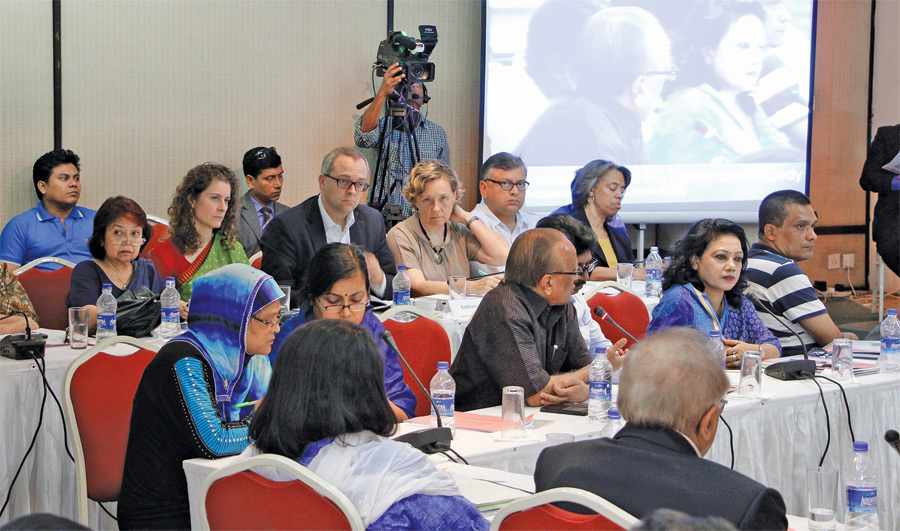
At one such event organized by the Centre for Policy Dialogue (CPD), a civil society think-tank, many eminent people committed to safety at work place – from workers’ unions to factory owners to legal experts to economists and even ambassadors of many western countries which are the main market for the garment industry – participated in an open forum dialogue titled ‘Re-emerging from the Rana Plaza Tragedy’. “The Rana Plaza building collapse was a wake-up call for us,” admitted Faruque Hassan, Vice-President of Bangladesh Garment Manufacturers and Exporters Association (BGMEA). Giving a fresh perspective to the tragic incident that claimed 1,334 lives, Dr. Khondaker Golam Moazzem, Additional Research Director, CPD reasoned, “Although Rana Plaza was a symbol of poor compliance, efforts of private sector, Government, international agencies and other stakeholders have made it a symbol of better compliance in the world.”
With many workers’ representatives present at the event, Professor Rehman Sobhan, Chairman of CPD, expressing solidarity for the rights of the workers, identified three key factors behind such tragedies – weakness of Government agencies, poor mindset of the industry towards workers, and the global market dynamics. He openly questioned the process of globalization which allows a product made at US $ 5 in Bangladesh to be sold at US $ 25 by western retailers and even then most buyers were not willing to share the gains for workers’ safety and upliftment and instead putting more squeezes on prices. Rehman also suggested that there should be more transparency in ‘costing’ so that each link in the supply chain gets its due.
Identifying challenges…
Setting the base for discussions, Dr. Moazzem presented the CPD-ILO study titled ‘Post-Rana Plaza Developments in Bangladesh: Towards Building a Responsible Supply Chain in the Apparels Sector’. He focused on five core challenges: remediation of RMG factories; freedom of association; strengthening the organisations; changes in governance in the global apparel value chain; and some of the unaddressed issues of Rana Plaza victims and their families. Laying bare the trauma that the survivors are going through, the study finds that the rate of re-employment of Rana Plaza survivors is still very low, at 21.4%, as many of them do not want to go back to their workplace, either for their physical health-related problems or mental trauma. Dr. Moazzem emphasized on developing responsible supply chain in RMG sector by strengthening the Department of Inspection for Factories and Establishments (DIFE) with adequate capacity. He also suggested upgrading the Department of Labour (DoL) into the Directorate of Labour to ensure better support to the workers.
Progress of Accord Initiative
• About 58% of work has been carried out till date
• Low percentage of completed CAPs (0.12% of total CAPs)
• High percentage of CAPs are behind the schedule of implementation (81.04% as of February 2016)
The biggest challenge in remediation of RMG factories lies in the fact that a good number of factories are still out of any assessment process (about 909), and in factories where the process is taking place the limitation in skilled professionals to undertake the task has slowed down the process considerably with 81.04% of suggested change implementation behind schedule as in February 2016. However, from a stakeholder perspective the remediation process has been good and many entrepreneurs consider the parameters used for inspection above national standards.
In the case of freedom of association, the report noted that the number of trade unions registered in 2015 slowed down drastically by 72% and only 10 new trade unions have been registered this year, till March 2016. Entrepreneurs argue that they are not against trade unions, but they fear that unions may disrupt work on small pretext due to outside influences. The need to institutionally recognize garment workers as partners in the industry by the factory owners to bring in ‘real and sustainable’ change was stressed upon.
Progress of Alliance Initiative
• Alliance has identified a total of 48,500 problems
• About 49% has so far been completed
• 24 factories have been fully remediated (4.1%)
Representing the administration, Mikail Shipar, Secretary, Ministry of Labour and Employment, GoB observed that factories being housed in shared and rented buildings are one of the major challenges in the remediation process. He admitted that lack of trained human resources is an obstacle to accelerate the remediation and that there is an urgent need for effective coordination among the factory owners, workers and trade union leaders which he felt is a challenging task. Appreciative of the serious intent of the industry and Government in bringing in changes for worker safety, Srinivas Reddy, Country Director of ILO Bangladesh Office, urged each and every garment factory in Bangladesh to go in for inspection and remediation.
Get Access to more Market Issues articles from
APPARELRESOURCES.COM. SUBSCRIBE TODAY
Suggestions for closure…
Debapriya Bhattacharya, a distinguished Fellow of the Centre for Policy Dialogue and a distinguished economist, pointed out five major issues that could put a closure to the tragedy and allow the industry to move on: punishment to the responsible persons for the collapse; re-employment of the victims; free treatment for them; compensation; and finding the missing workers. He lamented that even after three years of the industrial disaster many legal aspects of the Rana Plaza collapse have remained unaddressed.
Pace of remediation seems to be influenced by
• Costs incurred to undertake necessary remediation (seems to be high for building and fire-related problems)
• Non-availability of necessary corrective materials
• Limited availability of skilled professionals
• Lack of interest of entrepreneurs concerning the bleak prospect
Sara Hossain, an eminent advocate at the Supreme Court and a human rights lawyer made some very valid observations on the subject of ‘compensation’. “When working out a formula for compensation, no consideration has been given to pain and suffering, neither has the issue of pinning accountability for compensation been resolved,” she said. Sara was also critical of norms for compliance, questioning whether they should be in accordance to international sensibility or national realities.
Though official figures claim that over BDT 231 crore has already been disbursed among victims by stakeholders, including Government, factory owners and brands, Babul Akhter, Secretary General of IndustriALL Bangladesh, the local chapter of the global union federation, argued that the money the families of the deceased and the injured had received so far from various sources cannot be termed ‘compensation’; they are mere ‘grants’, and the injured should continue to receive medical treatment for life.
In a move that brought cheer, the Secretary announced that a fund would be set up soon wherein 0.03% of export earnings would be mandatorily reserved for the welfare of workers. “With the support of global brands/buyers and the ILO, a global trust has been created to provide Rana Plaza victims with compensation. More than US $ 19 million have already been raised for the fund, of which US $ 18 million has been distributed among 3,000 beneficiaries,” claimed the Labour Secretary.
Rift between exporters and monitoring agencies exposed…
In an interesting face-off between the industry and the monitoring agencies, Arshad Jamal Dipu, Chairman, Tusuka said he believes those who are conducting factory inspections are also promoting their commercial purposes adding that the Government should be at the driving seat for factory inspection rather than Accord and Alliance. “This ‘irritant’ has to be addressed; otherwise, the effectiveness of corrective action will not be there. The quality of inspections has to be ensured,” he said. His frustration was obvious as he went on to say that if the Government did not proactively look into the matter, many company owners may in fact think of other industries to work in rather than be harassed on ‘unpractical’ demands from the factory inspection agencies that cropped up after the Rana Plaza incidence.
Responding immediately and vehemently to the allegations, Rob Wayss, Executive Director of Bangladesh Operations of Accord on Fire and Building Safety, said that they are just working for a better compliance of the RMG factories and it is untrue that the Accord inspectors pushed garment factories to buy any specific service or product for remediation. “We have a list of the companies that are doing different types of work related to remediation. We state that we are not recommending and endorsing them. We have simply provided the information to the factory owners,” said Rob He, however, mentioned that the factory owners can lodge official complaints for any specific allegations they may have, regarding Accord’s engagement in providing assistance for remediation.
Rob reiterated that the Accord stood by the inspections done by Bangladeshi and international engineers during the initial inspection and by Bangladeshi engineers in the follow-up inspections. He said the Accord coordinated extensively ‘informally’ on a daily basis and ‘formally’ on a monthly basis with the Alliance, another factory inspection agency. Supporting the existence and role of the inspection agencies in bringing the needed change in the industry, Babul Akhter said the Accord and Alliance should work in Bangladesh until all the factories are fully safe, irrespective of what the factory owners were demanding.
Need for responsible reporting…
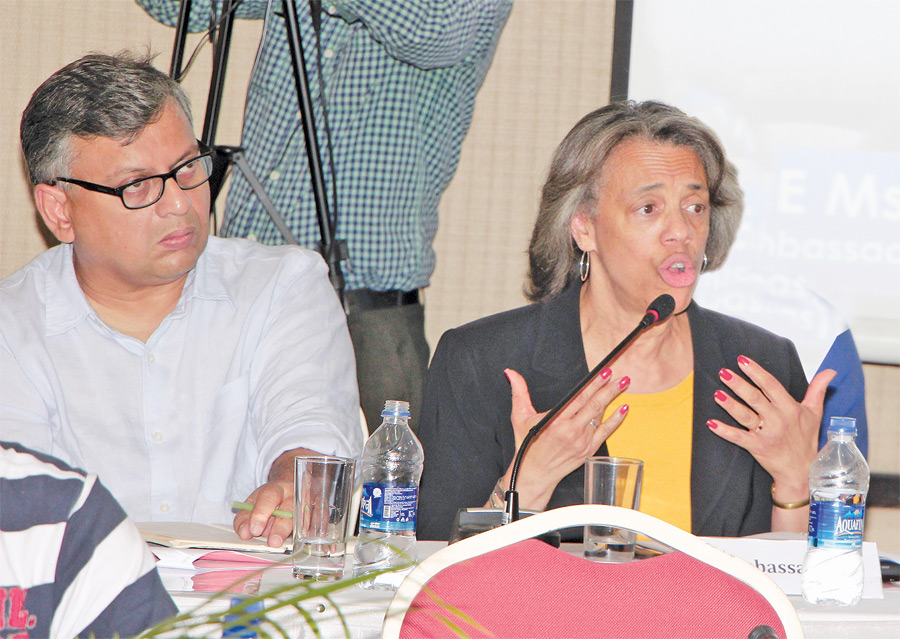
Ambassadors of the United States, Switzerland, Netherlands, France and Spain expressed satisfaction at the work being done in the past three years, though they felt that a lot still needs to be done. Marcia Stephens Bernicat, US Ambassador to Bangladesh, while urging the industry stay be positive said, “I strongly protest to the view that the garment industry in Bangladesh has been built on the back of cheap labour. They have been producing world-class garment items and they are much more than cheap labour suppliers.”
On a conclusion note Apparel Online, emphasized the importance of ‘responsible reporting’ to ensure that the positive developments and pro-activeness of the industry is highlighted to the world to understand and support the change, rather than just focusing on the low and negative happenings in the industry.





 Bharat Tex Special Report 2026