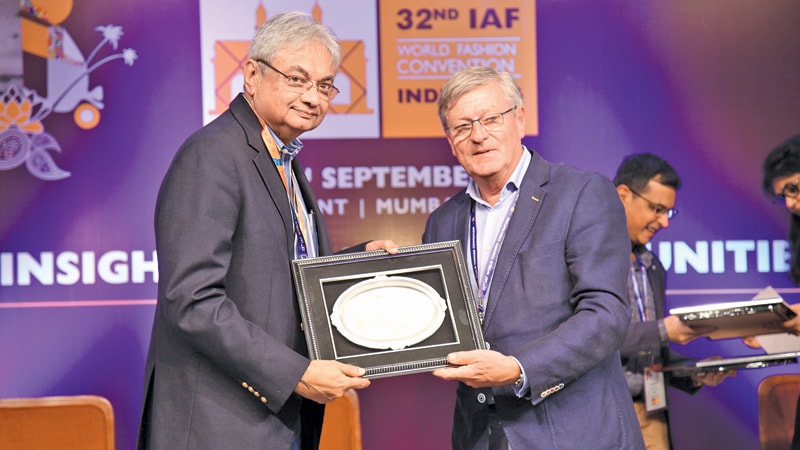
Held in Mumbai, the 32nd International Apparel Federation’s World Fashion Convention witnessed many thought-provoking sessions as stalwarts of Indian apparel and textile industry and many international experts discussed on issues like sourcing, growth, branding, and denim, online/offline. It was good to see that Indian apparel industry is enthusiastic as well as ready to solve its challenges. Overseas speakers’ positive attitude towards Indian apparel sector was noticed at the event.
Experts, however, have forecast India’s business from textiles industry to double in five years – from US $ 110 billion (US $ 68 billion of domestic and US $ 42 billion of exports) now to US $ 220 billion by 2021. But there are many steps that need to be taken like discussing on ‘India-EU Trade Relations – Future Perspectives’. Francesco Marchi, DG, EURATEX said, “The Indian Government should start negotiations for the FTA with the EU and the UK for the benefit of the Indian apparel sector. It is hard to imagine the success of the FTA without UK, post Brexit. UK continues to be textiles manufacturing hub contributing 29 per cent of the entire apparel trade in the EU; 22 per cent of India’s exports to the EU goes through UK.”
Han Bekke of the Netherlands was elected as the President of IAF as Rahul Mehta has retired from the post. The 33rd IAF convention is scheduled to take place in Rio De Janeiro, Brazil, ON October 17–18, 2017.
Ashok G. Rajani, Chairman, AEPC said, “India has to reach a target of US $ 30 billion of apparel export turnover in the next 3 years and we envisage an investment of US $ 11 billion over the next three years. In few months from now, we are looking at revolutionizing the way we service our buyers. We believe our buyers should be allowed to focus on their customers, while we focus on ours.”
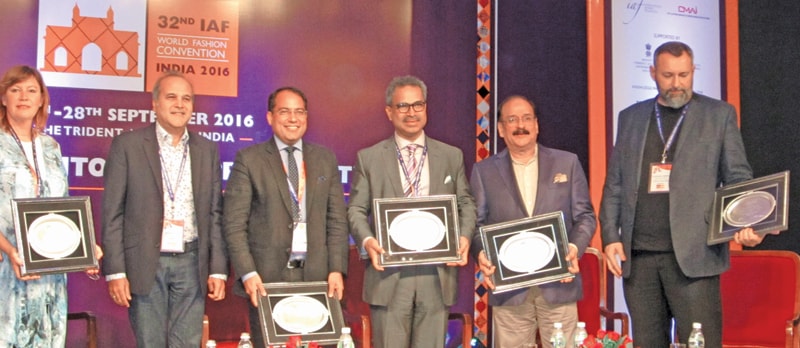
At a session on ‘New Opportunities in Denim’, industry experts opined that the Rs. 30,000 crore (US $ 4615 million)India’s denim industry has been growing at a CAGR of 15 per cent over the last five years and would continue to growth at the same speed in the next five years to achieve Rs. 54,600 crore (US $ 8,400 million) by 2023. With the emergence of denim demand from Bangladesh to which India exports huge quantity, Indian businesses have doubled their installed capacity of denim to 1.3 billion metres per annum over the last five years with an estimated investment of Rs. 60 crore (US $ 9.23 million) per million metres. Numbers of denim manufacturers have almost doubled to 42 now from 25, five years ago. But around 30 per cent of this capacity remained idle due to excess production capacity. Subir Mukherjee, Business Head (Denim), Bhaskar Industries said, “India is selling cheapest pair of jeans which nowhere in the world is available. If we bring down the price of jeans to US $ 10 apiece, as is currently prevailing in the US, India’s denim demand would increase, resulting into this sector’s growth at 20 per cent per annum.”
Rahul Mehta, President, IAF and CMAI insisted on India’s own brands as he said, “In my personal opinion, Indians have a British colonial hangover of foreign brands. But, Indians should create their own brands as they understand Indian consumers better than foreign brands. Foreign brands are luxury ones which are limited to metro cities only. Indian brands feel ownership pride as well. In fact, India is gradually moving towards branding from labelling. But, the average Indian business will have to shift from FOB-based pricing for profit making to brand building for long-term profits in apparel sector.”
The event also witnessed experts from various segment of industry like Anurag Asthana, Vice President, (Product Development & Sourcing), Myntra Designs highlighted that online sales complement to brick and mortar retailers so denim business will grow both online and offline. Sanjay Vakharia, Director and COO, Spykar feels that lower segment of denim is growing rapidly. But, there is a need to bring cheaper segment of denim for the consumers in the bottom of the pyramid. “Brands are getting disturbed due to rapid change in fashion and technology,” said Manjula Tiwari, CEO, Future Style Lab.
Aniruddha Deshmukh, MD and CEO of Mafatlal Industries Ltd. was also enthusiastic about e-retailing as he said, “E-retailing is going to be the next growth opportunities in the Indian textile and apparel sector in the next few years. Metro cities are overcrowded with retailers with higher overheads. Thus, there are more retail business opportunities in tier II and tier III cities. Companies have better opportunity of expansion though franchise route.”
During the event CMAI signed an MoU with China Chamber of Commerce for import and Export of Textiles (CCCT) for extending co-operation to each other in terms of new business opportunities and exchange of trade and data-related co-operation for mutual benefit. “This MoU will benefit both countries when we explore opportunities. While organizing trade fairs, both of us would co-operate in associating new clients, visitors and associated supply chain participants to the forum for the benefit of the apparel trade,” said Rahul Mehta.





 Bharat Tex Special Report 2026