Accessories are as important a part of garments as is fabrics! While 50 per cent of the cost of a garment is fabrics, accessories account for 18 per cent of the production cost. Matching the rapid growth of Bangladesh RMG industry, accessories manufacturers are also scaling up their capacities, expertise and offerings to support the RMG sector effectively, reducing its dependency on almost all kinds of accessories from countries like China, Hong Kong, Singapore, Japan, India, Taiwan, etc.
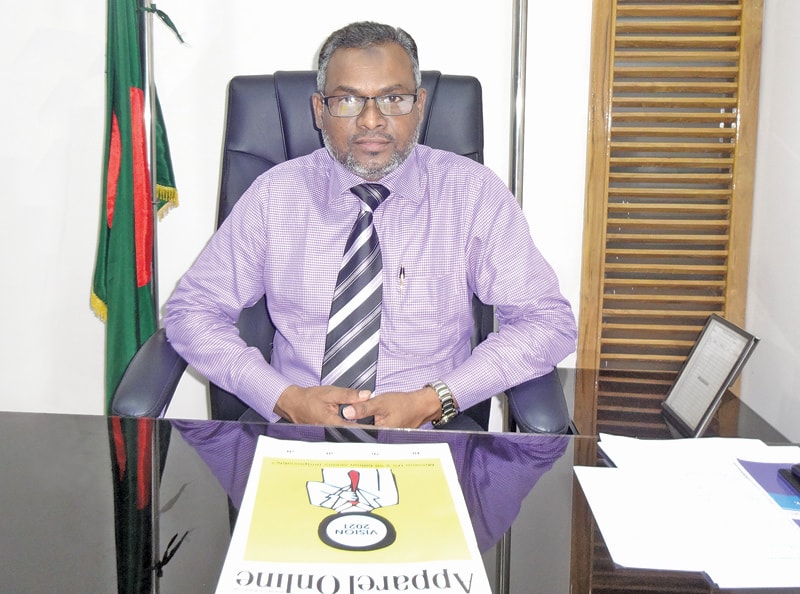
As local companies thrived, dependency on imported accessories gradually subsided so much so that the country is almost self-sufficient now accounting for 95 per cent of local accessories and packaging requirements and marking a growth of 10 per cent while contributing more than 30 per cent in value addition… Apparel Online Bangladesh spoke with Md. Abdul Kader Khan – President of Bangladesh Garments Accessories & Packaging Manufacturers & Exporters Association (BGAPMEA), in an exclusive interview to get his perspective on the accessory manufacturing industry of the country, its prospects and potentials, challenges faced, and the way forward.
AOB: Now that the industry is self-sufficient in fulfilling the local demands, where do you foresee the future growth would come from?
Md. Abdul Kader Khan (MAKK): Although we have been able to meet 95 per cent of the requirements of the readymade garment industry currently, but considering the progress it is making in order to meet the target of US $ 50 billion from apparel exports by 2021, accessories and packaging materials’ demand would also increase in equal proportion, which presents us a very good opportunity for growth.
Accessories export is another good avenue for us for the future. At present we are exporting around 10-20 per cent of our total production directly to countries like Vietnam, South Africa, Laos, Cambodia and few other Middle East nations. Through more than 1,400 garments accessories and packaging units in Bangladesh, we are not only meeting the requirements of the RMG sector, but other export-oriented industries as well for packaging like pharmaceuticals, leather goods, frozen food, ceramics, cosmetics, food and beverages, vegetables, flowers, handicrafts, jute products, etc. So, packaging is another very good option for us to maintain the growth curve growing.
In the last financial year our turnover from exports was US $ 6.12 billion. Export volumes could have been increased significantly had we been able to bring down the production cost apart from the two unfortunate incidents in the country, which have slowed down our growth. Shortage of gas, electricity and raw materials locally is further impacting our development.
AOB: As a trade body representing the accessories and packaging industry of Bangladesh, what steps have been initiated by the BGAPMEA to ensure growth?
MAKK: Many steps have been initiated by BGAPMEA to ensure the development of the garments accessories and packaging industry which include feasibility study under INSPIRED project with the help and support of the European Union and the Ministry of Industries (Bangladesh Government), plans to set up a garments accessories and packaging training institute and a testing laboratory to ensure highest standards of services. Besides, we in BGAPMEA and in association with the Asian Packaging Federation (APF) also organize various training programmes for the member factories from time-to-time.
AOB: What do you think are the challenges for the industry’s growth?
MAKK: I see four diverse challenges for the industry; the first challenge is because of the unpredictability in the market. We all know that export market is subject to high volatility and price fluctuations. Besides, it always has a downward trend, which affects the growth. In addition, mainstream exporters always try to pass the buck on accessories and packaging suppliers, which I feel is a case of victimisation.
The second challenge is of continuous price hike of raw materials. Raw materials from industrialised countries are rising adding to the production cost. Falling prices of finished products coupled with rising cost of production is making growth difficult for the accessories and packaging industry. Third challenge is of manpower shortage; lack of trained workers and non-availability of technicians to work on high-tech machines and equipments is a big issue facing us; and lastly it is the lack of testing, research and development facilities in the country.
AOB: What about compliance in the accessories manufacturing factories… Do Accord and Alliance have any role to play there?
MAKK: Accord and Alliance are more relevant to the garment industry as most of the garment factories are multi-storeyed, besides there are several safety issues related to building structure. Owing to heavy machines and equipments, accessories factories are mostly one or two-storied. As such there are hardly any building safety concerns. But yes, we have to conform to other buyers’ requirements, compliance and safety pre-requisites.
AOB: Out of the 1,400-odd accessories manufacturing units, how many factories have met these requirements?
MAKK: Currently, there are around 200 factories which are fully compliant. Since 2016, buyers and our Commerce & Industries Ministries have made compliance a must for accessories factories. But it is very difficult to become compliant overnight as remediation requires big investments… It would take some time before the sector becomes fully compliant. However, as compliance is a must to ensure growth and development, other factories have started working towards achieving compliance in the right earnest. We from BGAPMEA are also helping entrepreneurs who want to come up with new units with our views and suggestions pertaining to making a compliant manufacturing unit.
AOB: We are sure you must be seeking Government support to ensure growth?
MAKK: As one would know that Bangladesh Government has a vision to upgrade the country to a middle-income nation by 2021 and with respect to the same, Bangladesh Garments Manufacturers and Exporters Association (BGMEA) has declared RMG export target of US $ 50 billion by 2021. If they want to achieve this target, garments accessories and packaging sector has to export US $ 12 billion by the end of 2018 from the US $ 6.1 billion today, and US $ 18 billion by the end of 2025. Simultaneously we need to keep pace with the growth of the industry, and to achieve this, we need policy support from the Government, cash incentives for the sector to offset the high production cost, reduction in bank interest rate and availability of long-term loans, uninterrupted power and gas supply and development of infrastructural facilities.
AOB: Which all accessories the country is self-sufficient in and which are the categories that have good opportunities?
MAKK: We produce almost 30-40 items locally including zippers, buttons, hooks, hangers, elastic bands, laces, threads, backboards, butterfly pins, clips, collar stays, collar-bones, ply gates, etc. Besides, we also print labels and price tags, all of which have very good prospects for the future.
AOB: Can you name a few domestic accessories manufacturing companies that are growing significantly?
MAKK: KDS Accessories Ltd., Mon Trims Ltd., Fabian Industries Ltd., Dekko Accessories Ltd., Siam Computerised Elastic Pvt. Ltd. (Mumtex Group), Neo Zipper Company Ltd., Banga Plastic International Ltd., Shenzhen Metal Industries Ltd., Twice Poly Bag & Thread Industries Ltd., Uniglory Group, COSMO Group, NR Group and Khan Accessories & Packaging Company Ltd. (KAPCO) are some amongst the domestic accessories manufacturers that are witnessing good growth. All these companies produce and export different types of accessories and packaging items.