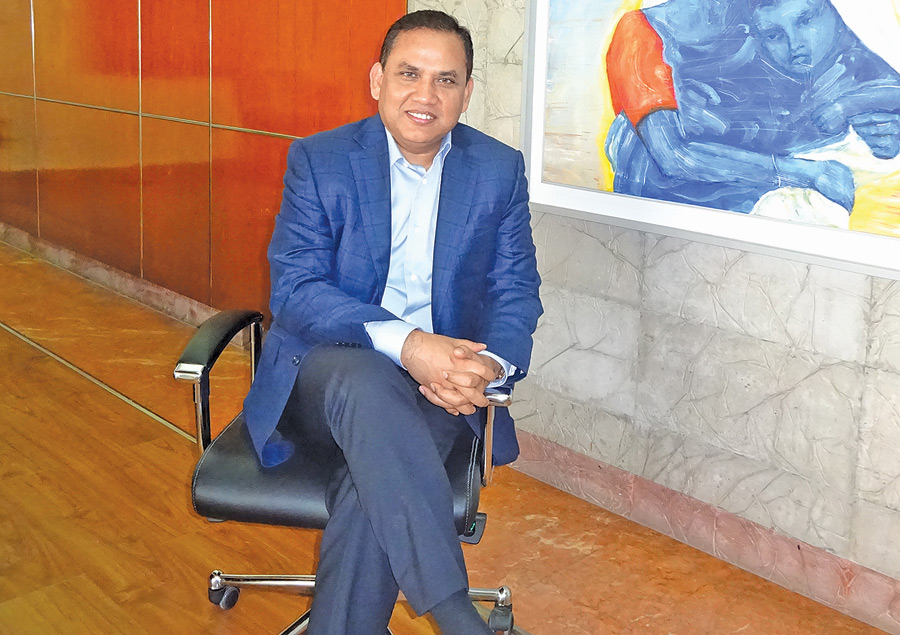
Building business on the foundation of sustainability, the DBL Group is a benchmark for many in the country for best practices. Not only is the company implementing unique ways to be sustainable, but is also sharing its experiences through its annual sustainability report. The latest edition of the report which tracks sustainability efforts during the period 1 July 2014 to 30 June 2015, was launched at the Federal Ministry for Economic Cooperation and Development in Berlin, Germany by Hans Joachim Fuchtel, Parliamentary State Secretary to the Federal Minister for Economic Cooperation and Development. A proud moment for the company, Mohammed Abdul Jabbar, Managing Director of DBL Group; Faruque Hassan, Senior Vice-President of the Bangladesh Garment Manufacturers and Exporters Association (BGMEA); and Dr. Georg Kippels, Member of Parliament, Germany were also present at the launch of the report.
As a signatory member of United Nations Global Compact, the vertically integrated DBL Group, which is manufacturing for brands like H&M, Walmart, Puma, M&S and NEXT, is committed to create a platform for ensuring sustainable growth for the company on many fronts. “Our sustainability strategy focuses on five major components, which are integrated in the core value of the organization: People, Process, Product, Community and Environment. We aim at relishing the idea of sustainability for generations to come,” says Abdul Wahed, Chairman of the Group. A sizeable portion of DBL’s profit is channelled into CSR activities, reflecting the commitment of the Group to social development. In order to ensure that the national and international laws, as well as those of buyers (through their codes of conduct) are maintained, DBL Group’s Compliance Department is divided into two wings: social and environmental.
Social Sustainability: People are the backbone of the organization…
DBL, currently having workforce of 20,450 is aiming to generate 10,000 more employment opportunities in the running year. As a policy, the Group only employs full-time employees and treats them as team members. Hence, significant operational changes, such as restructuring, outsourcing of operations, expansions, etc. are communicated to the concerned employees at least three months prior to the change in order to keep everyone updated. This also gives sufficient time in order to prepare them accordingly.

Many initiatives have been taken to support the workers in their daily lives besides engaging them in the company. In-house training is at the core of workers welfare and in 2014-15, the total training hours spent amounted to 1,95,838 with male and female employees receiving 1,23,574 hours and 72,264 hours, respectively. Women Health Program Initiative (WHPI); Future Leaders Development Program (FLDP); Bandhan Fair-price Shop – where workers of the company can buy their daily needs on credit, payment of which is adjusted from the salary; NIRAPOD, which enlightens women on unwanted pregnancies and Women in Factory initiatives, are the main projects in operation at the factories to support the workers. NGOs like Phulki, in partnership with the Embassy of Netherlands, are also supporting the Group to promote health awareness among the female workers.
Taking worker welfare beyond compliance, collective bargaining agreement is not prohibited in DBL. “To make a trustworthy relationship between the workers and the company, DBL Group has formed Workers’ Participation Committees, which constitute representatives of both the employers and the workers. Workers are encouraged to participate in them and over 50% of each committee comprises of workers,” shares Abdul Jabbar, Managing Director of DBL Group.
DBL Group appreciates taking ideas from all of its employees, including the workers; besides the ‘Suggestions & Grievances Box’ which is found in many factories today, an additional box has been included with the aim of taking in suggestions from workers that relate to improving production efficiency. This method provides a way to involve workers in the decision-making process which makes workers feel important. The ‘Kaizen Suggestion Boxes’ are present in all units and all suggestions are discussed in the ‘Kaizen Meeting’ held every month. The employee or the worker with the ‘best suggestion for the month’ is recognized with the ‘Kaizen Award’.
“In addition to the ‘Kaizen Suggestion’ system, efforts of our employees and workers are also recognized through another monthly recognition system: the ‘Employee of the Month’. The program was inaugurated in the knitting section and has been replicated for the other units too. These ideas are compiled under our ‘Idea Club Sustainability Programme’. A huge advantage of having an employee of the month incentive is the motivation to work at their highest potential and move them towards empowerment,” says Jabbar.
Environmental Sustainability: Saving energy and reducing impact of business on the environment
To reduce environmental footprint, DBL Group has formed an Environmental Management System (EMS) team. Standard Environmental Policy and Environmental Health and Safety (EHS) Policy have been formulated which address management of: Waste, Energy, Waste Water, Noise Pollution, Water Use, Greenhouse Gas (GHG) and Ozone Depleting Substances (ODS). The company also boasts of having the largest biological effluent treatment plant in Bangladesh, which is benchmarked by the Department of Environment of Bangladesh to set up other ETPs in the country. With the success of Cleaner Production Project Initiative by IFC (a World Bank group), DBL has been able to save huge amounts of energy consumption over the years. “We have a target to reduce waste, carbon emission, water and energy consumption by up to 25% within the year 2015 on the baseline of 2011,” shares Abdul Wahed, who is now eagerly awaiting results as the data is currently being compiled.
All input materials are weighted and tracked to control unwanted wastage. Different systems, such as Lean Manufacturing, Kaizen and 5S are used to ensure proper utilization of materials, thereby reducing waste. Electronic tabs are used for data input with in-house developed software and hence moving a step closer to paperless systems. State-of-the-art dyeing machines that consume 50% less water in comparison to the average dyeing machines have been installed to save water; in addition, water consumption in the fabric dyeing process has been reduced from 120 litres per kg of fabric to 55 litres per kg of fabric. Less water means consumption of less dyes, chemicals, steam and electricity, and reduction in waste water discharge. Adding trigger nozzles prevent unnecessary running of water during washing of process vessels, machines, chemical drums, floors, car, etc.
Recent Community Initiative…
In a community initiative, DBL Group and GIZ signed a cooperation agreement to establish a Mini Fire Brigade in March 2015. The objective of the Mini Fire Brigade rapid response and risk reduction unit is to prevent fire in the industrial buildings around Kashimpur and Gazipur areas. The Mini Fire Brigade unit will be located outside Jinnat Complex of DBL Group which will also serve other factories in the Kashimpur-Konabari industrial cluster. While DBL Group is providing land for a suitable construction for the Mini Fire Brigade, the volunteers of Bangladesh Fire Service and Civil Defense (BFSCD) will undertake the initiative to organize training for volunteer fire fighters and provide infrastructure support. GIZ will facilitate the procurement of fire-fighting equipment.
DBL on expansion route
Spinning catches pace in Bangladesh RMG sector…
“While Bangladesh’s apparel business is booming, the developments in textiles are too few. This is not sustainable for the long run when orders will start moving out of China at a faster rate,” states a slightly worried MA Jabbar, Managing Director of the US $ 320 million DBL Group.
DBL Group had identified this shortage of yarn availability in its early years when the company had just begun as a garment exporter. “We used to import most of our yarn from India, besides some special kinds of yarns from Indonesia, China, and Thailand which would drastically increase our lead times. So getting into spinning was a necessity for our value chain,” shares Jabbar, who is now not only manufacturing basic yarns at Matin Mills in Kashimpur, but yarns with special twist as well, if required. Currently, DBL Group is in a plush position as it easily meets its daily in-house demand of 90 tonnes and is still left with balance, which is used to cater to the demands of other factories in Bangladesh. Today, the company has reached a stage where both, textiles as well as garments, are the core businesses of the Group.
Looking at further reinforcing the Group’s competency, Jabbar has made a slew of big purchases at the recently concluded edition of ITMA. “I think we were the biggest buyers this ITMA as we bought machinery in all sections – knitting, dyeing, finishing, and printing. Only for spinning, we finalized about 9 companies,” avers a confident Jabbar, who has made these purchases for an upcoming 100% cotton mélange open-end spinning facility which will take the Group’s output to 130 tonnes of knitted finished fabric a day. “The increase in the textile capacity will reflect in the garmenting section of the Group as well,” Jabbar assures.
The highlight investment by the company will be the VORTEX spinning machine by Muratec which integrates the three processes of roving, spinning and winding. The superior pilling resistance, external appearance, printability and other characteristics of VORTEX yarns and fabrics have been recognized all over the world and have greatly expanded the product development possibilities in the fashion world.
The thought of backward integrating reverberates through a significant section of the industry in the country today, as companies like Envoy Textiles and ARGON Denims are venturing into spinning, while groups which already have spinning capacities are expanding. Esquire Group, Ha-Meem Group, and Square Group are some of the names. DBL with its proactive approach is leading by example and the future for the group can only be sustainable in all aspects – socially, environmentally and economically!