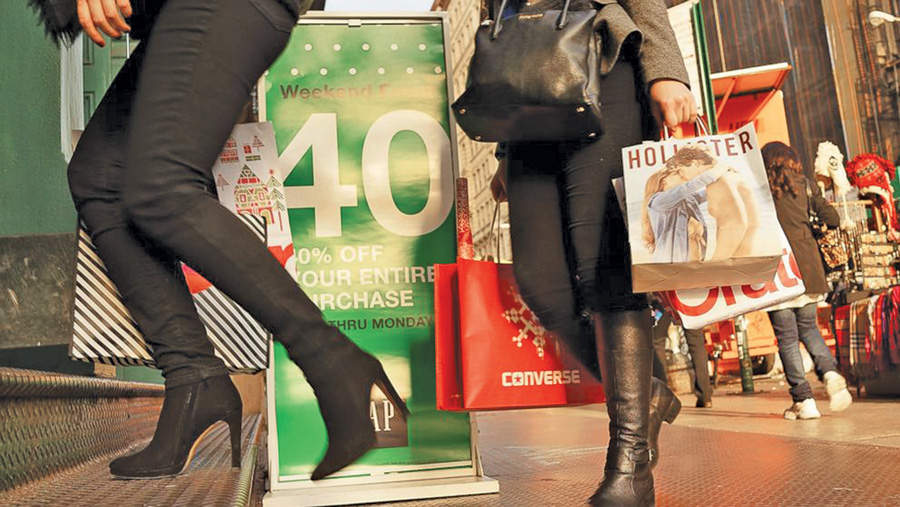
 The year 2015 yet again proved to be a tough holiday season for the industry due to harsh weather, inventory challenges, constant technological advances, a slowdown in purchases by international tourists due to the strong dollar, and deep discounts during the season that started earlier than previous years. According to the National Retail Federation (NRF), US holiday sales rose a less-than-forecast 3 per cent, as merchants coped with unseasonably warm weather and a shift to spending on services.
Analysing holiday sales, NRF had projected a rise of 3.7 per cent, which eventually grew to US $ 625.9 billion in the period spanning November and December – an increase of 3 per cent; while non-store sales – an indicator of e-commerce transactions, increased 9 per cent to US $ 105 billion, excluding spending on automobiles, gasoline and restaurants. On the other hand, First Data, another market Research Firm, analysed that retail sales increased 3.3 per cent from Oct. 31 through Jan. 4, up from a 3.2 per cent gain in the year earlier. While the Thanksgiving holiday weekend dominated spending in the period, with sales rising 6.3 per cent, the last two weeks of December also showed a higher concentration of sales. “Despite being challenging, the industry rallied, consumers responded and sales still grew at a healthy rate, which is a huge testament to the resilience, knowledge and expertise of our retail leadership,” reveals Matthew Shay, CEO and President, NRF.
The holiday season accounts for as much as 40 per cent of a retailer’s annual sale, thereby coming up with strategies such as early discounts and promotions to absorb maximum sales has become a norm. During this season, the retailer had to strike a balance between satisfying consumer needs online, while also trying to get them into the physical stores. Though representing just about 15 per cent of the total holiday sales, online sales rose 9 per cent, comparatively higher than NRF’s original forecast of 6 per cent to 8 per cent growth. This has shifted the spotlight back on to the importance of balancing online and offline retail. Despite years of effort and billions of dollars of investment, most retailers still get only a small percentage of their business from e-commerce, leaving them vulnerable to large online players.
Get Access to more Market Analysis articles from
APPARELRESOURCES.COM. SUBSCRIBE TODAY
 According to Slice Intelligence, a Research Firm, Amazon.com captured 42.7 per cent of online sales in November and December, from a gathered data on the email receipts of 3.5 million consumers. While the 10 biggest retailers combined, including Walmart, Target Corp., Macy’s, Nordstrom Inc. and Best Buy Co gathered together 24.8 per cent share of the total retail during the same period. Most sales are still made at physical stores. About 91 per cent of shoppers made a purchase at a brick-and-mortar store this holiday season, according to a survey by the International Council of Shopping Centers. The primary reason for going to a store was the ability to see, touch and try on the merchandise. Yet, the online buzz is forcing many stores to rethink the size of their stores and in response to competition from online retailers such as Amazon.com, major stores have started investing in bigger distribution centres to speed up online deliveries and push free shipping. A few others have expanded their services like allowing online shoppers to pick up their orders at the store.
In retrospect, the bleak holiday sale has pushed many major retailers to close down non-performing stores or cut jobs as austerity measures. The world’s largest retailer, Walmart Stores has announced closure of 269 stores globally, including 159 in the US, while Macy’s slashed its profit outlook and announced cutting of 4,800 jobs, about 2,700 of this job cuts will come from about 40 store closings, as sales at its existing stores fell 4.7 per cent in November and December. Gap Inc., which is also closing stores, revealed December sales for existing stores fell 5 per cent from previous year.
Though retailers faced several challenges this holiday season, holiday sales did show an increase in the face of a challenging retail environment, and a few retailers’ did crunch profits. L Brands Inc., including Victoria’s Secret and Bath & Body Works, posted an 8 per cent jump in sales, declaring it to be the ‘best December ever’. Also, JCPenney Co. reported a 3.9 per cent increase in sales despite warm weather, due to ‘record’ online sales for the holiday season.
Few statistics on holidays season sales
According to NRF, December retail sales, which excludes automobiles, gas stations and restaurants, decreased 0.2 per cent seasonally adjusted from November and increased 3.1 per cent unadjusted on a year-on-year basis.The US Commerce Department revealed that December retail sales, decreased 0.2 per cent seasonally, adjusted month-to-month and increased 2.2 per cent unadjusted year-on-year.
Kurt Salmon, a retail consulting firm, estimates that as much as 30 per cent of online orders are returned as an increasing number of stores offer free returns to make online shopping more convenient, but in turn they deal with higher costs in processing those returns from customers.
According to RetailMetrix, which collects data through analytics software provided to retailers, foot traffic fell 6.4 per cent in November and December.
There are many interpretations to the same story and according to research firm IHS Global Insight, consumer spending in 2015 adjusted for inflation has likely contributed its largest share to GDP growth in a decade. This was partly due to the approximate US $ 722 less that each household spent on gas last year. Nonetheless, it is also true that people were not spending the extra money on clothing or other items that typically tops holiday shopping lists; in fact what they are spending on is restaurants, car purchases and making improvements to their homes. Even if they are buying apparel they are shopping at sporting goods stores for ‘athleisure’ items, found IHS.





 Bharat Tex Special Report 2026