Pohela Boishakh and Eid-ul-Fitr are better forgotten in terms of business generation from the retailers’ perspective in Bangladesh. Ramifications of COVID-19 have been nothing short of disastrous for the retail sector of the country, especially for those into fashion and lifestyle, for whom Eid-ul-Fitr and the Bengali New Year were two such occasions to do some decent business.
With both the festivals failing to boost sales, retailers had their eyes set on Eid-ul-Azha to try and make up for the losses suffered, as now there’s no other big occasion to look forward to throughout the rest of the year.
So, let’s find out how the sales have been in the run-up to this festival…
“This time, people have come out of their houses, but the sales are not that much,” felt Soumik Das, CEO, Rang Bangladesh (which has 24 stores in the big cities of the country). He added that sometimes they witnessed a good day with skyrocketing sales, followed by sales plunging to rock bottom the next day.
“Maybe this is what is called the ‘new normal’,” Soumik exclaimed, adding, “Many people are at home after losing jobs due to the pandemic. How will they buy clothes!”
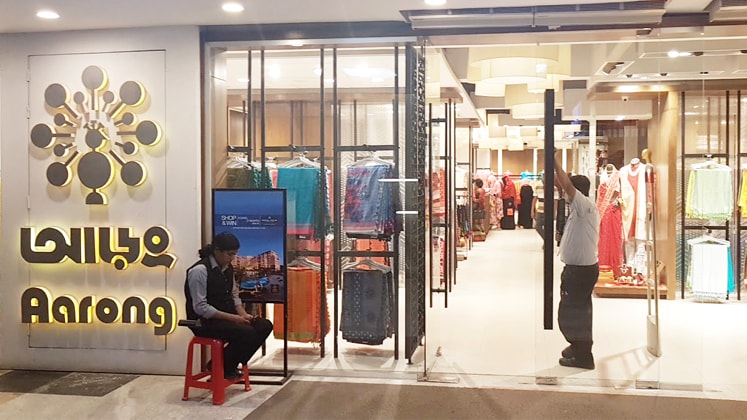
Meanwhile, Mohammad Ashraful Alam, CEO of the leading lifestyle brand Aarong, on his part, maintained, “Our business is very good if you consider we are in the middle of a pandemic.”
By the end of the day, sales would be 62 to 65 per cent of what it was during last year’s festival, Ashraful expects, while underlining that the brand’s e-commerce segment could witness a sales rise of 250 per cent month-on-month in July.
Also Read: Retailers pin hopes on Eid-ul-Azha now
The number of customers has increased in recent weeks, as the stores have been permitted to stay open for longer hours, said Ashraful. Aarong has been maintaining social distancing norms and other safety requirements ever since reopening its stores after coming out of the COVID-19-induced lockdown and associated restrictions.
“There are about 65,000 artisans who make our products. They would be left with no income if Aarong cannot make sales. Even in the pandemic, we went ahead with our store opening plan to save their livelihoods,” Ashraful underlined.
It may be mentioned here that on 25 July, Aarong opened a new 7,800 square feet store in Jessore, which took Aarong’s overall store count to 21.
“Restrictions have been relaxed more, so now people go out even after dusk and come to stores. Even though sales are not as per expectations, this change in people’s attitude has been encouraging,” Khalid Mahmood Khan, Co-founder, Kay Kraft and YOUNGKAY, maintained, further adding, “Buyers need peace of mind at first and then they will think of splurging.”
To bring in more customers, Kay Kraft and YOUNGKAY’s 24 stores offered a flat 20 per cent discount on all their products. This more or less has been the trend this time, with many even going ahead to offer discounts to the tune of 80 per cent to attract the buyers.
However, if industry insiders are to be believed, such moves have not been able to yield much in terms of business generation.
The cascading effect of COVID-19, especially in this festive season, has been rather telling on the footwear giant Bata Shoe, which in 58 years of its existence in Bangladesh, for the first time, suffered losses as sales in the festive season took a hit after people’s incomes have been wiped out by the pandemic.
Bata’s sales dropped 85.37 per cent to Taka 41.24 crore in the second quarter of 2020, while sales in the first half of the year dropped 55.37 per cent to Taka 204.92 crore.
Due to the collapse in sales, Bata Shoe sank into losses in the April-June period, giving up Taka 73.51 crore, whereas it had netted a profit of Taka 21.68 crore a year earlier, while the half-yearly loss stood at Taka 70.68 crore against a profit of Taka 26.14 crore year-on-year.
“As far as I know, this was the first time we suffered losses,” said Hashim Reza, Company Secretary, Bata Shoe.
About 25 per cent of Bata Shoe’s business comes during the Eid festivals (Eid-ul-Fitr and Eid-ul-Azha), according to the financial report of the company. Accordingly, it ramped up stock 3 months before Eid-ul-Fitr, the largest religious festival in Bangladesh. But the hope soon dashed after the Government imposed a countrywide lockdown on 26 March to contain the soaring cases of coronavirus infections.
By the time the economy was partially opened on 31 May, Eid-ul-Fitr (celebrated on 25 May) was already over.
Though the Government allowed limited opening of shops ahead of Eid-ul-Fitr, the turnout was low, so were the sales, said a store manager of the company in Dhaka, requesting anonymity.
The store normally posts revenue of Taka 30 lakh in Eid-ul-Fitr during normal times, but it was only Taka 2 lakh this time around.
The sales have been rising centring Eid-ul-Azha, but it can’t match the revenue stream recorded during normal times before the pandemic hit, the store manager stated, adding what happens after Eid-ul-Azha would indicate whether the situation is getting back to normal or not.
Bata Shoe manufactures and sells leather, rubber, plastic, canvas footwear, hosiery, and accessory items.
The reversal in the fortune of the company, a subsidiary of the Switzerland-based Bata Company, came, though it has become more optimistic about the country of late. Buoyed by the steadily growing economy, which was the fastest in Asia last fiscal year, and a young population, Bata opened its first-ever sneaker outpost anywhere in the world, in the capital Dhaka in November last year.
The store, dubbed B-sneakers, is on the Gulshan Avenue.
Bata, which has a network of 261 retail stores in Bangladesh, is also the lone franchisee of internationally renowned brands such as adidas, Nike, Hush Puppies and Skechers in the country.
However, notwithstanding the losses it suffered during Eid-ul-Fitr, the company came up with many offers, in an effort to ramp up sales on the occasion of Eid-ul-Azha. The company offered exciting cashback schemes for the consumers during the Eid shopping, collaborating with different bank’s cards such as AMEX-City Bank (15 per cent), Standard Chartered (10 per cent), BRAC Bank (10 per cent) and Mobile Wallet, Bkash (10 per cent), and many more for the loyalty members.
Further, in preparation for a safe shopping environment, it also made significant enhancements to the store environment and operations to prioritise the health and safety of customers and staff, which included social distancing measures, regular cleaning and sanitisation of outlets, as well as wellness and temperature checks, safety training, and the use of face masks and gloves.
Despite all the efforts, whether the company is able to make any profit this Eid-ul-Azha would be known in times to come. Until then, as one of the Bata managers underlined – what happens after Eid-ul-Azha would indicate whether the situation is getting back to normal or not, seems to be applicable for not just Bata, but other retailers as well, for many of whom, the fledgling sales this festive season could deal a hard blow with long-lasting ramifications.





 Bharat Tex Special Report 2026