 All eyes are turned towards developments in America, post the victory of Donald Trump as the next President of the United States, followed by various protests and question marks on how the economy will react in the long run. In this scenario, the outlook for holiday season sales is garnering mixed reactions, and according to many retail experts the uncertainty is likely to impact the holiday season sales this year. And even though retailers have come out in large, with various marketing tactics and a horde of promotions for their annual year-end gains, it remains to be seen whether the holiday season sales will reach its earlier forecast of an increase this year?
According to National Retail Federation’s earlier predictions, the holiday season sales of November and December, excluding autos, gas and restaurant sales would have increased a solid 3.6 per cent to US $ 655.8 billion, which is significantly higher than the 10 year average of 2.5 per cent and above the seven-year average of 3.4 per cent since recovery began in 2009. “All of the fundamentals are in a good place, giving strength to consumers and leading us to believe that this will be a very positive holiday season. This year hasn’t been perfect, starting with a long summer and unseasonably warm fall, but our forecast reflects the very realistic steady momentum of the economy and industry expectations,” revealed Matthew Shay, President and CEO, NRF when declaring the forecast. The overall non-store holiday sales in 2016 were expected to weigh in at US $ 112.35 billion. Also, in comparison to last year, retailers are expected to hire between 640,000 and 690,000 seasonal workers this holiday season, in line with last year’s 675,000 new holiday positions.
Another report from Deloitte was equally positive, projecting that the US retail holiday sales would exceed US $ 1 trillion, up 3.6 to 4 per cent over the same period in 2015, while online sales were projected to soar 17 to 19 per cent to reach US $ 98 billion between the two months. According to the report, consumers have ramped up their spending this year on the back of a strong labour market and also slightly higher growth in disposable personal income. “While attention toward presidential elections may be a temporary distraction in the early part of the holiday shopping season, it should not have a negative impact on sales, and retailers may benefit from a pickup in post-election consumer spending,” reveals the report.
But it seems as the positive outlook has taken a blow, and contrary to NRF’s forecast, Mintel, a Market Intelligence company’s new research reveals that the holiday season of November and December 2016 will only see a rise of just 1.3 per cent over 2015 to US $ 692 billion, the slowest growth rate since 2006.
Though providing an optimistic outlook for growth the pace is nonetheless conservative. The scaled down predictions for increase in sales during the holiday season is due to consumer concerns regarding the outcome of the elections and the global economic situation.
What was shaping up to be one of the most lucrative holiday sale season (according to earlier forecast) since the 2008 financial crisis, looms in uncertainty again as consumer spending analysts are worried about the surprise victory of trump derailing the earlier predictions. But, analysts believe that typically, the state of US economy impacts holiday shopping more than presidential elections and according to the US Census Bureau data, retail sales jumped 4.3 per cent during the holiday shopping season after George W. Bush beat Al Gore for the White House (another shock victory), from US $ 413.8 billion in November 1999 and December 1999 to US $ 431.7 billion during the same two months in 2000. But by contrast holiday sales dropped by almost 8 per cent immediately after Barack Obama beat John McCain in the 2008 presidential election. But one has to consider that this dip of US $ 592.9 billion in sales over November and December in 2007 to US $ 545.7 billion came during the time when the country was on the brink of the financial crisis. And in 2012, November and December retail sales hit US $ 641.5 billion as President Obama won a re-election bid against Republican Mitt Romney, which is up about 2.6 per cent from the US $ 625.5 billion retailers sold during the same two-month period the previous year.
• According to Deloitte, 74 per cent of shoppers plan to shop online this year as against 69 per cent in 2015, with Millennials driving online sales with 88 per cent planning to do half of their shopping online and 37 per cent looking to buy all their holiday gifts online.
• Consumers say that 47 per cent of their holiday shopping budget will go to online spending, and 47 per cent will go toward purchases inside physical stores, as per Deloitte’s report
• The Wall Street Journal reported in early October that most analysts anticipate a fairly strong holiday season, with spending up 3 per cent to 4 per cent compared with 2015.
• PwC estimates that spending will rise 10 per cent compared with the 2015 season and that digital sale will be up 25 per cent.
Greg Portell, lead partner in the retail practice of consulting firm AT Kearney, noted that realistically, any personal connection felt by consumers won’t be felt until January. Trump may have won the election, but he still hasn’t won the support and confidence of a significant portion of America. In his acceptance speech, Trump made clear he wants to unite the American people. But if Trump does not succeed in doing so, retailers can expect a “brutish” next four years, according to David French, senior Vice President of Government relations at the NRF.
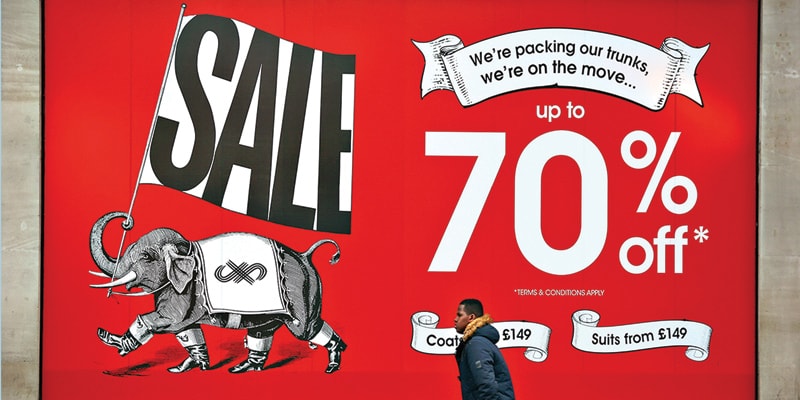
Notwithstanding the circumstances, retailers have gone out fully with promotions and discounts. Gap Inc., Macy’s and Toys R Us are blasting email subscribers with deals ranging from 15% to 40% off and Wayne, NJ-based Toys R Us have also promoted a two-day ‘Big Brand Blitz’ sale. Apart from this various retailers are re-strategizing such as Walmart by staffing stores with holiday helpers to assist shoppers find gifts and make purchases more quickly and also boasting selfie stations and toy demos to liven things up. Also, Target’s holiday strategies include new value propositions, like US $ 10 off US $ 50 purchases for a rotating set of categories in the weeks leading up to Christmas, as well as Wondershop, a store-within-a-store concept stocked up with 2,000 new seasonal items. Meanwhile, retailers like Kmart and Toys R Us are emphasizing deals and service with special offers focused on layaway and price matching, respectively.
Though retailers have put their strategies in place but the early figures by retailers such as Barnes & Noble and Gap have not been very encouraging, both of these retailers blamed their recent poor sales performances on shoppers being too focused on the presidential elections. There is also some evidence that stores have delayed holiday advertising because it would be waste of money as the whole nation was engrossed in the elections and subsequently its result. While the holiday season sales predictions is being closely watched by the retailers, industry experts and analysts, one thing is for sure that stores will discount more heavily if they anticipate a slow holiday period and the discounts will be especially large late in the year, practically few days before Christmas, if the season doesn’t turn out as expected.