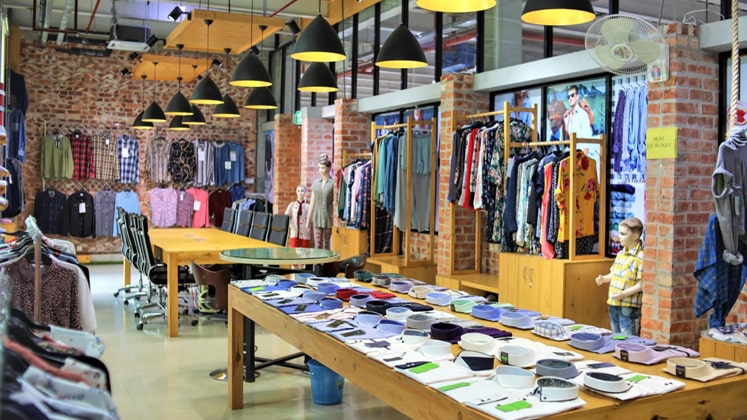
Last year has been a very challenging one for the retail sector of Bangladesh!The first case of COVID-19 was first detected somewhere in the early part of March, and by the end of the month, the Government had imposed a lockdown which virtually brought everything to a grinding halt including the retail sector.
Considering Ramadan and Eid-ul-Fitr, even though the Government allowed businesses to operate in the month of May, it was but on a very limited scale and with strict restrictions as shops were allowed to remain open to do business,but only on a limited basis. Even shopping malls were asked to make arrangements for hand washing/cleansing and other safety requirements.
“From 25 March 2020,all Noir and Miniso Bangladesh stores remained closed and reopened only on 10 July 2020. The health and well-being of our customers, colleagues and community are and will always be our top priority which is why we had opted to keep our gates closed during the peak seasons and resumed operations after taking time out to carefully implement strict safety protocols to ensure a comfortable and safe shopping environment,” observed Shah Rayeed Chowdury, Director, Evince Retail Limited, speaking to Apparel Resources.
The developments have been rather devastating for many local brands with names such as Deshi Dosh, Western Fashion, Artisan, Cats Eye and Aarong underlining that sales were still down by 50 per cent than usual even as footwear brands have also been going through a similar selling condition. They are not getting more than 60-65 per cent of buyers compared to the pre-pandemic times, said Md. Shamim Sheikh, Branch Manager, Apex, a leading footwear brand at Bashundhara Shopping Centre, while adding that traffic (customers) has been picking up to some extent for a week with customer flow now being around 65 per cent.
“It will take more time to get back the sales of normal times,” said the Manager at Western Fashion’s Bashundhara Shopping Mall outlet then, while Shaheen Ahmed, President, Association of Fashion Designers of Bangladesh and the Owner of Anjans, on his part, had then underlined that the demand for new clothes has decreased with social events remaining suspended and people reluctant to go out much.
The unprecedented impact of the pandemic further resulted in many companies facing a severe cash crunch as sales plummeted for the Bengali New Year (Pahela Baishakh), and two big festivals of Eid-ul-Fitr and Eid-ul Azha as products piled up on the shelves, forcing many a name to offer discounts to clear the stock.
A lot of water has since flown down the bridge. In this year, Pahela Falgun(the first day of Spring)and Valentine’s Day, which could have helped give a boost to the fledgling sales, has passed. And as per reports, even as the city dwellers prepared to embrace Pahela Falgun(the first day of Spring) and Valentine’s Day, both of which coincided on 14th February, local brands and boutiques came up with clothes in colourful designs to brighten up the festivals. Despite the pandemic, sales reportedly hasn’t been bad either even if it is slightly lower than the last year’s Pahela Falgun and Valentine’s Day.
As per businesses,apparels sales had boomed for the last four to five years on the eve of Pahela Falgun, which is why different brands and boutique houses have prepared as much as they could in anticipation this time around even if some of the entities have been hesitant to come up with new products, more so considering the heavy losses that they suffered during Eid-ul- Fitr and Eid-ul Azha, on account of the pandemic.
Despite the initial hesitancy, many big names reportedly decked up their stores with DeshiDosh’s — Rang Bangladesh is one of the main partners of Deshi Dosh — Basundhara City mall outlet displaying items even as the company’s Chief Executive Soumik Das, on his part said, “Business is not bad. But we could predict our sales in the past, which is not possible this year due to the Coronavirus pandemic.”
As per reports, last year, local brands and boutique houses made significant profits on the eve of Pahela Baishakh and Valentine’s day as well as international language day before the lockdown was imposed to curb the transmission of the pandemic.
Business is good one day, not so good the next;even so, sales has been showing positive outcome, reportedly further added Soumik Das while he went on to underline that the sales for Pahela Baishakh and Valentine’s Day are about one-and-a-half times more than normal monthly sales.
The fact that schools, colleges and universities remained closed due to the pandemic dampened the festival mood as well.
If reports are something to go by, the scenario has not been very different for another big name in the realm of fashion retail, Aarong, the 35,000 sq. ft. sales outlet centre of which at the Tejgaon-Gulshan Link Road witnessed people buying outfits of their choice even if Aarong’s Chief Operating Officer (COO) Ashraful Alam said normalcy was returning after the arrival of the vaccines for Coronavirus.
The fact that there were no festivals in the immediate past and due to the previous lockdown, sales has definitely witnessed an increase, elaborated Asraful, adding, “It is still unclear how much profit we will eventually make.”
Meanwhile, interacting with the media, SM Khaled, Snowtex Group’s Managing Director — Sara Lifestyle is a new fashion brand of Snowtex Group which has earned a name in the clothing industry over the past few years — on his part said, “Most of the clothes we made for Spring and Valentine’s Day have already been sold. Hopefully, the next two days will be good ones,” even as reports suggest that there are no exact figures as to what is the volume of clothes sold on these celebrations by local brands and fashion houses.
“About 3 to 4 per cent of yearly total sales come during the three festivals in February. We did good business at the same time of the last year. But the situation this year is different. However, sales seem promising compared to the last few months,” underlined the President of the Bangladesh Fashion Entrepreneurs Association (FEAB or Fashion Enterprise), Shaheen Ahmad, which if at all, is an indication that considering the apprehensions that built up centring the sales this time because of the lockdown last year and the lingering impact of the pandemic, sales apparently was not that bad this time around, one would assume.





 Bharat Tex Special Report 2026