Global apparel retailers and brands voiced their concerns on Monday on the prompt delivery of merchandise in the wake of the most recent wave of violence caused by the quota reform movement, curfews, and a five-day internet blackout that severely disrupted economic activity.
Retailers asked officials of the Bangladesh Garment Manufacturers and Exporters Association (BGMEA) to make sure that products sold during the Christmas season be sent on schedule given the current circumstances.
Additionally, they asked that broadband and high-speed internet be restored as soon as possible by the government so that they could communicate promptly with their overseas offices.
They presented their requests to BGMEA representatives during a meeting held at the trade organization’s Uttara office in the capital.
Despite being a regularly scheduled conference, the latest situation brought several significant problems for the BGMEA and buyers.
For instance, a senior BGMEA leader who attended the conference stated that buyers demanded that the backlog and congestion of containers at the ports of Chittagong and Benapole be addressed to facilitate export activities.
Their concerns had been compounded by the fact that factories faced a complete shutdown for four days, especially as July, August and September are the peak time for the shipment of goods to be sold during Christmas, the biggest retail sales extravaganza in the Western world.
Also, this is the best time to check the costs of items that will be shipped in the spring and summer of next year.
At the time of the production, delivery, and shipment disruption, Bangladesh’s exports were on the decline.
According to figures from the Bangladesh Bank, overall exports decreased from US $ 39.69 billion in the July–May period of FY ’23 to US $ 37.35 billion in the same period of FY ’24.
Bangladesh’s garment shipments fell 5.2 per cent to US $ 33.04 billion in the same period.
Many garment factories cannot continue timely production due to a lack of raw materials like yarn, which could not be transported to factories because of the volatile situation over the past week.
In addition, during the last week, suppliers were forced to reschedule hundreds of prearranged meetings and factory inspections.
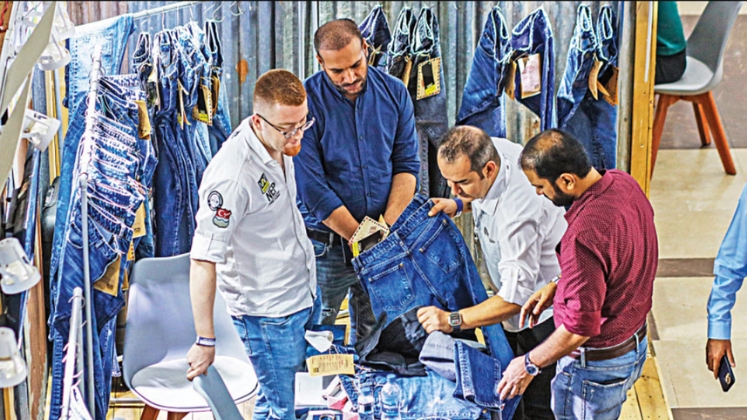
Present at the meeting were representatives from almost all of the main clothing sourcing businesses, as well as retailers such as Bestseller, H&M, and M&S.





 Bharat Tex Special Report 2026