The global market is in continuous evolution and the manufacturing apparel has to look for new solutions to be competitive. Manufacturing systems should be adaptive to both product and market. In the last two years, Francesco Bellino, Apparel Manufacturing Specialist has adopted in important leading companies producing high quality trousers using Unit Production System. It maintains high quality and improves response time due to better visibility and accountability.
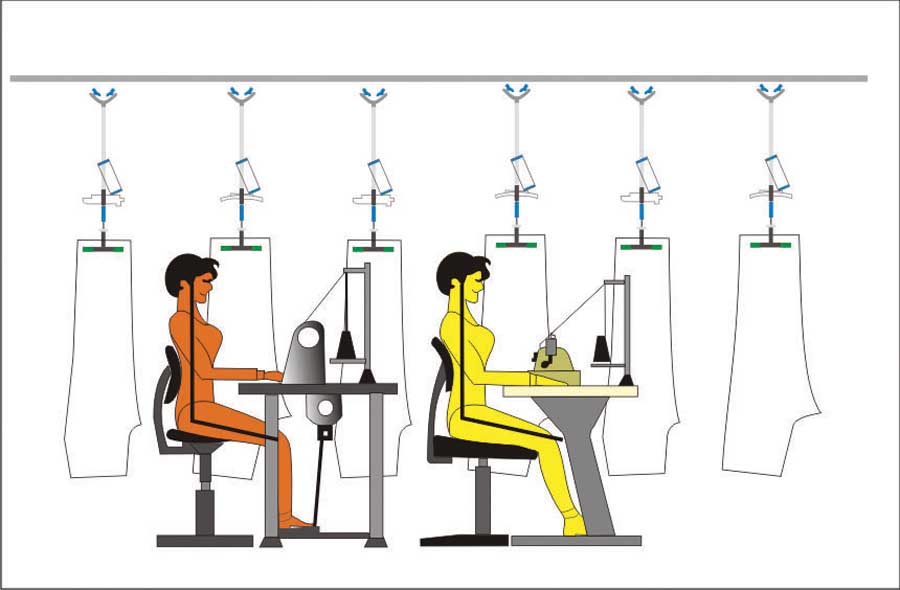
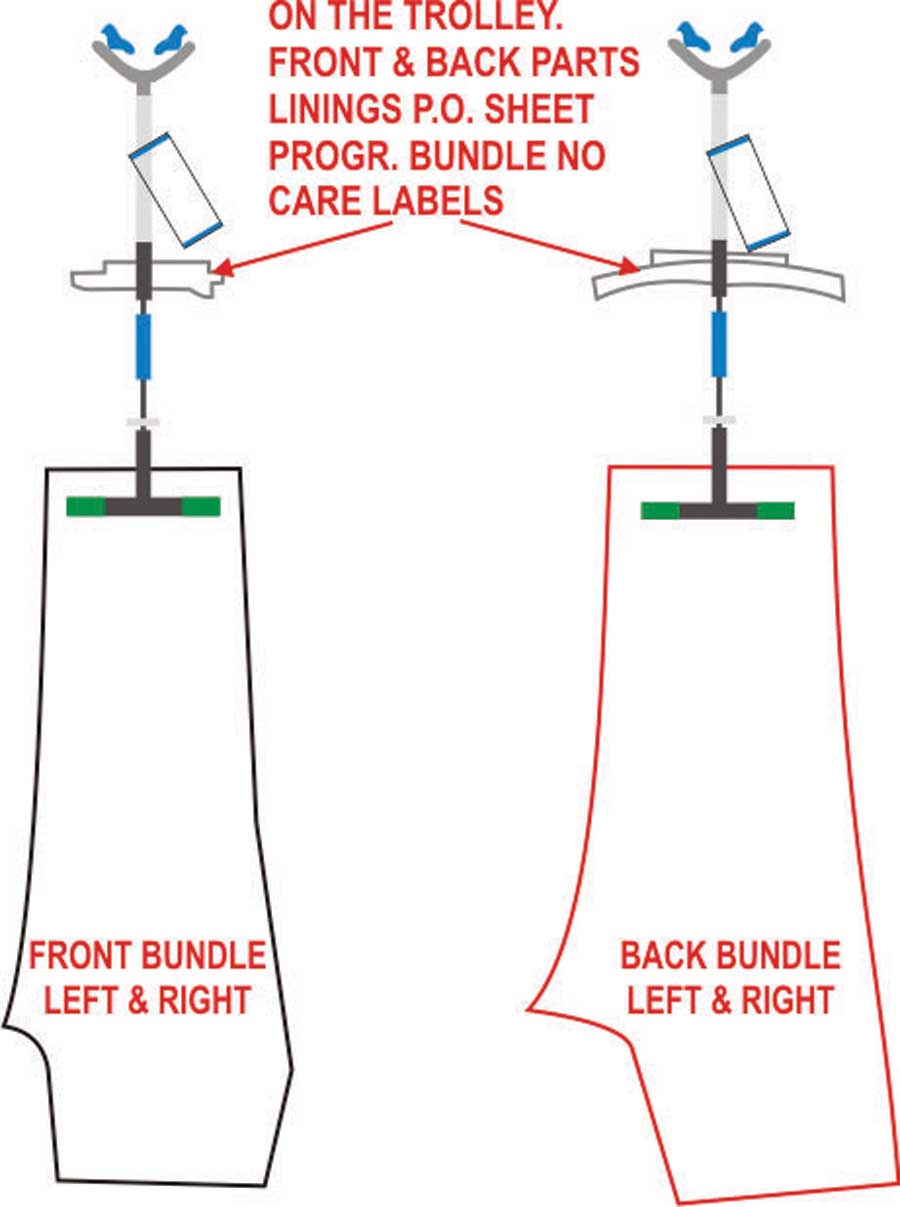
The system under discussion is based on a concept of suspended bundles of trousers’ parts (fronts, backs and all other components included zips, buttons, linings and interlinings, labels and sometimes special threads to be utilized) hung by special clamp that flow on a conveyor situated on the left of the operator. The bundle of trousers’ fronts and backs (right and left) including all the parts, are loaded onto two clamps (one for the front’s bundles and the other one for the backs). Both the clamps reach every work station along the line in such a way that the operator is able to perform his operation without detaching the garment components from the clamps. The bundle then returns to a natural position and the clamp keeps moving on the aerial conveyor from one workstation to the other. Nevertheless it is necessary to detach the bundles from the pliers only for the following three operations:
1. Front knee lining attach and back serging;
2. Outseam and Inseam stitch; and
3. Side seam and Inseam ironing.
Always in these specific operations, the workstation must be properly equipped with workaids and stackers.
The two clamp systems make it possible to have an immediate visual control of the WIP. This system, because of the vertical placement of the bundle, also allows:
- A notable saving of space;
- The material (often expensive and delicate fabric) is hung for the whole cycle of transformation and therefore does not get wrinkled, accordingly saving on time and giving better finishing on ironing;
-

Diagram 1 – Front and back bundles on separate clamps An immediate visual control of the material in production line;
- Reducing operators stress;
- Reducing 70% of handling time.
Front and back bundles on separate clamps with all the parts components attached with special strap band help the operator concentrate more on the operation and do not waste precious time in searching parts and accessories (Diagram 1&2).
The “Bundle Suspended Concept” has a big advantage in trousers production because we can load front and back onto two different clamps included all the parts and accessories, production orders sheet, tech files, bundle’s progressive number in order to avoid errors in assembling the bundles (shade variation, size variation).
The entire process make it easy to produce even very small order quantities because in this way we can track the garment loaded on line very easily and can also find all the information we need to process the garment and to identify the bundle’s location in the line.
SYSTEM UTILIZATION METHOD AND FEATURES
- After loading, the bundles move on the appropriate rail that is situated on the left of the operator (conveyor 1), and it is transported from workstation to workstation. Nevertheless it is suggested to install one more conveyor (conveyor 2), parallel to the one that can be utilized to load urgent orders or pre-production samples (Diagram 3).
- The bundles are presented very close to the operator in order to reduce drastically the handling movement.
- The operator takes the bundle (without detaching it from the clamp); wraps it around the floating arm trolley installed on the machine’s table on the left side (Diagram 4).
-
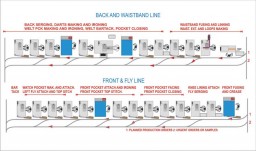
Diagram 3 – Pre-production order samples under manufacturing The operator removes the small parts from the special band straps situated on the clamps and places them on the machine.

- The operator performs the first operation allowing falling down of the clamp of the first piece to perform the other operations and when the bundle is over he pushes the clamp’s trolley to the next work station. (The special clamp prevents the components from falling out during movement.
- At the end of parts section, front and back are checked, joined and loaded in one clamp with all the components (right fly and zips, waistband and loops, buttons too (Diagram 5).
- Whereas, at the end of assembly line trousers are hung on the customer’s hanger, placed on a different trolley through to the finishing section where the finished garments are trimmed, checked, ironed, tagged and then sent to the ware house (Diagram 6).
With this system the bundles of garments are hung by special clamps in a vertical way with all the required information on it from parts through to the assembly and finally to finishing and warehouse. This entire process helps in:
- Reducing the inventory level and handling time;
- The garments are packed on the same day, so the warehouse cost decreases;
- Fewer supervisors, quality inspectors, service workers to move bundles around;
- The supervisors can dedicate more time to the operators in order to achieve high performances or to train better and new operators when it is required;
- Quality inspection workstations can be placed in the same line and thanks to this system it is easier to ensure the quality control;
-

Diagram 4 – Floating arms trolley installed on the machine’s table Transportation time between one workstation to another workstation or from department to department is significantly reduced;

- Temporary storage time is also reduced along with idle time;
- Inspection time is reduced;
- Flexible manufacturing is possible.
For the Apparel Production Unit, flexible manufacturing means the capability to produce a variety of styles in small production runs with no defects and to adopt different strategies in different departments to approach the problem’s solution.
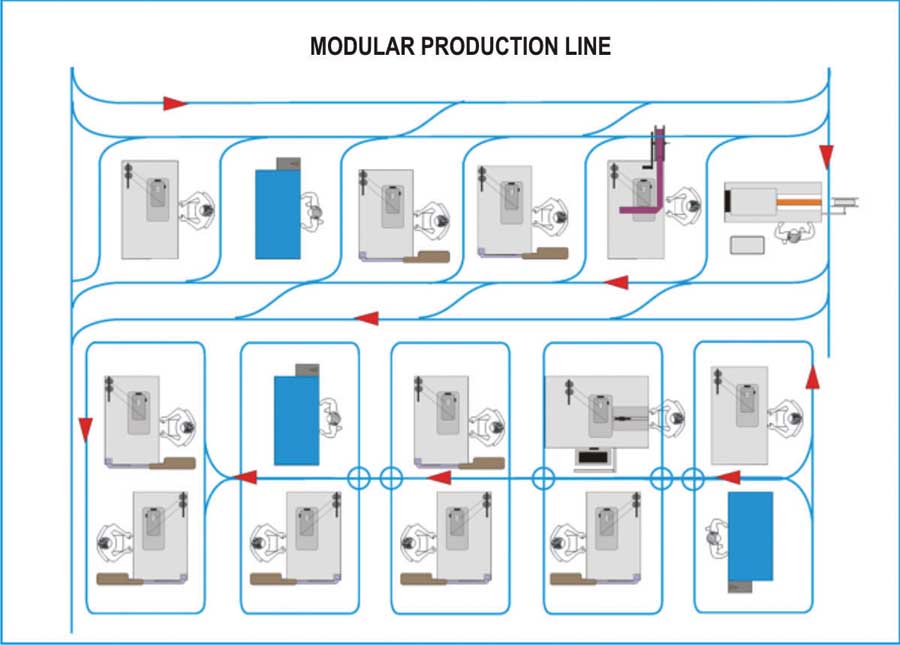
The same system but with a modular production configuration can also be implemented in sampling department where multi-skilled operators are able to perform different operation on the same line (Diagram 7).