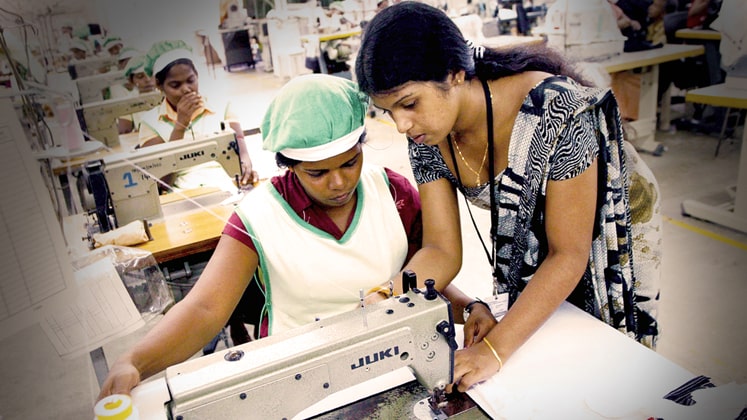
Skill development and knowledge management are emerging as a critical element in support to growth of the apparel industry with not only the exporters but the buying offices too looking to put in a module for training of manpower or creating a knowledge centre to help its employees achieve more. Indeed growing competitiveness has given the need for training a completely new dimension. While ‘skill development’ means different methodologies at different levels, the object is to prepare people for a particular role or responsibility. Knowledge management on the other hand means creating a pool of documented case studies to fall back on for solutions in case of any problem and transparent sharing of experiences.
Skill development involves training and retaining of already employed staff for better efficiencies and new job responsibilities. For this, more and more garment factories are building in training programmes both internal and through third party assistance to keep abreast with new regulations, different products, better working methods and implementation of new technologies.
Many organizations, consultants and associations are coming forward to support the skill development efforts of the industry. GTZ is one such organization which in partnership with other stakeholders is working on projects to increase competitiveness of the apparel industry. Players in the industry are increasingly coming forward to avail the expertise that such interventions can provide. In the meanwhile, IL&FS has joined hands with many players in the industry to train workers for the apparel industry from remote villages and catchments areas. The goal is to train 1,25,000 persons over the next three years for this industry…
With global industry becoming increasingly less tolerant to ‘mistakes’ and buyers searching for better services, the challenge to be efficient is not only for the factories, but the buying offices too are taking on more responsibilities and training their people to execute defined roles in the ‘best’ way possible. In fact, as buying offices rise above the mundane role of a ‘communicator’ between the exporters and buyers, preparing new inductees for challenges has become a must… so also the need for merchandisers, quality controllers and designers at the buying house to stay updated on not only what the buyer wants but also shop floor challenges and probable solutions…
The objective is to create a synergy between the buying offices and exporters to deliver on time the best quality at the most competitive price… Buying offices like Li & Fung, Impulse, Triburg, Taffles, Fusion Consulting, Pardesh, Asmara and liaison offices like GAP, H&M, JCPenny, Target to name a few have very structured induction and training schedules in place. At Taffles, the training module involves both in-house efforts through classroom and web-enabled solutions and involvement of experts like SGS for training in specific areas. Asmara has internal intranet software which helps the employees to know more deeply about the organization and the various elements that go into performing their job better. Fusion Consulting depends more on shop-floor training and the approach is hands on. GAP holds regular training schedules for its employees and many international experts are invited to interact with the staff. Li & Fung is extensively using IT solutions to keep its employees updated.
Triburg has taken the concept of skill development to another level and besides on-floor training, has developed an in-house module for knowledge management. This module has the double responsibility of skilling employees while also having documented case studies of problem areas in handling products with suggested solutions.