China has signalled a renewed push into Bangladesh’s manufacturing sector, with senior officials highlighting investor interest in green technology, jute, textiles and pharmaceuticals as part of support for the “manufacturing revolution” outlined by Chief Adviser Professor Muhammad Yunus.
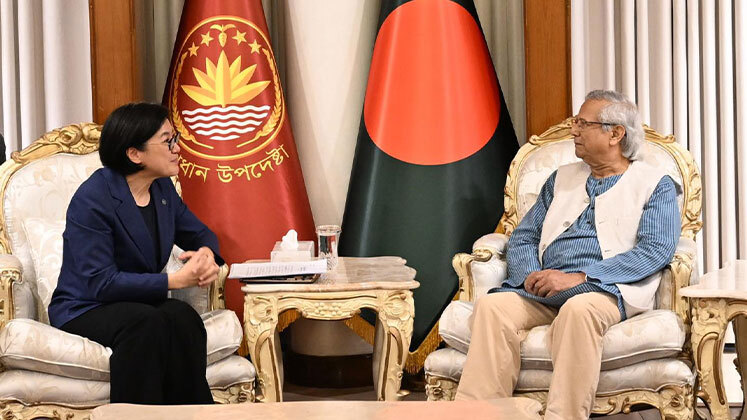
During talks with Yunus at the State Guest House Jamuna, Yang Dongning, Vice-President of the Export-Import Bank of China, said Chinese investors were shifting their focus from large infrastructure projects to high-value industrial ventures. She was accompanied by Dr Ma Jun, President of the state-run Institute of Finance and Sustainability.
Yang said China was exploring large-scale investments in Bangladesh’s jute industry, including projects involving biofertilisers, energy generation and biodegradable alternatives to plastic, alongside financing for rooftop solar panel production. She noted that both Exim Bank and Chinese companies were prepared to back these shifts with direct industrial investment.
Dr Ma said Chinese firms seeking joint ventures were showing “strong interest” in Bangladesh’s traditional jute sector.
Yunus welcomed the pivot towards manufacturing, saying investors from the world’s second-largest economy could help position Bangladesh as an export-driven industrial hub. He said Bangladesh could “go full speed” in sectors such as healthcare and pharmaceuticals, and encouraged Chinese investment in solar energy, where China is a global leader.
The Chief Adviser urged Chinese companies to relocate manufacturing facilities to Bangladesh, citing the country’s large youth workforce and opportunities to repurpose idle state-run jute mills. He also invited Chinese technology firms to explore opportunities in e-commerce and artificial intelligence.
Yunus further called for enhanced regional connectivity, proposing new rail links between Bangladesh and southern China to support exports from relocated factories and strengthen trade routes through Southeast Asia.





 Bharat Tex Special Report 2026