India traditionally manufactures high-fashion ladieswear, and Bangladesh is known for its expertise in bottom and knit manufacturing, but both the countries also manufacture quality shirts. A smaller and separate assembly for cuff, collar and sleeve and a final assembly line for joining all those parts to make a complete shirt, is the globally accepted system for shirt manufacturing. However, the deployment of technology as well as the management systems which vary based on the buyer specifications, market scenario, labour availability and other such parameters gives rise to many different ways to achieve the same goal – ‘quality shirts’. StitchWorld previews shirt manufacturing units in India and Bangladesh addressing vital points on shirt manufacturing in different ways, giving a varied perspective on creating productive excellence.
The article discusses all aspects of shirt manufacturing and different unique ways that companies are addressing the various key issues for quality, productivity and on-time delivery. There are numerous ways to achieve a common goal, be it progressive bundle unit system in sectional assembly line as found at Radhamani in Bangalore, modular quick response line at the Laguna factory on the outskirts of Bangalore, or relying on automation as in the Vardhman Nisshinbo’s wrinkle-free shirt plant in Ludhiana. While Radhamani can take pride in its improvised system of bundle management to ensure best accountability, Laguna very cleverly distinguishes small order quantity from large ones and manufactures the same in a U-shaped modular line with finishing machines kept in the centre for ease of access and least material movement outside the sewing line. Vardhman Nisshinbo’s ‘niche automation’ helps company to de-skill specific operations while keeping the capital investment low. Among the first shirt manufacturers of Bangladesh, Babylon Group has developed a time tested system for quality checking and auditing, which are complemented by the productivity-driven operator and supervisor training programs run by the company. BSA Group from Bangladesh works on ‘sewing block’ system, a modified version of sectional assembly line system to ensure maximum utilization of workers when facing heavy absenteeism and employee turnover. Quality system is built into every single organization and Dressmen is an example of that, 100% fabric inspection using a 4-point system follows shrinkage test of every lot, and fabric is segregated based on shade and shrinkage. Operation description for sewing as well as pressing is being standardized, clearly displayed in the work area with pre-determined Motion Time Systems and set targets to be followed by each operator. Quality of collars and cuffs are ensured by double fusing technique of renowned fusing machine manufacturers. In its quest to minimize waste in the areas of transportation, temporary inventory and operator waiting time, SQ Group has established a single sewing line of 30 machines to produce shirt in near lean environment.
Babylon Group, Bangladesh
Indigenously Developed Quality Management System

The USP of Babylon Group, Dhaka is its indigenously developed quality checking and auditing system. Each of the manufacturing units is equipped with an independent QC cell. This, along with modern machines and Computer Aided Design, has helped to increase productivity manifold. The group’s R&D cell headed by a five-member team also helps a lot in terms of best layout, improved work-methods and reduced rework and re-processing. Different appraisal forms are used to record hourly/daily productions per worker to assess their efficiency in pressing, folding, checking, poly packing and cartoning, whereas the productivity check at the cutting room of cutting workers is a fairly recent addition. The company’s internal study team has designed formats to check the efficiency of cutting room workers. Results are expressed in terms of pieces/hour, or pairs/hour, lays/hour, or lots/hour, or in standard allowed minutes (SAM) as felt most suitable. CAD is used in the cutting room to achieve better utilization of fabrics, grading of patterns and preparation of markers for quicker cutting. In the sewing section, use of special folders, machines equipped with devices like auto-trimmers (UBT) and programmable sewing machines help to boost productivity. A line-production system ensuring division of labour is rigorously followed, benefiting from higher productivity due to process specialization amongst the workers.
Operator and Supervisory Training is done in-house through specific training programmes using modern training facilities to impart training to the workers and staff on various aspects including productivity enhancement techniques. While training programmes influence productivity per se, executive training programmes affect productivity in a positive manner as they increase awareness amongst production people with regard to the company’s objective, target, bench-marks, current performance level, comparative study of the company’s performance against competitors, strengths and weaknesses of the company, etc. Workers and staff, while undergoing formal training, are evaluated and commendable performers are officially recognized. This inspires and encourages them to do better and stimulates others to improve. The company believes that human factors like workers’ morale, management-worker relationship, job security, job satisfaction, compensation, workplace environment, presence of able and effective leadership amongst the managers, etc. are directly related to productivity. The technical factors are the use of modern machinery, arresting the frequency of machine breakdowns, availability of proper equipment, ergonomics, use of gauges, folders, jigs, etc., enabling fool-proof operations. Inappropriate machinery, gauges and folders, improper balance of skill versus machinery, are some of the factors responsible for loss in productivity, apart from absenteeism, frequent change of styles and poor morale of the workers. The type of fabric also has a big role to play in productivity. Some fabrics lack dimensional stability, or are too soft and slippery and hence have poor sewability compared to other fabrics. Instead of quantitative targets in operations like final quality inspections, ‘observation’ as a tool for optimal utilization of human and technical resources is encouraged. Babylon has introduced targets at processes such as cut panel checks, etc. and weightage is given to order quantity and fabric quality in enhancing productivity, as continuity of an operation increases efficiency making workers proficient in that particular operation resulting in a high production rate.
BSA Group, BANGLADESH
Operation-based Sewing Groups Preferred to Assembly Lines

Chittagong-based BSA Group comprises of 7000 sewing machines with capacity to produce 1.8 million shirts per month. The production system followed by the company is based on the grouping of sewing operations rather than setting up an assembly line. Vanguard Dresses, one of the units of the company, has 600 machines divided into 6 sewing blocks as the company calls it, with 100 sewing machines per line for final assembly and part preparation, all together producing 4,500 shirts per day. The company has been attuned to this system for the last 13 years and attributes high absenteeism and labour turnover as the reason for following this system. In this system machines are allocated to a certain operation as per the daily target and the operator dependency is greatly reduced as if one operator is absent the production would not be hindered as much as it would be in a sewing line. For example to achieve the daily target of attaching 400 pockets in the shirt front, four operators are a part of the pocket group in a particular sewing block. The target of 400 is common for all the operations and hence, operators. The groups are divided as per 16 operations, which are further broken down into smaller operations within the groups. The operators are divided among four grades – A, B, C and D, based on the types of operations the operator is doing. For example, Grade ‘A’ operators are doing operations of cuff and collar preparations and attachment along with side seam and armhole attaching. Within these operations lower grade operators are also utilized for doing basic operations like topstitching. Placket preparation would be accounted as a critical operation in case of a checked shirt but a basic in a case of a solid shirt, due to the requirement of check matching in the former.

Another variation of the placket which makes it a critical operation, is when the same has to be attached as a separate piece using a folder, but when it has just to be folded over, it becomes a simple operation. The quality checkers are placed after every sewing group and after which the parts are passed on to the assembly lines, where 100% finished product checking is being done. The manufacturing system is obsolete compared to the assembly lines and the new modular systems in terms of output, man-machine requirement and WIP, but ensure complete man-machine utilization, unhindered production when a sewing operator is absent, requires no helpers, no advanced machines and zero style changeover time. With the help of time and motion study, the manufacturing system can be converted into a modular system with single piece flow.
SQ GROUP, BANGLADESH
OPERATING WITH A LEAN MINDSET

SQ Group, an already established name in sweaters and stitch-free lingerie products, ventured into formal shirts in 2008 in a joint venture with a UK-based Quantum Clothing, manufacturing high-quality formal shirts for M&S. SQ Group has setup a single sewing line instead of smaller batches, combining the smaller part preparation lines in a single sewing line of around 30 sewing machines with both small parts preparation and final assembly. With a single sewing line for shirt manufacturing minus any separate lines for part preparation, SQ Group has greatly reduced the wastes of transportation due to which the throughput time has greatly reduced. These single sewing lines of around 30 machines not only require less supervision but also less quality checkers and helpers. For achieving streamlined production from such long lines, SQ Group has integrated the job of quality checking with that of every sewing operator and every 48th sewing machines is monitored by a roving quality checker. Envisioning to setup six green factories, SQ Group will be establishing two new green factories and converting the existing four factories into green facilities, affiliated by the US Green Building Council (USGBC) for LEED Certification. The entire shirting facility would be shifted to the new upcoming green facility in the SQ station with a capacity of 1 million shirts per month.
Dressmen, Bangladesh
Maintains epitome of quality with both pre-defined and random checks

Dressmen, Dhaka sees shirt manufacturing differently, for them dress shirts is an art where anyone can setup a shirt factory but for deriving the right quality, the right people and systems has to be put in place. At Dressmen, an assembly line has 32 sewing machine and the part preparation lines have in all 20 sewing machines, in addition 12 helpers and a quality checker have been placed after every 5 operations. The first in the two-part training started when GSD imparted industrial engineering specific training and the Bangladesh Institute of Management was responsible for training the middle management in soft skills. The company relies heavily on its IE department for balancing sewing lines and production scheduling. Along with this one of their core job responsibility is to develop innovative work aids and attachment for deskilling various operations. Dressmen has been running a training school for the past 10 years with around 40 machines, focussing on multi-skilling the workers and also upgrading their efficiencies and quality in individual operations.
For ensuring quality, the company does a pilot run of every new style and only after a successful pilot run, the fabric is released to the cutting room for bulk cutting. 10% fabric is inspected based on the 4-point system. If defects are found in 10% of fabric, 20%, 50% and 100% fabric quantities are inspected accordingly. A shade card is made to control dye lot/colour shade of all fabric rolls prior to planning for cutting, a copy of which is sent both to cutting and packing department to avoid mixing of shades. The shrinkage test is done for bulk fabrics for at least 10% on all dye lots and colours. A detailed report is made for inspection findings, fusing shrinkage, colour change and ironing shrinkage prior to cutting and sent out to the technical and quality assurance department for follow-up actions.
In the cutting department, markers are checked for style and PO number, width, components, grain line, pattern and nap direction, notches and sizes, etc. prior to cutting. Spreading is being done manually ensuring the absence of wrinkles, undue stretch and adherence to the pre-defined lay height. If different shade lots are cut together then a paper is laid to separate out between different shade lots. A spreading quality report is maintained after completion of spreading, similar to cutting. In the sewing department job specifications are made for each operator to ensure that the workmanship standard is fully understood by all and followed. A mock up is provided to each and every operator as ready reference. A proper procedure is made to verify stitch density (SPI) and tension on each machine. The defective garments are properly identified, labelled and segregated by defect types for review, repair and follow-up actions. 100% in-line checking is set at critical points to ensure the garments meets quality standard at different stages of assembly process. A detailed report based on the concept of statistical process control (SPC) is maintained to find out root cause of problem and to take corrective & preventive actions by line supervisors. The data from the report is analyzed and reviewed by quality checker, quality manager and director for quality improvement.
All inspectors use proper pre-determined methods for inspection of different garment types to avoid missing any area. Inspections are conducted on appropriate tables with clean & undamaged surface and under sufficient lighting. Measurement checks are also done every two hours in each sewing line randomly on two pieces of garments across any colours or sizes prior to sending to washing or finishing sections.
Laguna Clothing, India
Modular Sewing Lines for making High-end Small Quantity Shirts

Created through a joint venture between a 100 years old Italian fabric mill, Tessitura Monti and Aquarelle Clothing, a Mauritius-based company and a part of CIEL Textiles, Laguna Clothing has a manufacturing setup and systems that are treated as benchmarks by various shirt manufacturers. Bangalore-based Laguna has come a long way from a small manufacturing unit in Jigani with 200 sewing machines, producing 3,200 shirts per day to producing 7,200 shirts per day with 350 sewing machines with a state-of-the-art facility in Kanakpura on the outskirts of Bangalore. The company’s facilities are equipped with all the latest technological solutions from a Richpeace spreader in the cutting room to Juki button sewing and holing indexers in the sewing along with automated collar and cuff pressing machine in the finishing department. Besides having such an advanced setup, the real niche of Laguna as a shirt manufacturer lies in its modular sewing lines. All orders below 800 pieces are manufactured in the modular sewing line and the rest in its assembly lines. Presently, Laguna has a single modular sewing line producing 150 to 200 shirts per day, but in the coming times, it plans to set up 5 modular sewing lines in the same facility. Handling orders of less than 800 pieces, the line comprises of 19 sewing machines and 16 operators doing at least 2-3 operations individually, but the ratio will reduce further as the operators are still in their learning curve. Due to greater number of operations, the efficiencies are presently not even close to the highest mark achieved in the company’s assembly lines and would increase further once the skill sets are more refined. The improvement is desired in the multi-skill portfolio of the sewing operators, as due to absenteeism the modular line suffers the most as each operator is an integral part of the line doing more than one operation and when all the sewing operators reach the optimum level of multi-skill sewing, the line can be re-balanced with the available operators easily.
The setup of the modular line is U-shaped. While on the periphery are the sewing machines, the ironing tables, button sewing and button holing machines, cuff blocking, collar blocking, rotary fusing and serging machines placed right in the centre from where the final output comes out. To ensure the flexibility of the machine to do a set of operations, attachments like revolving head attached to the presser foots, called turret presser foot bar with three different presser foots, can be seen on the floor.
Surprisingly there is no supervisor in the modular line, and apart from the sewing operators, there is one quality auditor and maintenance personnel.
One of the advantages of a modular line is the focus on quick turnaround time in case of small orders and quality rather than speed of operation, due to which the quality is higher and the rejection rate is also very minimal. Since the operators work in standing position, it might be tiring for the operators in the beginning, but they get used to the same with the course of time. Surprisingly there is no supervisor in the modular line, and apart from the sewing operators, there is one quality auditor and maintenance personnel. While the job of the maintenance personnel is to ensure non-stop production, the quality auditor, is only there as a referee, since the modular operation is new. Over the time, he will be released.
Radhamani group, India
Specialised Bundle Management System
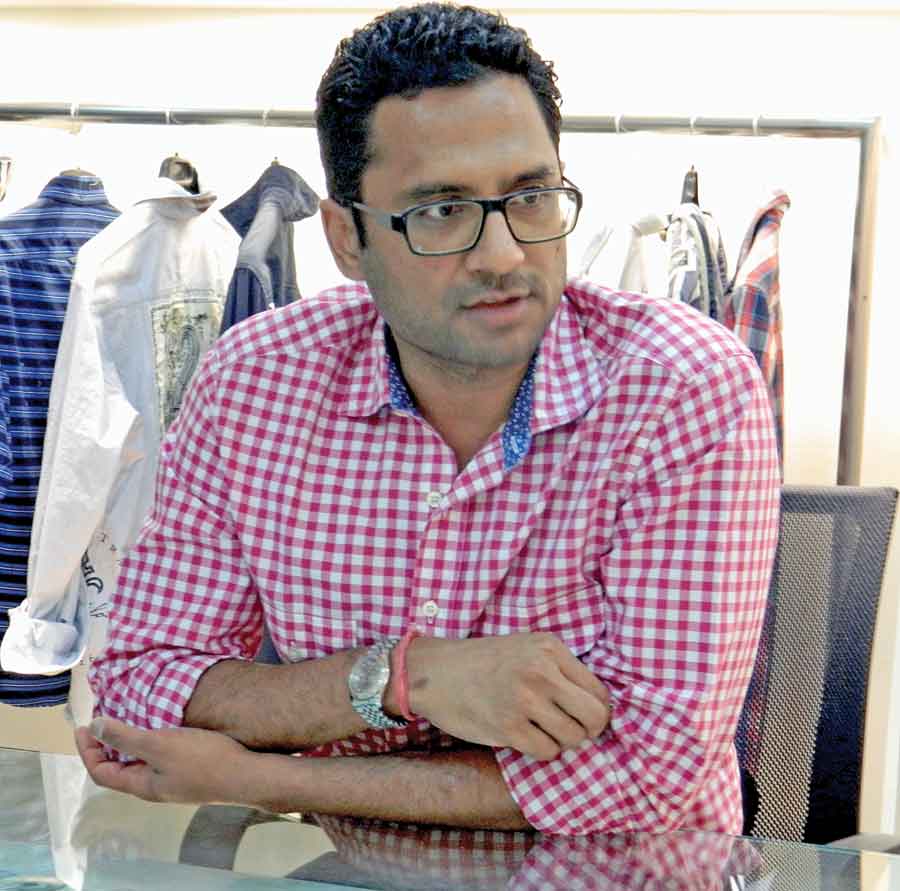
One of the major casual shirt producers of India, Bangalore-based Radhamani Group manufactures more than one million shirts per month, while managing 70 styles in the same time period. The company with a setup of 650 sewing machines has turnover of US $ 65 million and specializes in casual shirts, embellished with embroidery, printing, appliqué work and additional sewing operations compared to basic formal shirt. The company has an in-house printing setup and 25 automatic embroidery machines. The manufacturing system followed by the company is a ‘batch system’ which can also be called a sectional assembly line system that has different batches for part preparation and is then passed on to the final assembly line. This system ensures optimum utilization of all the three M’s – Man, Machine and Material – and also enables quality control. It is characterized with low WIP within the line but high WIP between different sections, as one part of a certain style in a particular batch are completed, new style parts are immediately fed into the line for parts preparation. This system guarantees high utilization of machine and labour, making it an ideal system for high volume manufacturing. The challenges faced in this system are longer sewing throughput time and the possibility of parts being misplaced. They, of course, go for assembly only when all the parts are completed. The only drawback of this system is that if any kind of defect is detected in the collar during the final assembly, it is a huge problem to go back to the line as by that time collars from a different style are being manufactured.

For robust bundle management, the company has adapted a system which the Italians call ‘relook’ and has been implemented in their internal order processing and production monitoring ERP system, termed as ‘Mother & Baby Model’. A single style is broken down into smaller components like pocket, collar, cuff and sleeve, and kept in Baby bags. All the Baby bags of a style are part of a bigger bag called the Mother bag, of the same style. The system being bar-code driven, there is no chance for errors. From time to time various components from the Mother bag are sent for detailing to various departments (printing, embroidery, embellishment, etc.) in Baby bags and then reunited to the Mother bag after the value addition. Only on the completion of all value addition, the Mother bag is sent to the production line for stitching. This forms an ideal example of disciplined production management philosophy, Mother and Baby bag system, which ensures that all parts and materials are there before the pieces go to the assembly line.
The drawback of this system is that at times components of a style which are not planned for production in a particular month or day could still be seen on the floor. Otherwise this system brings optimum utilization of manpower of the facility at any given point of time. This high inventory production system is closely monitored by mobile bar-code scanners on the shop floor and the production status gathered is discussed and planning is done for the next day. Another big advantage of the system is that the final assembly lines are not affected with the change in shirt specifications, as all the value additions are already completed before the Mother bag is passed to the assembly line. Due to this the style changeover time has been just reduced to an hour or so.
Vardhman Nisshinbo Garments, India
Perfect Automation for Producing a Perfect Shirt

The manufacturing facility of Ludhiana-based Vardhman Nisshinbo Garments is highly automated compared to a regular shirt manufacturing factory. The company uses semi-automatic lockstitch machines from Juki, equipped with under-bed trimmers and various other innovative interventions not only focussed on deskilling an operation but also for improving the quality of the overall product. The company uses Gerber automatic spreading machine to strengthen its cutting room and the real highlight of the company’s pre-sewing departments is the fusing sections with machines from Veit, for collar, cuff and collar band fusing. After cutting the pattern from the fusing material, the same is temporarily bonded on the fabric panels with the help of spot fusing machines, which keep the fusing in place till the time it is fused permanently on the fabric panels. The company uses KOBE placket fusing machines which are claimed to be unique in having a heating element which moves against the gravity of pressing thus maintaining required pressure and accurate hold time providing high quality fusing. Besides the above mentioned machines, the company also has a collar and collar band fusing machines from Veit and sleeve placket (small part) creasing machine from Hashima. Working on batch production system in which every part is differently manufactured and then assembled into the final garment. The part preparation section of the company has ‘niche automation’ for deskilling and reducing the handling time in cuff, collar and collar band preparation. Basic single needle lockstitch machines equipped with pneumatic stackers are used by the company for top stitching and run stitching on areas like the collar and cuff hem. For ensuring the shaping of the collar and cuff, blocking and pointing machines for collar, cuff and collar band have been placed in the part preparation section, and are also present in the final assembly lines. The operations of sleeve placket preparation and pocket creasing require a highly skilled operator, if done manually. Vardhman has installed a sleeve placket creasing machine from PMM which takes-up the cut pattern and produces a perfectly creased and folded placket in less than a minute. Similarly, the pocket creasing machine from Ngai Shing only requires the operator to place the cut pattern on to the machine and the rest is taken care of, requiring only one operator to handle two machines simultaneously.
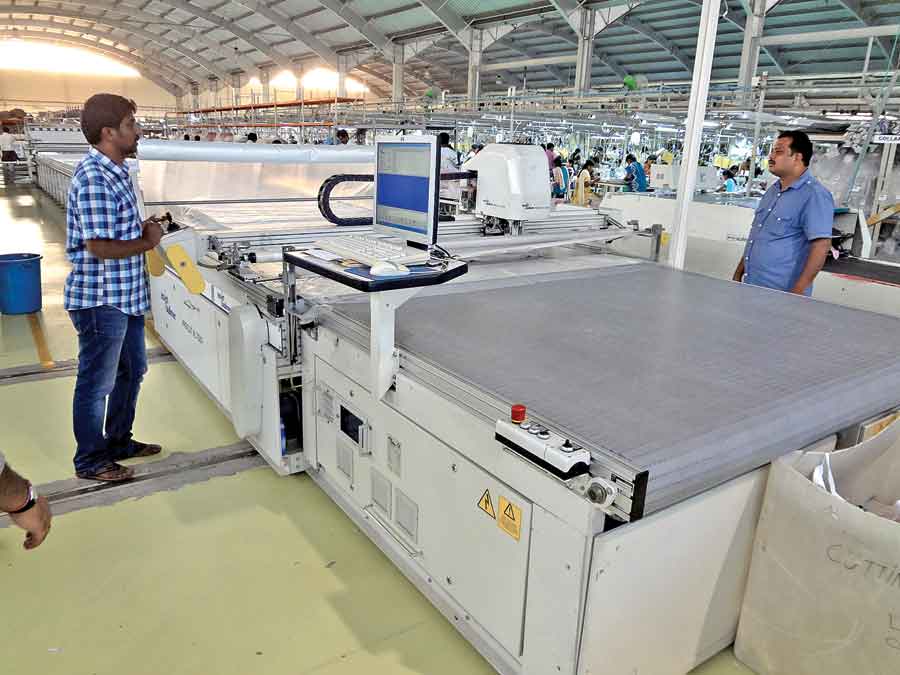
The sewing section has many specialized machines for various specialized operations such as the placket attaching machine from Kansai with a Ngai Shing folder attachment that can directly attach the fusing and placket in one operation. In another innovation, a fine pipe is fitted adjacent to the left of the presser foot which blows air at the seam and eliminates the need of the operator to manage the fabric and keep it within the seam. It also keeps the frayed thread at the edge of the panel and within the seam, when attaching the side seam on a feed-off-the-arm sewing machine. For deskilling the operation of button attaching, the company uses the button feeder attachment from Loiva. Other special technologies are the pressing machines from PMM and Ngai Shing, installed solely for the purpose of pressing shoulder and side seams with tape between them. With the use of specialized pressing equipment the puckering like effect is eliminated giving a perfect finish.