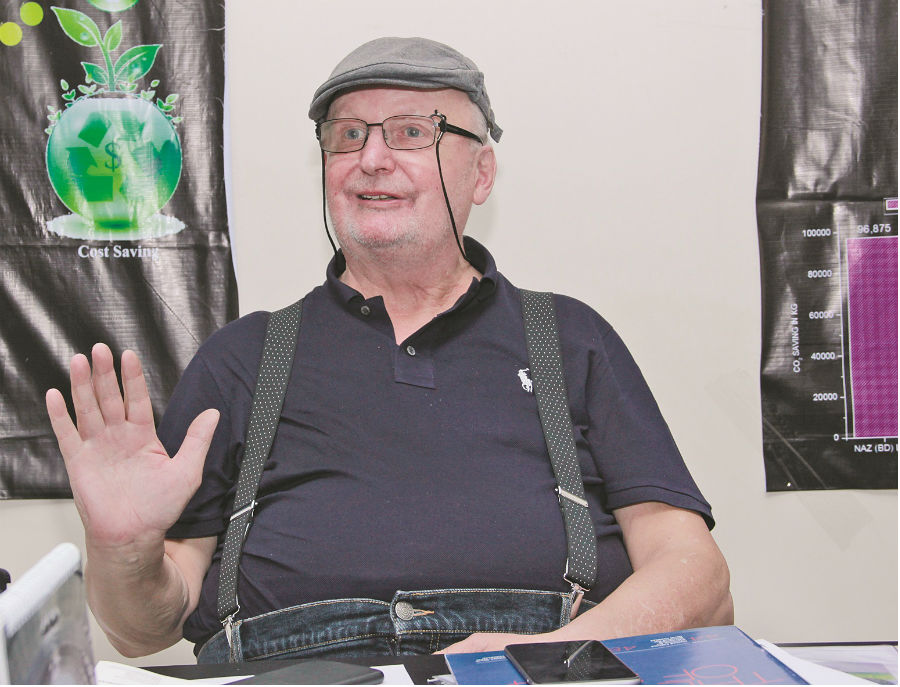
With a long history in the apparel and textile industry, Dr. Engel was heading a buying office in Dhaka until 2010, the year in which he read a UNICEF report on the water situation in Bangladesh, changing his life forever. “The report showed that 44% of the population of Bangladesh is using river water for cleaning and sanitary purposes; 22% of the Bangladeshi population is drinking contaminated water and globally one million children are dying every year due to consumption of contaminated water,” he recalls. The report unwittingly became the motivation behind Green Project WST, a revered company supporting water saving and cleanliness in Bangladesh.
Landmark group and grameen knitwear were the first successful projects of Dr. Engel in the country, subsequent to which his organization got the attention of unfccc (united nations framework convention on climate change) and even of international buyers such as lidl. “for two years nobody listened to us and outrightly rejected our claims and methods. but then we got the push from the Japanese Environment Ministry which was looking for partners for the clean Development Mechanism (cDM) project, part of the kyoto protocol, an international agreement linked to the unfcc. We are the first cDM project partners in the world and we got the national approval from Japan and bangladesh,” adds Dr. Engel. operational since 2006, cDM has already registered more than 1,650 projects and is anticipated to reduce carbon emissions amounting to more than 2.9 billion tonnes of co2 in the first commitment period of the kyoto protocol, from 2008 to 2012.
When greenpeace asked all international retailers and brands to ensure zero discharge of hazardous chemicals from their vendor’s manufacturing facilities, the 2nd largest discounter of the world lidl approached green project Wst for doing the same with its vendors in bangladesh, and they have been on this job since last year. “till now lidl has placed 13 orders with different vendors in bangladesh to be manufactured under the green project Wst programme, which is equivalent of 2.5 million pieces and by the end of the year we will reach 35 million pieces because a lot of new textile companies are approaching us, as lidl is paying for the project,” shares Dr. Engel. in the last four months, green project Wst has audited around 29 factories of lidl’s vendors in bangladesh and the company has paid green project Wst an auditing fee along with a license fee per garment produced under the Wst programme. at the end of the programme, vendors are given a certificate highlighting the savings the company has achieved in its consumption of water, steam and energy. “from the money coming from lidl we will invest in portable water purification units that will go in rural areas of bangladesh and provide people contamination free drinking water,” shares Dr. Engel.
On being probed about the specific interventions done by his team, Dr. Engel states, “We are doing nothing special or innovative as everything we are doing is available in the market. What we do is educate fabric manufacturers about better chemicals and solutions present in the market for reducing the consumption of water. companies such as Dystar, huntsman and archroma have solutions for the same. these chemicals are as per the greenpeace Detox requirements and by using them the consumption of water for producing a kilogram of white fabric can be reduced to just 12 litres.” green project Wst is also about using good quality cotton as usually a very cheap quality cotton yarn is used to make the fabric and then the fabric is enzyme washed to improve its hand-feel. this process is called bio-polishing and it causes a process loss of 4-5%. if good quality yarn is used for making the fabric, no bio-polishing would be required. “people must not focus on saving 10-15 cents while buying yarn and waste many dollars in processing it. this is our first step and we always tell the companies that the yarn is the foundation,” explains Dr. Engel.
Similarly if the yarn has low twists per inch (tpi), then the fabric will automatically have soft hand feel and even the seams in the garments will not skew with the passage of time. “such interventions have a ripple-effect in the complete manufacturing chain. usually it takes 4-5 hours to bleach white fabric but by using the methods and chemicals recommended by us, the same can be done in just two hours. Moreover, by using dyes which have higher affinity towards the fabric, the consumption of dyes and chemicals can be reduced along with reduction in the number of rinse cycles, contamination level of the discharge and increasing the overall factory output due to reduced dyeing time,” he further adds. similarly, once the consumption of water is reduced, the water discharged to the Etp plant will also reduce and a factory can expand its manufacturing capacities without increasing the capacity of the Etp plant.
The above mentioned interventions do not require any capital investment from the manufacturers as the companies are only required to buy better quality chemicals, install metering devices such as flow meters in relevant outlets and inlets, and invest in restructuring of the internal ducting, plumbing and sewage systems. naz (bD), tex town, giant textiles and urmi are the top four factories with which green project Wst is working and these companies are handling the major portion of lidl’s orders to be produced under the programme. among these four, naz (bD) is doing the maximum order for lidl under the green project Wst and hence is touted to save 14 million litres of water, 29,860 units of electricity, 0.5 million kilogram of steam and 96,875 kilograms of co2. giving his definition of a sustainable factory Dr. Engel states, “a factory which would have achieved 80% of all the requirements of the greenpeace’s Detox campaign is sustainable, as it is impossible to reach 100% because of too many contamination points which cannot be measured, analyzed and avoided.”
Working on the benchmarks of sustainable manufacturing defined by greenpeace’s Detox campaign, Dr. Engel defines green project Wst’s future plans, “by the end of this year, we want to eliminate enzyme washing from all the factories we are working with. by 2018 every factory should only be using Detox certified chemicals and dyes. after one year we will again do an audit and if the factories pass, then only we will change our role from enforcers to auditors. We would end up saving 32 million litres of water and 210 tonnes of carbon emissions. this would be possible by making just 2.5 million garments.” besides these targets, Dr. Engel has his eyes set on waterless dyeing technologies using which he plans to reduce the consumption of water per white t-shirt to just 5 litres, which is presently 40 litres of water. “to further improve the quality of recycled water and reduce the load on the Etp plant, the dyes used must have lower contents of salts, which are very essential for colouring. hence we will demand from companies to develop salt-less and salt-free dyes. such dyes are already used by companies dyeing polyester and polyamide fabrics and yarns, but the same has not been achieved for cotton,” concludes Dr. Engel.