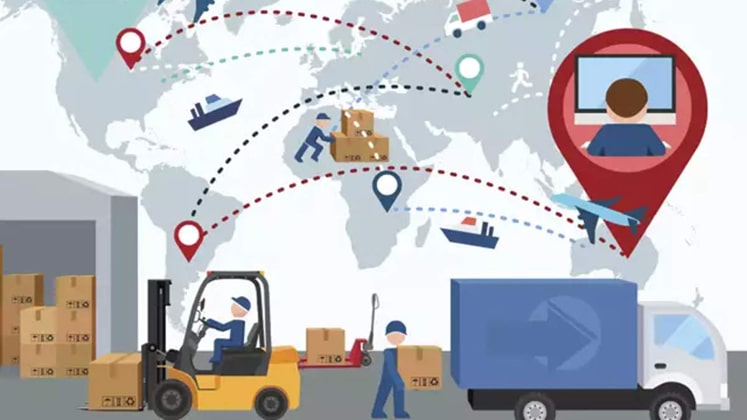
Good infrastructure and efficient logistics are the prerequisites for sustainable economic development, and if experts and industry insiders are to be believed, these two continue to be the Achilles heel, hurting the aspirations of both the apparel manufacturing and export industry and Bangladesh’s e-commerce sector.
“Efficient logistics enhances countries’ competitive edge substantially reducing cost of doing business. The efficient logistics management has a stronger effect on trade promotion than tariff cuts,” feels Shams Mahmud, President, Dhaka Chamber of Commerce and Industry (DCCI), the largest and most vibrant business chamber in Bangladesh. Its membership consists of industrial conglomerates, manufacturers, importers, exporters and traders mostly of small and medium enterprises (SMEs).
“Irrespective of the remarkable economic progress, Bangladesh still lags behind competing countries in terms of logistics infrastructure competitiveness,” he adds.
So, what is the way forward in such a scenario?
Formulation of a national logistics policy to give a boost to diverse logistics infrastructure development, including ports and multimodal sub-regional transport connectivity so as to improve Bangladesh’s trade competitiveness and secure low-cost trade potentials with South and South East Asian markets, felt most of the experts, with some even advocating formation of a separate ministry for logistics services.
“We need to ensure best utilisation of the full capacity of ports. In terms of improvement in logistics performance, inward FDI and intra-regional trade are also important,” says BGMEA President Dr. Rubana Huq, adding Bangladesh needs to have an internal index of competitiveness which needs to be monitored regularly.
Petrapole, the Indian side of the Petrapole-Benapole land port and Bangladesh’s largest and most active border crossing, is a very important aspect of the country’s trade, but recently, hundreds of trucks laden with goods were stranded at the Petrapole for 3 days, causing untold sufferings to the local businessmen as shipment delays caused the products to deteriorate in quality over time, Dr. Rubana shared an instance of the existing bottlenecks.
Port activities need to be expedited a lot to improve trade; Rubana, hence, emphasised while hailing the initiatives that have been undertaken to improve the ease of doing business and overall port performance, but were yet to get enough publicity either locally or at global level, she felt.
Meanwhile, highlighting the importance of Logistics Performance Index (LPI) towards increasing exports, Dr. Selim Raihan, Executive Director, South Asian Network on Economic Modeling (SANEM), maintained Bangladesh’s progress in LPI between 2007 and 2018 was not up to the mark.
“Lower position in LPI may hurt our competitiveness. Besides, to increase export, improvement in LPI is crucial,” Raihan stated while underlining countries like China, Vietnam and Thailand have gained tremendous growth in this direction.
He emphasised on faster implementation of large infrastructure projects, upgradation of railways, shipping and river connectivity on priority basis.
Launched in January 2007 in Dhaka, SANEM is a non-profit research organisation and also a network of economists and policymakers with a special emphasis on economic modelling which aims to promote objective and high-quality research in the areas of international trade, macroeconomy, poverty, labour market, environment, political economy and economic modelling. SANEM contributes to Governments’ policy-making by providing research supports both at individual and organisational capacities.
Agreeing with Selim Raihan on the same, Chairman of the Policy Exchange, Masrur Reaz said that port charge for a single consignment in Bangladesh is US $ 408, while the rate in Vietnam is US $ 290 and US $ 211 in Indonesia.
However, these rates are declining in both Vietnam and Indonesia lately. What’s more, Bangladesh was yet way behind its competitor Vietnam in terms of consignment clearance with the former taking around 168 hours to secure port clearance for a consignment compared to Vietnam’s 55 hours.
Meanwhile, a recent study carried out by DCCI identified that container congestion, port demurrage charges, delays in the customs clearance process, a lack of port infrastructure, hinterland connectivity and high shipping costs as major bottlenecks for the import/export process, which end up increasing operation costs. Further, due to slow, expensive inland transportation, cumbersome customs and border management processes, inadequate consolidation of terminals, inland clearance depots, trade corridors and a lack of coordination amongst trade related agencies along the border, goods shipments are 35 to 50 per cent slower than what they could be.
Although many international companies are trying to come to Bangladesh with investment proposals, they think about the lead time factor because of the poor logistics services available, said Sameer Sattar, a lawyer at the Supreme Court.
In 2019, the Chittagong Port (the country’s premier port) handled three million container units, up from two million in the previous year, said Md. Zafar Alam, a member of the Chittagong Port Authority, while adding that by this, one can understand that although the port’s container handling capacity has risen significantly in a short span of time, the handling facilities have not improved as much.
“The Government has already implemented up to 45 changes to the customs regulations in a bid to better facilitate trade. However, customs officials need to remain vigilant in order to protect the interests of domestic industries,” Alam added.
Echoing the sentiment, Zaidi Sattar, Chairman, Policy Research Institute, said Bangladesh needs to expedite the development of logistics services. Modernising the country’s port customs services is also needed to facilitate trade growth, but not as a means to solely increase revenue, he added.
These apart, Bangladesh also lacks in terms of boosting its storage facilities. Reports state that the combined storage space of all warehouses across Bangladesh is currently about 4.2 million square feet, which is set to increase to around 6.7 million square feet by 2022. But due to a lack of formal warehousing facilities in the country, most importers and exporters take it upon themselves to store their products, usually inside their own factories or other private properties, whereas in other countries, there are third-party warehousing facilities, which provide a secured environment and a number of other services to maintain product quality.
These inefficiencies in the country’s warehousing and logistics services are the root cause of increased operation costs and extended lead times, which badly impact a business’s competitiveness, Masrur said.
Export aside, even the country’s e-commerce sector is adversely impacted due to poor logistics which have led players in the e-commerce sector calling for sound delivery systems along with a strong e-commerce policy while adding that logistics challenges are going to make it difficult to develop the e-commerce industry.
“Logistics are an integral part and challenge of e-commerce businesses and this is one of the major areas that need to be addressed in terms of policy and technical aspects,” said Mahbubul Anam, former president of Bangladesh Freight Forwarders Association. He emphasised on cross border e-commerce and paperless trade policy as well as possible ways to address logistics issues.
So, going by the views and opinions shared by the stakeholders, immediate and substantial improvement in terms of logistics and infrastructure in the country is required the most in the given scenario if Bangladesh is to make further progress in terms of trade and business, it seems.