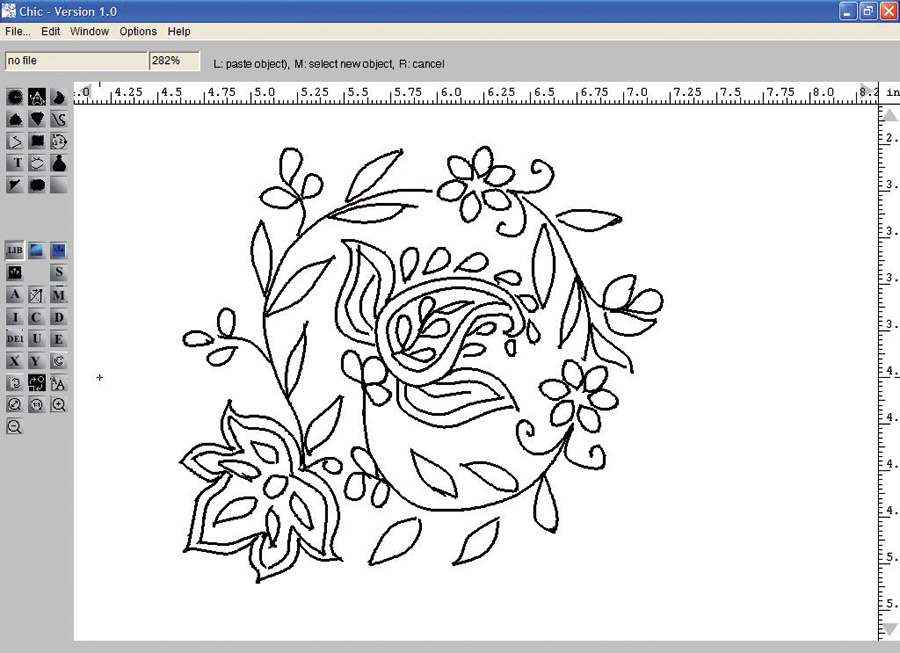
The tradition of Chikankari, although passed down over generations, is now mostly practised by womenfolk. It has been adapting and undergoing constant changes. Today, the structure of the chikan manufacturing units reveals an interesting inverted pattern. There are about 1500 manufacturers in the Kanpur-Lucknow region of Central Uttar Pradesh out of which only 10 are of big size (having turnover of Rs. 4 to 5 crores per annum each). Of these only two manufacturers have registered their brand names and there is only one 100% export oriented unit. Total sales turnover of the entire cluster is to the tune of Rs 400 crores. Chic software is a technology that is being used as a tool to facilitate the conservation and improvement of the Indian heritage and its traditional arts and crafts. The software offers an archive of traditional patterns and designs which could otherwise have been lost with time.
Project Background:
Media Lab Asia (MLA), a Govt. of India Sec. 25 non-profit organization with its headquarters in Mumbai, and a part of the Department of Information Technology, has been actively developing indigenous technologies to be effectively deployed amongst communities in partnership with NGOs. The company, with the help of IIT Kanpur’s Centre for Design, has developed the ‘Chic CAD’ application for innovating the chikankari design. The tool was introduced in partnership with Datamation Foundation, a community organization actively working towards deployment of innovative Computer Aided Design (CAD) tools and capacity building solutions in the unregulated crafts and handloom sector of India.
Datamation Foundation offered a ready platform for ‘Chic CAD’ tool under the aegis of InfoDev-World Bank and Microsoft supported project intended to help the chikan embroiders of Lucknow. It also attempts to develop market linkages between the producers and the buyers by facilitating buyer-producer meets, exhibitions, sampling, cataloging, ICT (Information & Communication technologies) enabled internet marketing, fulfillment and quality control. Both the organizations’ objective by deploying ‘Chic CAD’ tool and providing supply tool management is to increase the turnover of the cluster by 50% within 3 years by developing high quality fashion products and entering into export market.
Features of the ‘Chic CAD’ Design Tool:
The tool was conceptualized and designed by Media Lab team led by IIT Technologists. The software offers the following features:
- The application has been designed and developed in JAVA and is 2D based offering an exhaustive library where thousands of designs can be stored.
- The software, basic and user friendly, draws shapes with only one click. The operator can draw a figure, shape and resize it, copy and move it in (x y axis), also in mirror display in (x y axis), color (internal & lining), and outlining. It also enables use of multi type of threaded/stitches designs. The software is also capable of breaking a complex design into different parts.
- The application enables making of a block within 30 minutes cutting short the time process, which otherwise takes more than 2-3 hours with hand. Once the block has been made, the design can be printed on cloth with the help of an engraving machine. For unconventional fabrics such as denim, the design can be printed on resin film and transferred accordingly.
Dr. Ramaraju, Principal Research Director, MLA commented, “The purpose of this project is to leverage the power of Information & Communication Technologies to benefit the artisans by enabling creation of new designs with quick turn around times and provide market linkages to the products through public – private partnerships”. Chetan Sharma of Datamation added, “The most important feature of the project is that it is being used as a tool in improving and conserving the Indian heritage and its traditional crafts”.
MLA has recently forged a public-private partnership with institutions such as NIFT & NID on one hand, as they are already working on artisan cluster development programmes, and with manufacturers on the other, so that products made by artisans using this tool could reach customers. OS Pasricha, MD TCNS whilst reacting on the software, said, “The software is already providing a good format for usage in the apparel industry. It just needs to be modified to be made more user friendly for designers.” While making suggestions to MLA on the existing software, he pointed out the need for a provision where the designer can start with the desired product instead of the design. Based on the designer’s requirement, the software should be able to adjust the designs/motifs as per the desired placement on the garment or home furnishings, especially products such as bed linen.
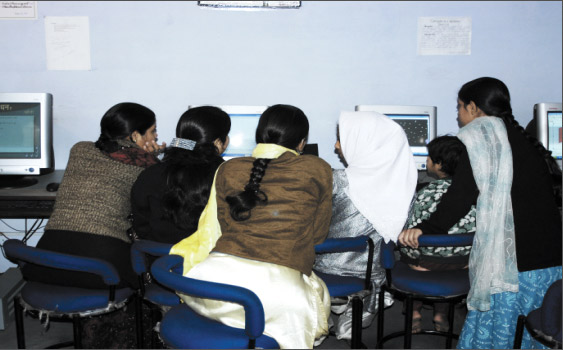
The software has proven to be immensely valuable and useful for over 1000 artisans from 8 different Datamation Foundation sites in the Kanpur-Lucknow region of Central Uttar Pradesh. However, local language interface is essential in the design tools to be adopted. Besides, existing ‘chikancad’ can be adapted and modified while new practices need to be developed in order to make it more compatible for export purposes. SN Goswami, MD & CEO of MLA commenting on the success of the software said, “We are in the final stages of developing another CAD software for carpet design which will be made available to the carpet designers and the carpet industry”.