Bangladesh has not received any formal written clarification from Washington regarding the latest changes to United States tariff policy, Commerce Minister Khandaker Abdul Muktadir has said, describing the situation as still evolving.
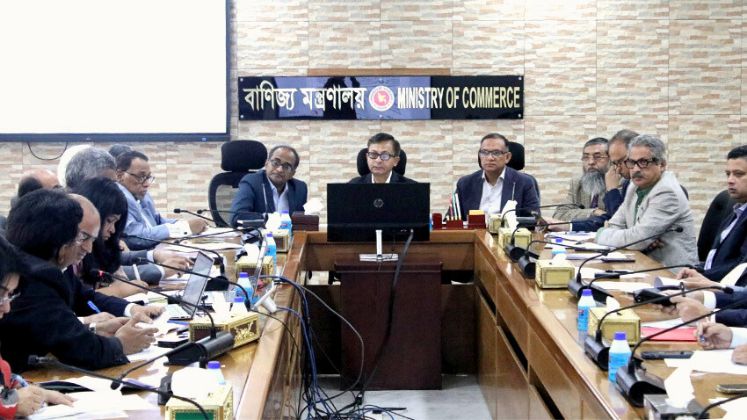
The minister made the remarks while speaking to journalists after a meeting with leaders of leading business associations, trade bodies and chambers to discuss export performance and sector-specific concerns.
He stated that following a ruling by the US Supreme Court declaring previously imposed tariffs under the Economic Emergency Power Act invalid, the US administration invoked Section 122 of the Trade Act of 1974. Under this provision, a 10% tariff was initially announced, which was later revised to a uniform 15% rate applicable to all countries.
However, Bangladesh has not yet received any official written notification on the matter, he said, adding that under Section 122, the US Congress must ratify such tariffs within 150 days.
Referring to the earlier 19% tariff, Muktadir explained that it had been a reciprocal duty that varied between countries, whereas the newly imposed 15% rate is applied uniformly. He noted that the implications would need to be assessed in the context of the broader trade environment.
The tariff trajectory has shifted several times over the past year. In April last year, the US initially imposed a 37% tariff on Bangladeshi goods, which was subsequently reduced to 35% and then 20% following negotiations. After the signing of the Agreement on Reciprocal Trade (ART) on 9 February this year, the rate was reduced to 19%. However, the US High Court later struck down the reciprocal tariffs on all countries, describing them as unlawful. President Donald Trump subsequently imposed a 10% tariff across the board, later increasing it to 15%.
Separately, the US Customs and Border Protection (CBP) agency began collecting a temporary 10% global import tariff from Tuesday, according to an official notice. The CBP stated that the measure had been introduced under a 20 February Presidential Proclamation titled “Imposing a Temporary Import Surcharge to Address Fundamental International Payments Problems”, issued pursuant to Section 122, and would remain in force for 150 days. The move has added to uncertainty over US trade policy, with limited clarification provided regarding the rate applied.
Regarding the Agreement on Reciprocal Trade signed by the interim government, the commerce minister said the current administration was reviewing its provisions before determining its position. He stated that the government was assessing which clauses were favourable and which were not, noting that agreements typically contain a mix of beneficial and less advantageous elements. A decision on the next course of action would be taken following this review.
On the non-disclosure agreement signed during negotiations, Muktadir said it had been part of standard confidentiality requirements and that the sensitivity of the issue placed the government in a delicate position.
Commenting on the meeting with business representatives, he said it had been convened to address export growth prospects and challenges faced by different sectors. Representatives from the ready-made garment, textiles, pharmaceuticals and home textiles industries were among those present. He added that, owing to time constraints during Ramadan, discussions had been held jointly, with sector-specific meetings to follow.
Responding to a question on whether any political party had been consulted prior to signing the agreement, the minister said that, to his knowledge, there had been no such consultation with the Bangladesh Nationalist Party (BNP).