Vardhman Nisshinbo Garments, a 51:49 joint venture between Ludhiana-based Vardhman Group and Nisshinbo Garments of Japan is specializing in the production of non-iron formal shirts, catering to domestic retailers like Zovi, Arrow, Blackberry’s, Turtle to name a few. The company had recently bagged their first export order for the Japanese market, which would go into production in the beginning of April this year. Known for quality, Vardhman Nisshinbo Garments Limited (VNGL) is manufacturing wrinkle-free shirts with latest post-cure technology, introduced in India for the first time. Team SW visited the company recently for a first-hand review…
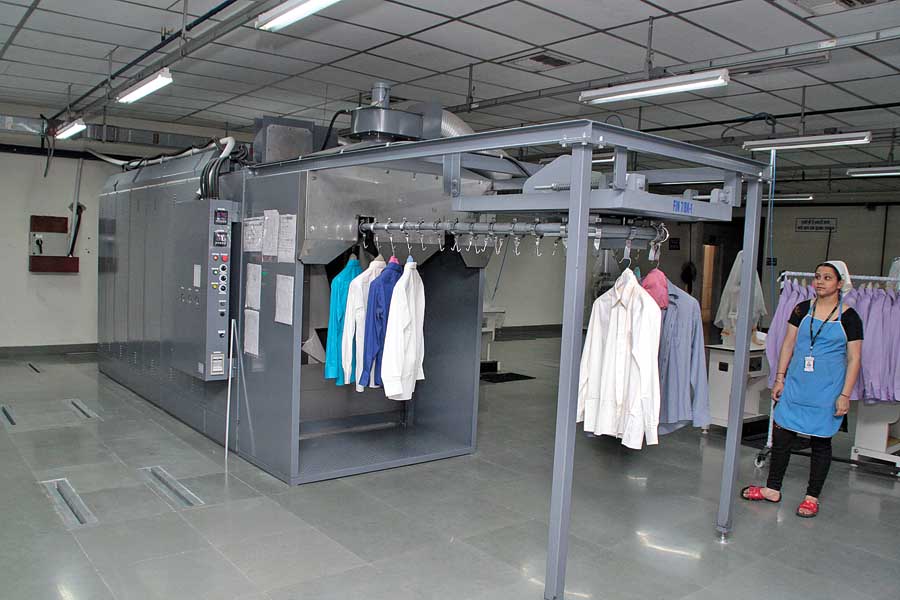
The final quality of any product is defined by the perfection of the finish and at VNGL, finishing is the USP, for which a one of its kind liquid ammonia treatment plant has been established in Baddi, Himachal Pradesh where the shirt fabric is treated with liquid ammonia resin and then sent to Ludhiana for stitching, fixation and finishing. At the Ludhiana unit, the shirts after stitching are put in a baking machine at 150oC for 6 minutes that sets the resin at its place and provides a wrinkle-free shirt.
The SSP (Super Soft Phase) technology used to produce the wrinkle-free shirts is the brainchild of Nisshinbo Textiles, Japan. “The biggest reason for the tie-up was that while Nisshinbo had a trademark in Super Soft Phase fabrics, Vardhman with its updated technology for shirt manufacturing achieves a 3.5 DP (Durable Press) rating shirt (on a scale of 5), which is considered very good and even exceptional if compared with other shirts manufactured in India,” says Lalit Mahajan, Vice President, Vardhman Nisshinbo Garments Limited. Vardhman, a major textile company having an annual turnover of around $ 986 million with over 24 yarn and fabric manufacturing facilities in 5 states of India, is happy with its first ever garment manufacturing venture.
In fact, Nisshinbo a textile giant from Japan, which is into spinning, weaving, finishing, knitting and sewing, reviewed the manufacturing capabilities of many integrated units in India including Raymond and Arvind before selecting and sharing its patented technologies with Vardhman as a manufacturing partner. “Our Japanese techniques were able to seamlessly integrate with the manufacturing facilities at Vardhman, otherwise this type of manufacturing setup would not have come to India,” avers Motohiro Kan of Nisshinbo Textile Inc. The factory is currently manufacturing 1000 shirts per day, though it has an installed capacity of 5000 pieces per day mainly, primarily because of the freshers who are still under training.

Manufacturing Paradigm
The manufacturing system implemented at the Vardhman factory is different from the regular shirt manufacturing systems being practiced in the country. Using a batch production system in which every part is differently manufactured and then assembled into the final garment, the factory uses semi-automatic lock stitch machines from Juki, equipped with under-bed trimmers and various other innovative interventions. The company uses Gerber automatic spreading machine to strengthen its cutting room.
Special Sewing Machines
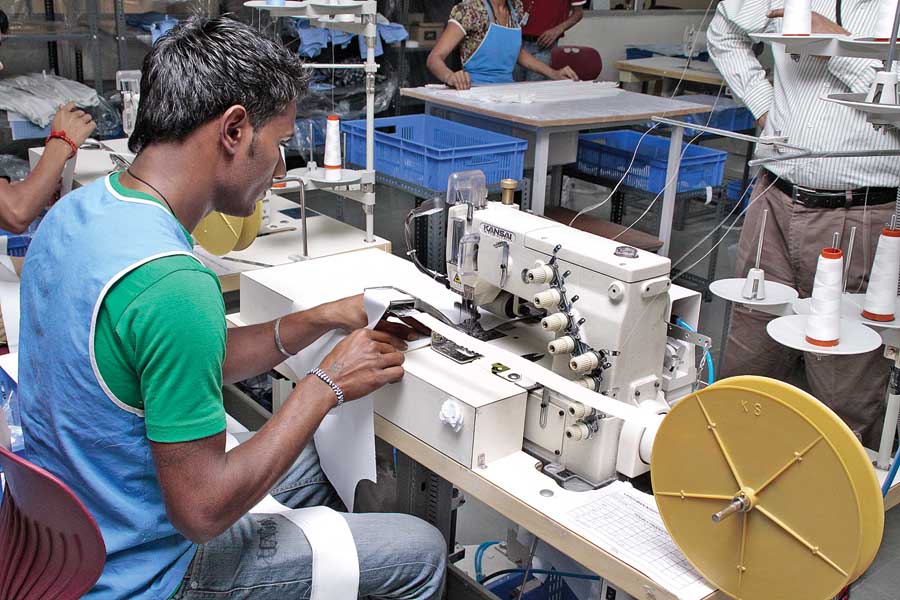
The sewing section has many specialised machines for various specialised operations such as the placket attaching machine from Kansai with an Ngai Shing folder attachment that can directly attach the fusing and placket in one operation. In another innovation, a fine pipe is fitted adjacent to the left of the presser foot which blows air at the seam and eliminates the need of the operator to manage the fabric and keep it within the seam. It also keeps the frayed thread at the edge of the panel and within the seam. Likewise many other machines are also fitted with innovative attachments to improve quality and productivity.
Fusing Machines
Fusing at the right temperature and pressure is critical for any quality garment and the company uses KOBE placket fusing machines which are claimed to be unique in having a heating element which moves against the gravity of pressing thus maintaining required pressure and accurate hold time providing high quality fusing. Besides the above mentioned machines, VNGL also has collar and collar band fusing machines from Veit and sleeve placket (small part) creasing machine from Hashima.
Pressing Machines
The quality of a shirt is dependent on the quality and finishing of the collar, cuff, plackets and pocket. For a perfectly finished collar VNGL has installed collar finishing machines from Ngai Shing for imparting sharp tips and edges to the collar. Similarly, the cuff pressing machines from Ngai Shing are used not only for finishing quality cuffs but also for streamlining the whole process.

The operations of sleeve placket preparation and pocket creasing require a highly skilled operator, if done manually. VNGL has installed sleeve placket creasing machine from PMM which takes-up the cut pattern and produces a perfectly creased and folded placket in less than a minute. Similarly, the pocket creasing machine from Ngai Shing only requires the operator to place the cut pattern on to the machine and the rest is taken care of, requiring only one operator to handle two machines simultaneously.
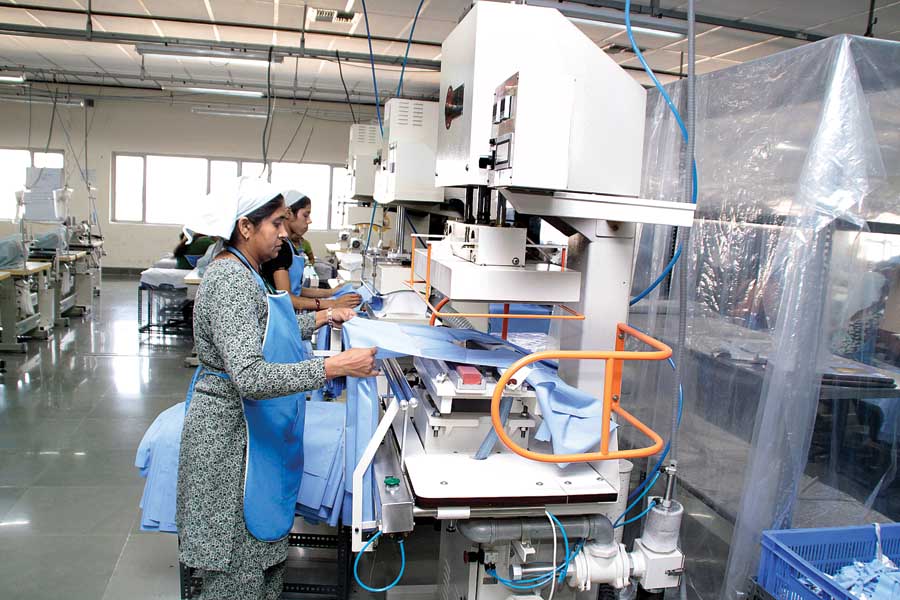
Other special technologies are the pressing machines from PMM and Ngai Shing, installed solely for the purpose of pressing shoulder and side seams with tape between them. If shirts with tapes inserted in the shoulder and side seam are ironed with hand irons, the tapes are bound to get deformed, however with the use of specialised pressing equipment the puckering like effect is eliminated giving a perfect finish.
Finishing Department
A lot of time and effort at VNGL is put into improving the aesthetics of each and every shirt, due to which the WIP of the finishing department is maintained on an hourly bases. For the perfect finish, the company has 3 body pressing machines, which are used for pressing the front and back side of the shirt. While form finishing a shirt, the size of the dummy is set according to European standards as it is closest to the Indian body type. The dummy expands inside the chamber and helps the shirt get ironed. An additional provision of water spray is provided which can be used in case excessive wrinkles persist. There is an exhaust for hot air emission which releases the air in the surrounding atmosphere.
Quality Assurance
To ensure very high standard of quality for its high-end formal shirts the company has also installed a humidification system so as to prevent stains from the sweat released during manufacturing; the housekeeping systems are also very strictly followed in the premises with no outside footwear being allowed inside the factory. Usually factories manufacturing high-end garments make operators wear gloves, but at VNGL it is mandatory for every worker to wash their hands before entering the unit.
Three QC points are marked within a line; one is at the end of each preparatory section, one after side seam and one final QC point at the end of the line. At the last there is a final audit of all garments, at 4 AQL. Japanese technician’s quite frequently visit the factory, giving and implementing solutions to improve the productivity and efficiency of the sewing system.
[bleft]Critical for Quality
A fine pipe fitted adjacent to left of the presser foot, helps in keeping the frayed edges of the panel within the seam, minimising operator intervention for the same.
Unique placket fusing machines from KOBE with their heating element moving against the gravity, hence ensuring requisite pressure and hold time.
The baking machine from Naomoto for Liquid Ammonia Resin Fixation treats a shirt at 150°C for 6 minutes.
The company has installed a humidification system so as to prevent stains from the sweat released during manufacturing and no outside footwear is allowed on the sewing floor.[/bleft]
Workforce Management
Ludhiana is known as the knit hub of India and to operate a woven unit in this region is difficult because of the unavailability of skill levels for handling woven garments. Addressing this issue, VNGL only appoints untrained freshers, 85-90% of which are females as the company believes the female staff is more disciplined and at the same time gives better productivity. The freshers are trained at the company run training centre called the Manav Vikas Kendra; where the newly appointed operators are trained for a month, wherein 15 days are devoted to theoretical learning and the rest for practical. The training is conducted primarily by the HR department with the line managers working in the factory also involved in the training process.
The theoretical training starts with sensitizing the workers towards the basic values and believes of the company so as to create a lasting relation with the workers. In the practical training, VNGL first makes the workers comfortable in sewing application by doing paper practice in initial stage, after which operators are allotted different garment sections to stitch and the results are monitored. On the basis of these results, the management decides upon the allotment of sections to the workers and if somebody is not good in sewing they are given a non-sewing operation to perform.
As the company started its production only one year back with a fresh set of workers they had to face a lot of quality related problems at the earlier stages, but now the workers efficiency levels have reached as high as 70-75% and the company believes that in coming next year they will be able to do even better.
To enhance employee engagement levels in the organization, various efforts have been made by the company like canteen facility, introduction of chillers, hostel facility, recreational facilities, games, award ceremonies, team leader concept, which also helps to develop their potential to the fullest, festival celebrations, motivational lectures and so on.